Rechercher dans ce blog

Thursday, July 2, 2020

Hundreds arrested in Hong Kong protests, as analysts weigh in on national security law's impact - CNBC

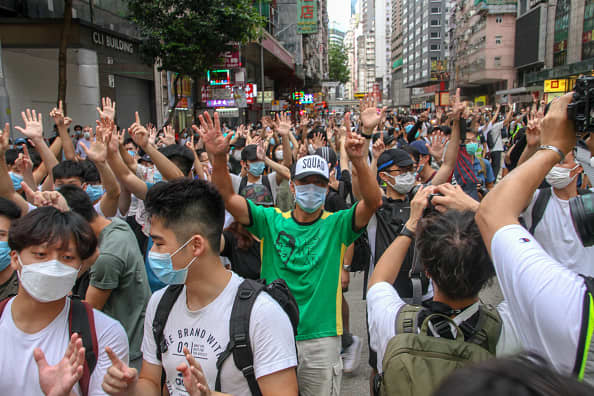
Protesters chant for five demands during street protests on Hennessy Road, Wan Chai, Hong Kong, China on July 1, 2020.

Tommy Walker | NurPhoto | Getty Images

About 370 protesters were arrested in Hong Kong on Wednesday — 10 of them were apprehended for breaching the new security law just one day after it took effect.

The new law came into force late Tuesday night, hours after the top decision making body of China's parliament passed the controversial legislation.

Police used water cannons to disperse thousands of demonstrators in Hong Kong who poured out into the streets. In some cases, the protests turned violent. Seven officers were injured while on duty, police said.

Opponents of the law say it undermines the city's autonomy that was promised when Hong Kong was handed over from the U.K. to China.

British Foreign Minister Dominic Raab said the fact that Beijing can have jurisdiction over complex national security cases is a "flagrant assault on freedom of speech and freedom of peaceful protest for the people of Hong Kong."

Hong Kong, a former British colony, returned to Chinese rule in 1997.

Under the "one country, two systems" policy, the territory is given more freedoms than other cities in China, and has a largely separate legal and economic system from the mainland that is attractive to international businesses. That framework was supposed to be in place until 2047.

Critics say the new law grants the central government in Beijing sweeping powers to clamp down on dissent in the Chinese territory, which saw more than a year of protests that sometimes turned violent. 

U.S. Secretary of State Mike Pompeo called the law "draconian" and said it "ends free Hong Kong."

I don't see why Hong Kong as a financial center will be severely affected by this law.

Lau Siu-kai

China Association of Hong Kong and Macao Studies

But analysts say it may be premature to draw conclusions about its impact on Hong Kong.

Whether the new law affects Hong Kong's attractiveness as a leading financial center will depend on the implementation of the legislation, said Tim Summers, a senior fellow at think tank, Chatham House.

"There's quite a bit in there that could be used in a fairly assertive way if the authorities want to. At the same time, we've had a number of officials in Beijing over the last months saying that the law will only be used to target a very small minority of people," he told CNBC's "Squawk Box Asia" on Wednesday, before the arrests were announced.

Summers also said that hearings for national security cases would be "rather separate" from normal court procedures.

"I think the commercial law, the commercial cases should be able to continue much as they have done in the past. That could continue to bolster Hong Kong's standing," he said.

Lau Siu-kai, vice-president of Beijing-based think tank, China Association of Hong Kong and Macao Studies, agreed that the city could retain its standing as a financial hub.

He said the law "only targets four major offenses" and isn't "comprehensive."

"In fact I would say that, as a financial center, Hong Kong needs political stability, and needs law and order," Lau told CNBC's "Street Signs Asia" on early Wednesday.

"I don't see why Hong Kong as a financial center will be severely affected by this law," he said.

Not everyone agrees.

The legislation could have a "chilling effect" on international business sentiment, making it more difficult to attract overseas capital and talent, Nick Marro, global trade lead of The Economist Intelligence Unit, said in a note on Wednesday.

"This could have consequences for future local investment and job growth, although this could be offset to a degree by mainland Chinese firms increasing their presence in the territory," he added.

Chatham House's Summers also said Hong Kong could get a "boost" from Chinese listings as a result of the U.S.-China conflict.

"I think there's a number of factors in the mix here," he said. "It's going to be difficult to assess how those are going to play out over the coming months.

Let's block ads! (Why?)


World - Latest - Google News
July 02, 2020 at 01:57PM
https://ift.tt/2Zt7twm

Hundreds arrested in Hong Kong protests, as analysts weigh in on national security law's impact - CNBC
World - Latest - Google News
https://ift.tt/2SeTG7d

U.K. Grants Asylum to Ex-Consulate Worker Who Told of Torture in China - The New York Times

HONG KONG — A former employee of the British Consulate in Hong Kong who said he was tortured by the authorities in mainland China last year has been given asylum in Britain.

The disappearance last year of the consulate worker, Simon Cheng, during the height of pro-democracy demonstrations in Hong Kong highlighted the issues that had set off months of protest. Hong Kongers took to the streets in part over fears that they could be subject to the opaque Chinese legal system as mainland officials expand their reach over people in semiautonomous Hong Kong, a former British colony.

“I am grateful for the determination and courage shown by the U.K. government to rescue British nationals,” Mr. Cheng wrote on Facebook above a photo of the letter granting him asylum. “I also hope my case can be a precedent for other Hong Kongers to seek for protection.”

The British Foreign Office could not immediately be reached for comment.

The asylum for Mr. Cheng came amid scattered unrest in Hong Kong on Wednesday after China imposed a national security law on Hong Kong that seeks to stamp out displays of dissent against the Beijing government. The move has prompted recriminations from other nations against China and spurred fears that it spells the end of the “one country, two systems” framework that had distinguished the territory.

The Hong Kong police, which made several arrests under the law during protests on Wednesday, said a 24-year-old man suspected of stabbing a police officer was arrested early Thursday at the city’s airport. Local news outlets said he had been preparing to depart for London.

The British government on Wednesday confirmed plans to open a pathway for as many as three million people from Hong Kong to obtain British citizenship. The country’s foreign secretary, Dominic Raab, said the decision was in response to the “grave and deeply disturbing” new security law.

Mr. Raab called the law a breach of the Joint Declaration, the 1984 treaty under which Britain agreed to return Hong Kong in 1997. He said the law violated the city’s autonomy, threatened civil rights and undermined judicial independence.

Secretary of State Mike Pompeo called the law “outrageous and an affront to all nations,” because under one of its articles, even nonresidents of Hong Kong could conceivably be punished for running afoul of Chinese law.

Last year, Mr. Cheng, 29, traveled from Hong Kong to the mainland city of Shenzhen for a business conference. He was stopped by the police on his return to Hong Kong in the city’s high-speed rail station, part of which is under mainland jurisdiction.

He was held for 15 days, during which, he said, he was hooded, hung for hours in a spread-eagle position and beaten to force him to stay awake. Under such abuse, Mr. Cheng said, he gave the authorities the password to his iPhone, information about British Consulate operations and the names of some Hong Kong protesters.

Mr. Cheng also gave a videotaped admission to soliciting prostitution, which was later released by the Chinese police. After his release, Mr. Cheng denied the allegations against him, insisting his confession had been coerced. The police have often publicized confession videos in high-profile cases, which legal experts say are meant to display the state’s authority over individuals.

Mr. Cheng said that his decision to leave Hong Kong had been a result of political persecution, and that he hoped to return some day.

“Leaving means not an end but a beginning,” he added. “We will continue the fight against the expanding totalitarianism, and be back to our hometown with true democracy and freedom.”

The case strained diplomatic relations between China and Britain, and Beijing’s new national security law threatens to damage those ties further.

Mr. Raab said that Britain would grant the roughly 350,000 holders of British overseas passports and an additional 2.5 million who are eligible the right to stay in the country for five years and then transition to applying for citizenship.

The British national overseas passport was created for Hong Kong residents but did not give them citizenship rights.

The Chinese Embassy in London on Thursday rejected Britain’s new citizenship pathway for overseas passport holders.

“If the British side makes unilateral changes to the relevant practice, it will breach its own position and pledges as well as international law and basic norms governing international relations,” the embassy said in a statement. “We firmly oppose this and reserve the right to take corresponding measures.”

Prime Minister Scott Morrison of Australia, meanwhile, said on Thursday that he was “very actively” considering proposals to provide support to Hong Kong residents. “There are proposals that I asked to be brought forward several weeks ago, and the final touches will be put on those and they’ll soon be considered by cabinet,” he added.

Mr. Morrison did not say what kind of residency terms would be offered under the proposals or how many Hong Kongers would be included.

Let's block ads! (Why?)


World - Latest - Google News
July 02, 2020 at 12:35PM
https://ift.tt/2ZylRmS

U.K. Grants Asylum to Ex-Consulate Worker Who Told of Torture in China - The New York Times
World - Latest - Google News
https://ift.tt/2SeTG7d

Jonathan Irons was freed from prison this week with the help of basketball star Maya Moore - CNN

On Wednesday, Irons walked out a free man -- and Moore was one of the first to embrace him.
"Thank God it's over," Moore said in a video of Irons' release she posted on her Instagram, captioned with the word "FREEDOM."
The two met in 1998, when Moore was just 16 years old, in a prison ministry. Irons had been convicted for burglary and assaulting a homeowner with a gun -- a conviction that was overturned by a judge in March.
"I feel like I can live life now," Irons said Wednesday. "I'm free, I'm blessed, I just want to live my life worthy of God's help and influence. ... I thank everybody who supported me — Maya and her family."

A star in her prime

Moore, a basketball superstar in her prime, announced in January she would skip a second season to focus on criminal justice reform.
"When we take time to stand up for people, and to shine a light in a dark place, not everybody is going to like it," she had said. "When it costs your comfort or maybe something that you just want to kind of check out and enjoy, I get that.
Basketball star Maya Moore to skip second consecutive WNBA season and 2020 Olympics to focus on criminal justice reform
"Entertainment is a place where you want to relax and not have to think about the cares of the world, but we are in the world and the world is broken. So hats off to people that sacrifice, that pay a cost of a platform, of a job, of money to stand up for something greater than yourselves and at the end of the day, if we remember we're human beings first, I think it'll make it a little less controversial."
She's considered one of the greatest women's basketball players -- and winners -- of all time. Her resume is full of superlatives. Selected by the Minnesota Lynx as the No. 1 overall pick in the 2011 WNBA draft, Moore went on to win the league's rookie of the year award and her first WNBA title in her first season. She added titles in 2013, 2015 and 2017, winning WNBA Finals MVP honors in 2013 and the WNBA MVP award in 2014.
As a member of Team USA, Moore won Olympic gold in 2012 and 2016 as well as two world championships in 2010 and 2014. When she played in college at the University of Connecticut, the Huskies went undefeated in back-to-back seasons, winning national titles in 2009 and 2010.

Let's block ads! (Why?)


Sports - Latest - Google News
July 02, 2020 at 12:54PM
https://ift.tt/3ind7IX

Jonathan Irons was freed from prison this week with the help of basketball star Maya Moore - CNN
Sports - Latest - Google News
https://ift.tt/2Mbsnt7

Wednesday, July 1, 2020

China’s new national security law in Hong Kong is already chilling free speech - Vox.com

At 11pm local time on Tuesday, Hong Kong’s government unveiled the text of a draconian new national security law that gives the Chinese government vast new powers to crackdown on free speech and dissent in Hong Kong.

Drafted in secrecy by top Chinese officials in Beijing — and not seen by the public until that very moment — the law criminalizes “secession, subversion, organization and perpetration of terrorist activities, and collusion with a foreign country or with external elements to endanger national security.”

Those who commit such acts — which experts say are vaguely defined in the law, and thus allow for an extremely broad interpretation by authorities — face severe punishment, up to and including life in prison.

“The things that you talk about, you write about, you publish about, and even the people you know about, that you have connection with, can be potentially at risk of being prosecuted under this law,” Ho-Fung Hung, a political economy professor at Johns Hopkins University who focuses on China and East Asia, told Vox.

And, according to the New York Times, “The law opens the way for defendants in important cases to stand trial before courts in mainland China, where convictions are usually assured and penalties are often harsh.”

The law went into effect immediately. Less than 24 hours later, Hong Kong police announced the first arrest under the new policy.

And they weren’t subtle about it: They immediately posted photos on their official Twitter account of the young man they’d arrested. His alleged offense? Holding a pro-Hong Kong independence flag.

Chinese state media quickly reported the story of the first arrest — but they made sure to blur out the offending images of the pro-independence flag itself, lest they commit the same grievous act of promoting such a seditious idea (something the Hong Kong Police Force apparently didn’t think to do before tweeting the photos).

For many Hong Kong watchers, these images marked the beginning of the end of the freedoms that Hong Kong, unlike the rest of mainland China, had enjoyed for decades.

The “one country, two systems” principle — enshrined in the Basic Law, Hong Kong’s de facto constitution — has been in place ever since Britain handed back control of the territory to China in 1997.

As Vox’s Jen Kirby explains, “The ‘one country’ part means [Hong Hong] is officially part of China, while the ‘two systems’ part gives it a degree of autonomy, including rights like freedom of the press that are absent in mainland China. China is supposed to abide by this arrangement until 2047, but it has been eroding those freedoms and trying to bring Hong Kong more tightly under its control for years.” Kirby continues:

Last spring, Hong Kong’s legislature tried to pass an extradition bill that critics feared would allow the Chinese government to arbitrarily detain Hongkongers. That ignited massive protests, leading to months of unrest that sometimes turned violent. The bill was withdrawn, but the demonstrations continued, as the fight transformed into a larger battle to protect Hong Kong’s democratic institutions.

But Beijing’s imposition of this new national security law is the most direct and dramatic move China has made toward erasing those freedoms once and for all.

“[The National Security Law] is a complete destruction of the rule of law in Hong Kong and threatens every aspect of freedom the people of Hong Kong enjoyed under the international human rights standards or the Basic Law,” Lee Cheuk Yan, a veteran Hong Kong politician and activist, told US lawmakers during a House Foreign Affairs Committee hearing on the new law on Wednesday.

On July 1, 2020, Hong Kong residents awoke to discover a barge with a large banner reading “Celebrate the National Security Law” floating in the waters of Victoria Harbor.
Anthony Wallace/AFP via Getty Images

And Bonnie Glaser, director of the China Power Project at the Center for Strategic and International Studies think tank, told Vox, “This law really eliminates ‘one country, two systems.’”

Pro-democracy supporters hold a Hong Kong independence flag and shout slogans during a rally against the national security law as riot police secure an area in a shopping mall in Hong Kong on July 1, 2020.
Anthony Kwan/Getty Images

On Wednesday, Hong Kong Chief Executive Carrie Lam held a press conference to announce the new law — a law drafted without her input and whose full details even she didn’t know until just the day before.

Outside, thousands of Hongkongers took to the streets to protest against — and in direct defiance of — it, despite a heavy police presence.

Hong Kong’s Chief Executive Carrie Lam speaks during a press conference with Justice Secretary Teresa Cheng (L) and Security Secretary John Lee (R) about the new national security law in Hong Kong on July 1, 2020, on the 23rd anniversary of the city’s handover from Britain to China.
STR/AFP via Getty Images
Demonstrators in Hong Kong take part in a protest on July 1, 2020, against the new national security law that infringes on freedoms residents have had since Britain handed back control of the territory in 1997.
Anthony Kwan/Getty Images

Riot police deployed around the city held up large purple banners that read: “This is a police warning. You are displaying flags or banners / chanting slogans / or conducting yourselves with an intent such as secession or subversion, which may constitute offenses under the ‘HKSAR National Security Law.’ You may be arrested and prosecuted.”

By the end of the day, nearly 400 people had been arrested, including 10 who were specifically arrested for violating the new law.

Riot police detain a man as they raise a warning flag during a demonstration on July 1, 2020, against a new national security law imposed by Beijing.
Anthony Kwan/Getty Images
Riot police detain a man as they clear protesters taking part in a rally against a new national security law in Hong Kong on July 1, 2020.
Dale de la Rey/AFP via Getty Images

But experts fear that despite this initial strong opposition, the law’s chilling effect will happen eventually.

“People will be intimidated. They will charge people and they will sentence them,” Glaser said. “The Chinese have this saying, ‘kill the chicken to scare the monkey.’ They will look for very early cases that they can prosecute so that they can demonstrate their resolve in the hope of intimidating other people from challenging their authority.”

Johns Hopkins’s Hung also said the law could have major implications for September’s Hong Kong legislative elections, because the Chinese government could use the new law as a legal basis to suppress pro-democracy candidates.

“Under the new law, many of the slogans, many of the opinions are going to be illegal,” Hung said.

There’s already precedent for Chinese election officials intervening in Hong Kong’s legislative elections — in 2016, a number of candidates were disqualified for allegedly supporting Hong Kong independence, Hung said.

“I think that the Chinese were nervous after the last round of the district elections that there could be many Democrats who would be elected and, potentially, the pro-China legislature would lose legislators,” Glaser said.

“I think that if candidates do not moderate what they say, that they will be prevented from running under the law,” Glaser added. “They could easily be arrested.”

In fact, that has already happened: one pro-democracy lawmaker, the Democratic Party’s Andrew Wan, was arrested during the protests Wednesday.

It’s a stark example of just how quickly life has changed in Hong Kong, literally overnight.

Let's block ads! (Why?)


World - Latest - Google News
July 02, 2020 at 08:22AM
https://ift.tt/3ikBI19

China’s new national security law in Hong Kong is already chilling free speech - Vox.com
World - Latest - Google News
https://ift.tt/2SeTG7d

Frank Vogel Addresses Lakers Roster Updates for Orlando | Los Angeles Lakers - Lakers.com

When Frank Vogel became the head coach of the Lakers over a year ago, he knew there would be plenty of challenges, and plenty of pressure.

But there’s no way he could have predicted a truly unprecedented 2019-20 season including the events surrounding the team’s preseason trip to China, the tragic death of Kobe Bryant, the COVID-19 pandemic, and the racial and social justice movement that continues to evolve.

Amidst all of that, Vogel is trying to lead his players and staff through never-traveled terrain as the team’s first game in the Walt Disney World bubble is exactly one month away.

As players continue individual workouts at the UCLA Health Training Center, ramping up towards the planned departure of the team charter on July 9, Vogel acknowledged that JR Smith would replace Avery Bradley on the roster, though it would take a team effort to replace Bradley’s role.

The other question mark on the roster is about Dwight Howard, who’s dealing with a unique family situation that he described to us in May, in addition to his focus on social justice.

Vogel offered an update on Howard’s status.

“We’ve been in communication with Dwight the whole way,” he said. “We don’t know what the level of participation is yet. He wants to play. We’re hopeful he’s able to join us. We’re hopeful and optimistic that he’ll be able to join us in Orlando.”

Howard is one of 10 Lakers to average at least 16.8 minutes per game this season: LeBron James (34.9); Anthony Davis (34.3); Kentavious Caldwell-Pope (25.4); Danny Green (25.1); Kyle Kuzma (24.6); Bradley (24.2); Rajon Rondo (20.5); Howard (19.2), Alex Caruso (17.8); and JaVale McGee (16.8). Markieff Morris had also entered the rotation, earning 14.8 minutes in his eight appearances.

Meanwhile, Quinn Cook and Jared Dudley got spot minutes and filled in admirably when needed, and Vogel said repeatedly that he’d trust them in any game situation. One could surmise that both Smith and playoff-roster-deadline acquisition Dion Waiters would fit in with Cook and Dudley as veterans who could be called upon for specific reasons and matchups, i.e., the need for a guy who can get his own bucket off the bench (Waiters) or floor spacing (Smith, who’s a 37.3 percent 3-point shooter who ranks 9th all-time in postseason 3’s made, and 4th in the NBA Finals).

Vogel has yet to work with Smith on the court, but he did have a welcome-to-the-team chat with the 34-year-old veteran.

“The experience factor,” said Vogel about what Smith brings. “This guy’s a big-time player, he’s proven it over the course of his career. We know he can help us. We almost added him earlier in the year when we added Dion Waiters, and now we have the luxury of having both. We’re not going to ask him to come in and be Avery Bradley, he’s going to come in and be JR Smith.”

And while Smith provides depth on the wing, the bulk of Bradley’s 24.2 minutes could be split amongst KCP, Caruso and Rondo, depending upon the game situation.

“Avery’s loss is obviously a huge loss for us, but we’re a next-man-up team,” Vogel continued. “Alex is an elite defender in his own right in a different way than Avery, as is KCP. Offensively, clearly we wouldn’t run plays that Avery uses for Alex, we’d run plays that put Alex in the best position to succeed.”

On his own Zoom call with reporters earlier on Wednesday, Caruso offered a similar sentiment.

“It might not be with one person (filling Bradley’s role), but this team has done a great job this year when guys have been out, of stepping up and filling a role or a need,” he said. “I don’t know if I’ll be the sole provider of everything that Avery did, that’s a lot to ask for because of how good he is at what he does, but I’m definitely going to be ready to fill part of that gap and that need.”

Caruso mentioned Bradley’s skills as a supplementary ballhandler and defender who took open threes as things he thinks he replicate. On the other hand, Caruso acknowledged Bradley’s strength with mid-range pullups and floaters out of the sets Vogel was asked about as things with which he is less comfortable. Fortunately, those are sets that KCP can replicate.

In fact, KCP started all 18 games for Bradley from Nov. 15 – Dec. 22 after Bradley suffered a hairline fracture in November. The Lakers went 15-1 before back-to-back losses at Indiana and Milwaukee at the end of a difficult road stretch. LAL also won games at Chicago (Nov. 5) and at OKC (Jan. 11) with KCP starting for Bradley, bringing the total mark to 17-3.

One benefit to those KCP lineups is the increased floor spacing he provides. Caldwell-Pope has hit 87 3’s this season on an impressive 39.4 percent from the field, compared to Bradley’s 63 makes on 36.4 percent. With LeBron as the primary ballhandler with the starters, Rondo could remain in his playmaking role off the bench.

Fortunately for Vogel, his squad has a 5.5 game lead in the West, meaning he can use the eight seeding games to iron out such rotation questions ahead of the start of the playoffs. Vogel was asked how having that lead might impact his approach in Orlando.

“We do have a different type of perspective from some teams that are playing for their playoff lives, but it doesn’t mean we’re not going to go out and - like we always would if these were the last eight games of the regular season - we would compete to win,” said Vogel. “That’s how your habits are built the best … Does that mean we’re going to play certain guys 47 minutes? Obviously no.

“We’ll be intelligent with the whole process of trying to find the right pace to bring our group along from a conditioning standpoint and evaluating on a daily basis what we feel they can handle and what they’re ready for without compromising their bodies and putting them at risk to injury. We will be cautious with those eight games, but we will compete to win.”

Then it’s time for the playoffs, a unique challenge given the circumstances, and one for which Caruso is ready.

“This is something personally that I relish,” he said. “I’m looking forward to the challenge of lasting, of being the team that can be the mentally toughest, the mentally strongest and saying ‘Yeah, we may be on this isolated campus for three months, but we have a goal, we have a mission and it’s not going to affect us trying to get to that end goal and finish the job.’”

It’s that mental side of the game where Caruso thinks the Lakers will have an edge, with everybody dealing with a similar physical challenge.

“The hardest part for us is getting back to doing physically what we were able to do, as far as being early on assignments, being physically ready to box out, to play as physically as it takes to beat teams like the Clippers, Bucks, Rockets and Nuggets, all the good teams that are competing for championships and are going to be in the playoffs,” he explained. “Just getting back to that physical form of being able to do it night in, take a day off, night out, keep going and going and going for a month and a half. The mental part I feel like for our team is going to be easier just because we have such a heady and basketball-smart team, basketball-IQ led team and coaching staff.”

Let's block ads! (Why?)


Sports - Latest - Google News
July 02, 2020 at 10:13AM
https://ift.tt/38mSuI8

Frank Vogel Addresses Lakers Roster Updates for Orlando | Los Angeles Lakers - Lakers.com
Sports - Latest - Google News
https://ift.tt/2Mbsnt7

Sources: Three more FC Dallas players and one coach test positive for coronavirus - ESPN

Four more members of FC Dallas' contingent at the MLS Is Back Tournament -- three players and one coach -- tested positive for COVID-19 on Wednesday, sources confirmed to ESPN.

The Athletic was the first to report the news.

The new results bring the total number of positive tests since the team arrived in Orlando to 10, nine of whom are players.

- Stream MLS is Back LIVE on ESPN networks and the ESPN App (U.S. only)

Both MLS and FC Dallas declined to comment.

Earlier in the day MLS confirmed that six FC Dallas players had tested positive since arriving in Orlando. This is on top of three positive tests for FC Dallas players prior to the team leaving for Central Florida. It was not clear if the three players who first tested positive traveled with the team to Orlando.

The additional positive tests have called into question Dallas' participation in the tournament. At present, Dallas has 19 players remaining in Orlando who have tested negative for COVID-19.

A source with knowledge of the situation said that various scenarios are being considered as it relates to FC Dallas, including delaying their first game, scheduled for July 9 against the Vancouver Whitecaps. Other scheduling modifications are also being considered. The source added that cancelling the tournament isn't something that has been discussed by the league.

According to the MLS Player Tournament Handbook, a copy of which has been obtained by ESPN, any individual who tests positive for COVID-19 must immediately place a facemask on and participate in a triage assessment by an Orlando Health telehealth provider. The individual will be transported to an isolation area where repeat testing will be performed. The individual will receive meals, be monitored, and stay in isolation until he or she receives clearance from MLS medical staff. All close contacts will be identified, and those individuals will self-quarantine in their room and testing will be provided.

The resort where the team is staying will immediately provide cleaning and disinfecting of areas where the individual had recently been.

Let's block ads! (Why?)


Sports - Latest - Google News
July 02, 2020 at 11:16AM
https://ift.tt/3dN0hA9

Sources: Three more FC Dallas players and one coach test positive for coronavirus - ESPN
Sports - Latest - Google News
https://ift.tt/2Mbsnt7

Hagia Sophia: Turkey to rule on turning site into mosque - BBC News

Turkey's Council of State is due to decide if the Hagia Sophia in Istanbul can be converted into a mosque.

Built in the Sixth Century on the orders of Byzantine Emperor Justinian I, it was the world's largest cathedral for nearly 1,000 years.

The Unesco World Heritage site was turned into a mosque when the Ottoman Empire captured the city in 1453, but became a museum in the 1930s.

It may become a mosque again if the court approves the move on Thursday.

Turkey's President Recep Tayyip Erdogan called for the change during an election rally last year.

Islamists in Turkey have long called for it to be converted, but secular opposition members have opposed the move. The proposal has prompted international criticism, from religious and political leaders worldwide.

The head of the Eastern Orthodox Church has opposed the move, as has Greece - home to many millions of Orthodox followers.

Culture Minister Lina Mendoni has accused Turkey of reviving "fanatical nationalist and religious sentiment", insisting no change to a Unesco World Heritage site can take place without being approved by the body's own intergovernmental committee.

Unesco deputy director Ernesto Ottone Ramirez agreed that wider approval was needed, in an interview with Greek newspaper Ta Nea.

The UN body had written to Turkey about the proposal, but received no reply, he said.

What's the history?

The iconic, domed building sits in Istanbul's Fatih district, on the west bank of the Bosporus.

Justinian I ordered the massive construction built in 532, when the city - then known as Constantinople - was the capital of the Byzantine Empire, also known as the Eastern Roman Empire. Engineers brought materials from across the Mediterranean to build the colossal cathedral.

On completion in 537 it became the seat of the Orthodox patriarch of the capital. Byzantine imperial ceremonies such as coronations took place at the building.

The Hagia Sophia served as the home of the Eastern Orthodox Church for nearly 900 years, barring a brief period in the 13th Century when it was a Catholic cathedral under control of European invaders who ransacked and occupied Constantinople during the Fourth Crusade.

But in 1453, the Ottoman Empire under Sultan Mehmed II captured Constantinople and renamed the city Istanbul, finishing off the Byzantine Empire once and for all.

On entering the Hagia Sophia, Mehmed II insisted it be renovated and converted into a mosque. He attended the first Friday prayers in the building, days after it was ransacked by invading forces.

Ottoman architects removed or plastered over Orthodox symbols inside and added spires and minarets to the structure. Until the completion of Istanbul's Blue Mosque in 1616 the Hagia Sophia was the main mosque in the city, and its architecture inspired builders of the Blue Mosque and several others around the city and the world.

After the end of World War I in 1918, the Ottoman Empire was defeated and divided by the victorious Allies. Nationalist forces, however, rose up and created modern-day Turkey from the ashes of that empire.

The founder of Turkey and the secular republic's first president, Mustafa Kemal Ataturk, ordered the Hagia Sophia to be turned into a museum. Since reopening to the public in 1935 it has become one of Turkey's most visited tourist attractions.

Why does it matter?

Because of its 1,500-year history, the Hagia Sophia holds immense religious, spiritual and political significance for groups inside and outside Turkey.

Islamist groups and devout Muslims demand the building be turned back into a mosque, and have staged protests outside it, against a 1934 law that bars religious services at the site.

President Erdogan has echoed those calls. In a campaign speech ahead of local elections last year he said it had been a "very big mistake" to turn the Hagia Sophia into a museum, and he has since reportedly asked aides to examine how to convert the building.

The head of the Eastern Orthodox Church, known as the Ecumenical Patriarch of Constantinople, is still based in Istanbul. Patriarch Bartholomew I warned on Tuesday that the conversion of the building would "disappoint millions of Christians" and fracture two worlds.

US Secretary of State Mike Pompeo warned that any change in the Hagia Sophia's status would diminish its ability to "serve humanity as a much-needed bridge between those of differing faith traditions and cultures".

Last week US Ambassador at Large for International Religious Freedom Sam Brownback called on Turkey to leave the building as it was.

But Turkish foreign minister Mevlut Cavusoglu insisted that Athens had no say in the decision as the building was on Turkish territory.

"What we do in our country and with our property is up to us," he reportedly told Turkish broadcaster 24 TV.

Let's block ads! (Why?)


World - Latest - Google News
July 02, 2020 at 06:27AM
https://ift.tt/3gg0n55

Hagia Sophia: Turkey to rule on turning site into mosque - BBC News
World - Latest - Google News
https://ift.tt/2SeTG7d

Featured Post

Qatar 'appalled' by reported criticism from Israel's Netanyahu - BBC.com

By David Gritten BBC News Reuters Qatar's foreign ministry said the Israeli prime minister's reported remarks were ...

Popular Posts