Rechercher dans ce blog

Saturday, May 1, 2021

2021 NFL Draft grades: Analysis for every first-round selection from Trevor Lawrence to Joe Tryon - CBS Sports

trevor-lawrence-clemson.jpg
Getty Images

Want to know what I think of every pick made Thursday in the first round of the 2021 NFL Draft? You can find it all below. You can also follow along throughout the rest of the draft on Days 2 and 3 for more grades and more analysis. Be sure to refresh this page throughout the weekend to get the latest grades. 

If you want to do all that plus track the best available prospects and get access to every pick in the draft on one page, you can in our draft tracker.

Grades: Round 1 • Round 2 • Round 3 • Round 4 • Round 5 • Round 6 • Round 7      

1. Jaguars: Trevor Lawrence, QB, Clemson

Grade: A+

Lawrence will change the dynamic of this franchise for the next decade. They will win a Super Bowl.

2. Jets: Zach Wilson, QB, BYU

Grade: B

I like him as a player, but I would have taken Justin Fields in this spot. Fields will be a better quarterback.

3. 49ers: Trey Lance, QB, NDSU

Grade: C-

I just don't see trading up with two first-round picks as the price to get a guy who is raw and needs time. Lance has skills, but he will need time.

4. Falcons: Kyle Pitts, TE, Florida

Grade: A

He is a can't-miss prospect. He is a mismatch nightmare. Great pick.

5. Bengals: Ja'Marr Chase, WR, Bengals

Grade:  B+

Love this player. He will be a big-time pass catcher as he joins former college teammate, Joe Burrow. But I would have taken an offensive tackle here.

6. Dolphins: Jaylen Waddle, WR, Alabama

Grade: B+

I think he has the Tyreek Hill type of ability. I think he will help Tua Tagovailoa a ton. It works.

7. Lions: Penei Sewell, OT, Oregon

Grade: B+

They probably thought he wouldn't be here, so they had to be happy he was. Sewell has a ton of talent and will upgrade that line in a big way.

8. Panthers: Jaycee Horn, CB, South Carolina

Grade: B

I liked Patrick Surtain more, but I get it. Horn is a feisty corner who will definitely be a good cover player.

9. Broncos: Patrick Surtain II, CB, Alabama

Grade:  A

I love his game. He is one of those corners who will be sound from the minute he steps on the field. He will be a star.

10. Eagles: DeVonta Smith, WR, Alabama

Grade: B+

They needed to get another weapon to help Jalen Hurts, so I like the pick. When the corners went off, they had to be disappointed.

11. Bears: Justin Fields, QB, Ohio State

Grade: A

They gave up a lot, but they ended up with the second-best quarterback in the draft. It's a bold move, but necessary.

12. Cowboys: Micah Parsons, LB, Penn State

Grade: B

Do the Cowboys really need a linebacker? I know their linebackers didn't play as well last year, but this wasn't a major need.

13. Chargers: Rashawn Slater, OT, Northwestern

Grade: B

He will be an immediate starter at left tackle, which fills a major need. Justin Herbert will be happy.

14. Jets: Alijah Vera-Tucker, OL, USC

Grade: B+

They need to build the offensive line in front Zach Wilson. With Tucker, who can play guard or right tackle, they add to Mehki Becton from last year. Solid move to go get him.

15. Patriots: Mac Jones, QB, Alabama

Grade:  B

 It's the perfect situation for him. He fits in the Josh McDaniels' offense.

16. Cardinals: Zaven Collins, LB, Tulsa

Grade:  B+

He will add another big-time playmaker to a defense that needed it. He can run and chase or rush off the edge.

17. Raiders: Alex Leatherwood, OL, Alabama

Grade: B

I don't love this pick. They need line help, but he's more of a second-round pick in my mind.

18. Dolphins: Jaelen Phillips, EDGE, Miami

Grade: B

If his medical stays clean, it's a good pick. They address a need that had to be filled. He's loaded with talent.

19. Washington: Jamin Davis, LB, Kentucky 

Grade:  A

This is one of my favorite picks of the draft. He will be a special player on a talented front seven.

20. Giants: Kadarius Toney, WR, Florida

Grade: B

He has the tools to really add a big-play threat to the offense. Trading down and getting a playmaker and a first-round pick next year is a good move.

21. Colts: Kwity Paye, EDGE, Michigan

Grade: B-

This is a kid with a lot of raw talent, but didn't produce to that level. It will show better as he learns the tricks of the trade better. He fills a need.

22. Titans: Caleb Farley, CB, Virginia Tech

Grade: B-

This is a boom-or-bust pick. If he's healthy, this is a great pick. But injury concerns are real.

23. Vikings: Christian Darrisaw, OT, Virginia Tech

Grade: A

I love this pick. I believe he will be the best tackle in the draft. It fills a need in a big way.

24. Steelers: Najee Harris, RB, Alabama

Grade: C

I don't like picking backs in the first round. Good player, but backs should come later.

25. Jaguars: Travis Etienne, RB, Clemson

Grade: C+

He's my favorite back in this class as a true air back. He will give them the speed they need in the backfield and help the passing game. But he's still a back in the first round.

26. Browns: Greg Newsome II, CB, Northwestern

Grade: B

They've spent a lot of draft capital at corner in recent years. Newsome is a good, solid player but they have bigger needs.

27. Ravens: Rashod Bateman, WR, Minnesota

Grade: C

I know they needed help at receiver, but there are better options down the line.

28. Saints: Payton Turner, EDGE, Houston

Grade: C

I know they need edge help, but there were better options.

29. Packers: Eric Stokes, CB, Georgia 

Grade:  B+

He has size and can run and addresses a major need. I like the pick a lot.

30. Bills: Gregory Rousseau, EDGE, Miami

Grade:  B-

The talent is there, but he didn't play last year and it hurt his stock. He is a big power player who fills a need.

31. Ravens: Jayson Oweh, EDGE, Penn State

Grade: B-

He is raw and has a ton of talent, but he didn't produce. He does fill a need.

32. Buccaneers: Joe Tryon, EDGE, Washington

Grade:  B

With the entire team back, it makes sense to draft another edge player with Jason Pierre-Paul getting up in the years.

Let's block ads! (Why?)


Sports - Latest - Google News
May 01, 2021 at 11:13AM
https://ift.tt/3vBHgtJ

2021 NFL Draft grades: Analysis for every first-round selection from Trevor Lawrence to Joe Tryon - CBS Sports
Sports - Latest - Google News
https://ift.tt/2Mbsnt7

Texans draft quarterback Davis Mills in third round amid Deshaun Watson allegations - Yahoo Sports

The Houston Texans want to make sure they are covered at quarterback. With Deshaun Watson facing multiple allegations of sexual misconduct, the team selected Stanford quarterback Davis Mills in the third round of the 2021 NFL draft on Friday night.

While Davis was selected with the No. 67 overall pick, it was the Texans' first pick of this draft. The team traded away both its 2021 first- and second-round pick to acquire offensive linemen Laremy Tunsil from the Miami Dolphins in 2019.

Mills, 22, joins the team after three seasons at Stanford. He played in 14 games at Stanford, starting 11. In those games, Mills threw for 18 touchdowns against eight interceptions. Mills ranked No. 70 on the top 100 draft prospects list of Yahoo Sports draft analyst Eric Edholm. 

Mills has dealt with knee and leg injuries in high school and college. He's considered a developmental prospect who may need a year before he starts in the NFL, according to Edholm.

What does Davis Mills pick mean for Deshaun Watson?

With Watson facing allegations of sexual misconduct, his status in 2021 is up in the air. The NFL is conducting an investigation of the allegations and it could get involved before the offseason is over. League commissioner Roger Goodell has the power to suspend Watson — or place him on the commissioner's exempt list — depending on what the NFL finds from its investigation. 

Even before those allegations emerged, Watson wanted out of Houston. While he was adamant about a trade, both new general manager Nick Caserio and head coach David Culley expressed confidence Watson would remain with the team to start 2021. 

The Houston Chronicle reported that at least eight teams were interested in acquiring Watson before the allegations surfaced. Now, it seems unlikely any team will acquire Watson until — at the very least — the Houston police complete their investigation.

With that much uncertainty facing Watson, the Texans decided it was in their best interest to take a Mills in the third round.

More NFL from Yahoo Sports:

Let's block ads! (Why?)


Sports - Latest - Google News
May 01, 2021 at 08:59AM
https://ift.tt/335DvRa

Texans draft quarterback Davis Mills in third round amid Deshaun Watson allegations - Yahoo Sports
Sports - Latest - Google News
https://ift.tt/2Mbsnt7

Packers trade up to select Amari Rodgers - NBC Sports

COLLEGE FOOTBALL: JAN 01 Allstate Sugar Bowl Semifinal Game - Ohio State v Clemson
Getty Images

There will be at least one ARod on the 2021 Packers.

Green Bay traded up from No. 92 to No. 85 overall to select Clemson wide receiver Amari Rodgers.

The son of former Steelers, Eagles, and Raiders quarterback Tee Martin, Rodgers caught 77 passes for 1,020 yards with seven touchdowns as a senior at Clemson. He contributed for all four years in his time at the program, winning a national championship in 2018.

The Packers are returning much of their wide receiving corps from last season, led by All-Pro Davante Adams. Devin Funchess will also return, after opting out of the 2020 season.

But the big question remains whether or not quarterback Aaron Rodgers — who reportedly wants out — will be there to throw them the ball. The Packers have also selected Georgia cornerback Eric Stokes and Ohio State center Josh Myers so far in the 2021 draft.

Green Bay traded its 92nd and 135th overall picks to the Titans to move up to No. 85.

Let's block ads! (Why?)


Sports - Latest - Google News
May 01, 2021 at 09:55AM
https://ift.tt/335jZo0

Packers trade up to select Amari Rodgers - NBC Sports
Sports - Latest - Google News
https://ift.tt/2Mbsnt7
Friday, April 30, 2021

Biden calls Netanyahu to offer condolences over Mount Meron stampede - Yahoo News

Reuters Videos

Israel stampede: Netanyahu vows to investigate

Israeli Prime Minister Benjamin Netanyahu has called for an annual day of mourning, after at least 45 people were crushed to death at an overcrowded religious festival in the early hours of Friday (April 29).Visiting the site hours later, he was heckled by angry protesters, but vowed to unearth the cause of the deadly incident:"We will carry out a thorough, serious and in-depth investigation in order to ensure that such a disaster does not reoccur."Tens of thousands of ultra-Orthodox Jews had gathered at the Mount Meron tomb for the annual Lag B'Omer commemorations, which include all-night prayer and dance.Ecstatic crowds assembled despite warnings to maintain social distancing against COVID-19.A stampede ensued in the men’s section of the festival, according to medics, and casualties included children.Some victims were asphyxiated or trampled on in a tightly packed passageway, and some went unnoticed until the PA system sounded an appeal to disperse.Over 100 were wounded and videos on social media showed men trying to push through walls of iron to escape the crush.Bodies lay on stretchers in a corridor, covered in foil blankets.Hayim Cohen was among the attendees:"I was there exactly when it happened, down there on the side. It started when a few paramedics started to run, and then there was some kind of mess, police, screaming, a big mess, and after half an hour it looked like a scene of a suicide bombing attack, numerous people coming out from there on stretchers."A police spokesman said the overall capacity at Mount Meron was similar to previous years but that bonfire areas were partitioned off this time as a COVID-19 precaution.Israeli media said that may have created unexpected choke-points on foot traffic.The Justice Ministry said investigators would look into whether there had been any police misconduct connected to the tragedy.

Let's block ads! (Why?)


World - Latest - Google News
April 30, 2021 at 11:31PM
https://ift.tt/3aSTcj6

Biden calls Netanyahu to offer condolences over Mount Meron stampede - Yahoo News
World - Latest - Google News
https://ift.tt/2SeTG7d

Prime Minister Narendra Modi could have prevented India's devastating Covid-19 crisis, critics say. He didn't - CNN

His country was on the brink of a humanitarian crisis. That day, India recorded more than 261,000 new coronavirus cases -- more than many countries have seen during the entire pandemic.
And it was only going to get worse. Each day since April 22, the country has reported more than 300,000 new cases -- at times, up to half of the daily cases reported globally. The capital New Delhi is now running out of wood for cremations. Hospitals are full and lacking oxygen. Only 2% of the population has been fully vaccinated. Foreign leaders are now rushing to India's aid.
While Modi's Hindu nationalist Bharatiya Janata Party (BJP) spokesman Narendra Taneja told CNN this week that responsibility for India's second wave belonged "first and foremost" to the government, he maintained the crisis could not have been foreseen -- despite countless countries being battered by second waves as new variants emerged globally.
Others in Modi's orbit have argued state governments are to blame for not imposing regional lockdowns and mismanaging their health care systems. Last weekend, Health Minister Harsh Vardhan said oxygen shortages at hospitals were a problem not of supply but distribution, which he claimed was the responsibility of state governments.
But many in India believe responsibility lies with Modi and his Hindu nationalist government, which not only didn't prepare for a second wave but also encouraged mass gatherings at Hindu festivals and political rallies, including in a closely contested battleground state.
"The government has failed us all," Priyanka Gandhi Vadra, the general secretary of opposition party Indian National Congress, said in a statement this week. "Even those of us who oppose and fight them could not have foreseen a complete abdication of leadership and governance at a time as devastating as this."

Modi's pandemic PR moves

Modi has been keen to tie himself to positive aspects of India's pandemic responses.
Vaccinated Indians receive a certificate with his face on it. The Covid relief fund, a charitable trust which gathers voluntary contributions to help support those affected, is named PM Cares -- an acronym for Prime Minister's Citizen Assistance and Relief in Emergency Situations Fund. It also bears Modi's face on its official website.
With his name tied to these positive initiatives, a first wave that avoided the catastrophic caseload some experts feared, and a roaring pharmaceutical industry that had produced a homegrown vaccine, India's pandemic response was on track to be a PR win for Modi. The country was positioning itself to help other countries, having exported more than 66 million doses of vaccines, rather than be the one in need of aid.
"(India) has saved the world, entire humanity, from a major tragedy by effectively controlling coronavirus," Modi boasted at the World Economic Forum on January 28.
With many in India feeling the pandemic was over, there was a slower take-up of vaccines there than expected. About 300 million of India's 1.3 billion population are illiterate, meaning they may have had less ability to investigate what was going on for themselves.
"You can't blame people for thinking 'maybe the government knows best, maybe things are back to normal, maybe we should go out and live our normal lives,'" said Pradeep Taneja, an expert on Asian politics at the University of Melbourne and a fellow of the Australia India Institute.
But the pandemic was far from over. By February, cases were beginning to tick up. The BJP, however, still claimed India had "defeated Covid under the able, sensitive, committed and visionary leadership" of Modi.
On March 7, when the country reported about 18,000 new daily cases, the Health Minister Vardhan said India was in the "end game of the Covid-19 pandemic." And on March 30, a day before authorities reported more than 81,000 cases in a single day, Vardhan said: "The situation is under control."
Yet mutations had been circulating overseas for months, and epidemiologists in India believed another wave was coming. While the second wave was inevitable, its size took everyone by surprise, said Ramanan Laxminarayan, an economist and epidemiologist at Princeton University who is in New Delhi.
"I think there was a premature sense of optimism among many that was probably unwarranted and in hindsight has ended up being quite deadly," he said.
Asia politics expert Taneja said: "Modi was complacent, even arrogant in thinking that India had succeeded when more developed countries, countries with much stronger health systems ... were struggling."

Fury over the second wave

As it became clear India's cases were spiraling, Modi stayed largely silent -- and a second nationwide lockdown that some expected never came. In a national address last month, he actively advocated against a nationwide lockdown.
Modi's apparent inaction prompted a wave of anger, spurring hundreds to share hashtags on Twitter such as #ModiMustResign and #ModiMadeDisaster. This week, the national vice president of the Indian Medical Association, Navjot Dahiya, called Modi a "super spreader" for holding political rallies and allowing millions of pilgrims to descend on Haridwar in northern India, to celebrate the Hindu festival Kumbh Mela, local media reported.
"People expect their governments to assure them that they are in charge and taking care of things ... but the government is almost missing in action," Pradeep Taneja said. "Now that India is facing the worse crisis, in my lifetime, certainly, where is the Prime Minister?"
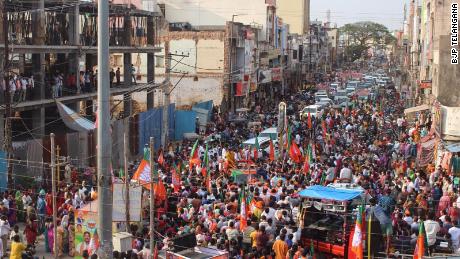
Members of Prime Minister Narendra Modi's Bharatiya Janata Party continue to hold rallies despite a devastating second wave of coronavirus gripping the country.
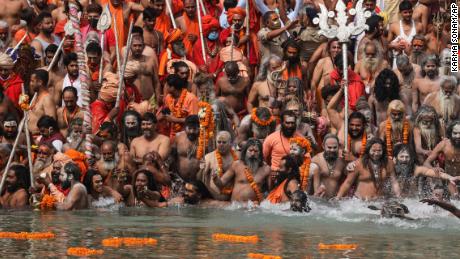
Naked Hindu holy men take dips in the Ganges River during Kumbh Mela, one of the most sacred pilgrimages in Hinduism, in Haridwar, northern state of Uttarakhand, India, on April 12, 2021.
This sort of criticism of Modi is remarkable in a country where he is seen by many as a "saintly" figure who always acts in the national interest, according to Asim Ali, a researcher at the Delhi-based Centre for Policy Research think tank. Modi's landslide 2019 re-election for a second five-year term gave him a sweeping mandate to push his Hindu nationalist agenda, in a country where 80% of the population is Hindu.
Despite this, experts believe Modi was too concerned about losing support to impose another nationwide lockdown.
When on March 24, 2020, Modi announced an unprecedented nationwide lockdown, India had only reported 519 cases. Buses and trains were brought to a halt, cross-state travel was banned, and most people weren't allowed out of their house unless they were buying groceries. Some called it the world's strictest lockdown.
That lockdown lasted months in some parts of the country. Although cases eventually fell after peaking in September, the elongated lockdown hurt India's millions of daily wage workers. The country's economy shrank by a record 24% in the second quarter, and GDP contracted by 6.9% overall last year.
This time, Modi has instead advocated for "micro containment zones," where restrictions are focused on areas of concern. It's been up to states to decide when and how to implement them. So far, at least eight of India's states and territories have some form of lockdown, ranging from a curfew in Karnataka and Gujurat states to a full lockdown in New Delhi.
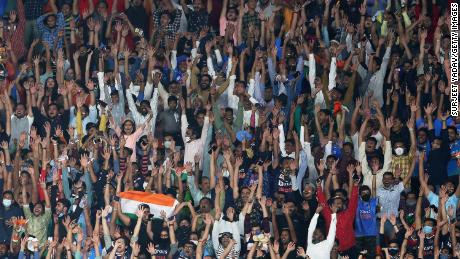
The crowd during the first T20 international match between India and England at Sardar Patel Stadium on March 12, 2021 in Ahmedabad, India.
Rajeev Sadanandan, a former bureaucrat in the health ministry of the state of Kerala and CEO of non-profit Health Systems Transformation Platform, said the reason for that was simple: "Last time, the lockdown was widely criticized as a failure" because it came at a huge economic cost and suffering to the poor.
The legislative elections held over the past month in Assam, West Bengal, Kerala and Tamil Nadu states, and Puducherry union territory, may have also been a factor. Two of those are BJP-run, while one -- West Bengal -- was a closely contested state. When asked why BJP had continued to hold rallies, the party's spokesman Taneja said the "autonomous" Election Commission of India allowed election events to proceed.
Michael Head, a senior research fellow in global health at the University of Southampton's Clinical Informatics Research Unit, said aside from restricting gatherings and having clearer messaging, the government could have curtailed cross-country travel -- as it did during the first lockdown.

Lack of preparedness

As India enjoyed a relative period of calm at the beginning of this year, Modi could have been preparing his country for another battle with Covid-19, patching up health care gaps in preparation for a possible future outbreak.
Pradeep Taneja said there was "criminal negligence on the part of the government" to not prepare for another wave despite knowing other countries with better health care systems had experienced multiple waves.
Both the US and the UK were hit harder by their second waves than their first, despite warnings from experts. In the US, White House trade adviser Peter Navarro said last June the US was preparing for a second wave by "filling the stockpile."
Despite local media in India reporting officials had warned of looming oxygen shortages in April last year, and then again in November, the government didn't appear to take action. Pradeep Taneja said it was "arrogant" for Modi to hold campaign rallies, rather than safeguarding the country's oxygen supplies.
The criticisms of the lack of preparedness in India's government, however, go beyond Modi.
In April, local media outlet The Caravan reported the country's national scientific taskforce -- a group intended to advise the central government on how to respond to the pandemic -- did not meet during February and March, as daily cases increased more than sixfold. CNN has contacted the chairman of the taskforce, V. K. Paul, for comment.
And India's health system has been underfunded for years. In 2018, India spent 3.5% of its GDP on health care, according to World Bank figures -- well below the world average of 10%, or the 17% spent in the US, which also battled to contain its Covid-19 outbreak. India has 0.9 physicians per 1,000 people, well under the world average of 1.6, or the US's 2.6, according to the World Bank.
As human rights activist Harsh Mander puts it, India had "starved" its public health systems for decades -- long before Modi's time in office.
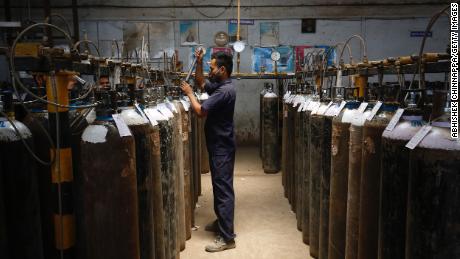
An employee fills oxygen cylinders inside an oxygen filling centre on April 28, 2021 in Bengaluru, India.
Even before hospitals were overwhelmed, this impacted India's ability to monitor the virus. According to a paper published in February, India had only sequenced 0.06% of its reported cases. Its rate is lower than neighbors Sri Lanka and Bangladesh.
Sadanandan, the former Kerela health official, said most parts of India did not have an adequate surveillance system to keep track of the outbreak. But to him, that was a state-level failing -- not a central government one -- as health is a state issue. "I'm not surprised by what has happened because we've seen this happen for many epidemics," he noted.

Was it all Modi's fault?

To critics, while state leaders have some blame to bear, ultimately if Modi is going to take credit for India's pandemic wins, he also needs to take responsibility for its pandemic failings.
His extraordinary popularity means his actions have power -- so underplaying the risk of the pandemic could have influenced how millions of his followers across the country acted. By the start of this year, many people in India stopped wearing masks and many social distancing measures had fallen by the wayside.
It's too early to know if the grim scenes India is witnessing will tarnish Modi's reputation. There are still three years before the next general election, and Modi has no clear challenger.
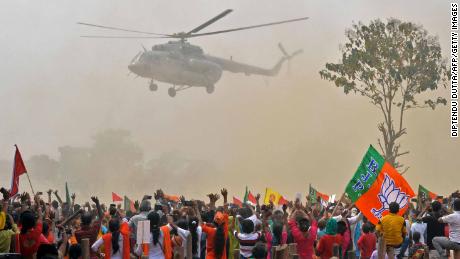
Supporters of Bharatiya Janata Party (BJP) wave towards a helicopter carrying Indian Prime Minister Narendra Modi upon his arrival at a public rally at Kawakhali on the outskirts of Siliguri on April 10, 2021.
But Taneja expects to see a "significant reevaluation of the Modi government by the Indian public."
"No single person can be blamed for the catastrophe that India finds itself in. But if you are the Prime Minister, clearly the primary responsibility falls on you," he said.
Barkha Dutt, a Washington Post columnist whose father died from Covid a few days ago, said her father's last words were: "I'm choking. Please give me treatment." She felt angry and betrayed that as people across India battled the virus, politicians were still holding rallies. Dutt described Modi's government as "callousness," "tone deaf" and in "complete denial."
She said the health care system had clearly collapsed -- but that wasn't the fault of doctors, hospitals or frontline workers.
"We've been failed by the government that did not think to put in place a contingency plan for the second wave," she said. "Is anyone going to take accountability for the thousands that are dying?"

Let's block ads! (Why?)


World - Latest - Google News
May 01, 2021 at 09:22AM
https://ift.tt/3e7B5rN

Prime Minister Narendra Modi could have prevented India's devastating Covid-19 crisis, critics say. He didn't - CNN
World - Latest - Google News
https://ift.tt/2SeTG7d

Cam Newton Posts Captivating Instagram After Patriots Draft Mac Jones - NESN.com

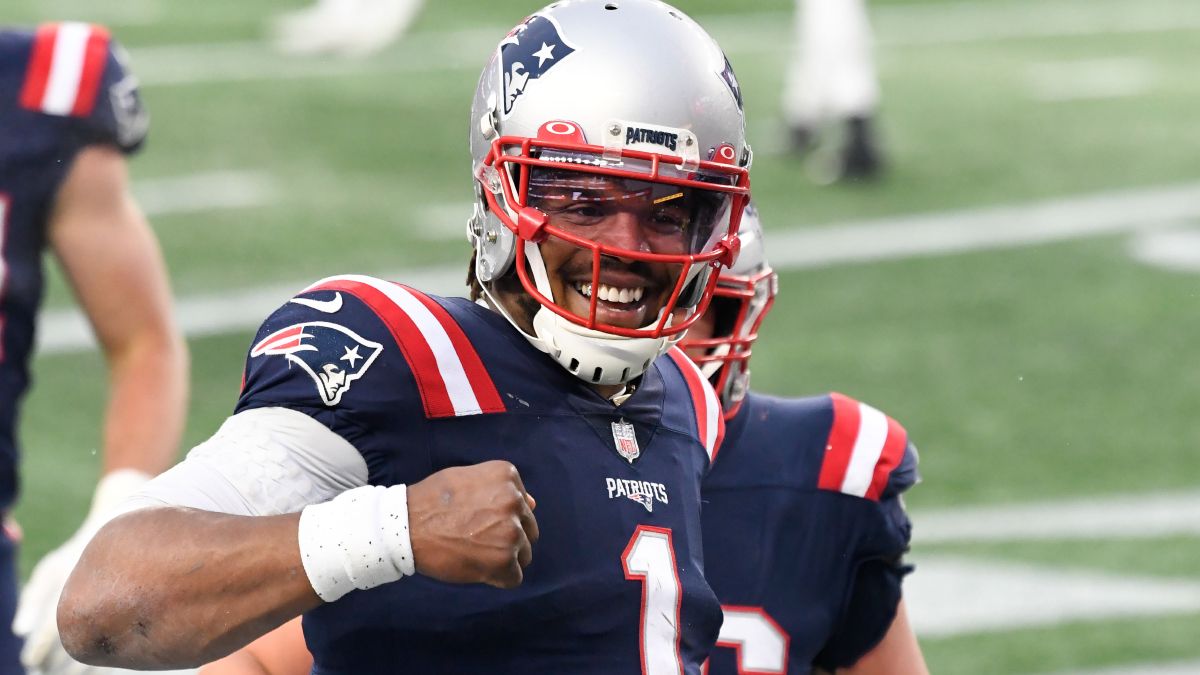
Cam Newton took to Instagram on Friday morning, mere hours after the New England Patriots selected Alabama quarterback Mac Jones on Thursday night with the 15th overall pick in the 2021 NFL Draft.

Newton’s post, per usual, is both cryptic and thought-provoking.

The photo, which shows Newton standing in front of a mirror, is accompanied by a caption that reads (in his typical unique font): “it was always me vs. the world until I found out it’s me vs. me!!”

This, as Newton notes, is a quote from Kendrick Lamar — more specifically, the rapper’s song “DUCKWORTH.”

So, what does this mean?

Well, Bill Belichick made it clear Thursday night while discussing the decision to draft Jones that Newton is New England’s quarterback. It’s less clear whether Newton will be the Patriots’ starter come Week 1 of the regular season, but that’s a strong endorsement of the veteran, nevertheless.

Let's block ads! (Why?)


Sports - Latest - Google News
May 01, 2021 at 02:57AM
https://ift.tt/3nBNyXI

Cam Newton Posts Captivating Instagram After Patriots Draft Mac Jones - NESN.com
Sports - Latest - Google News
https://ift.tt/2Mbsnt7
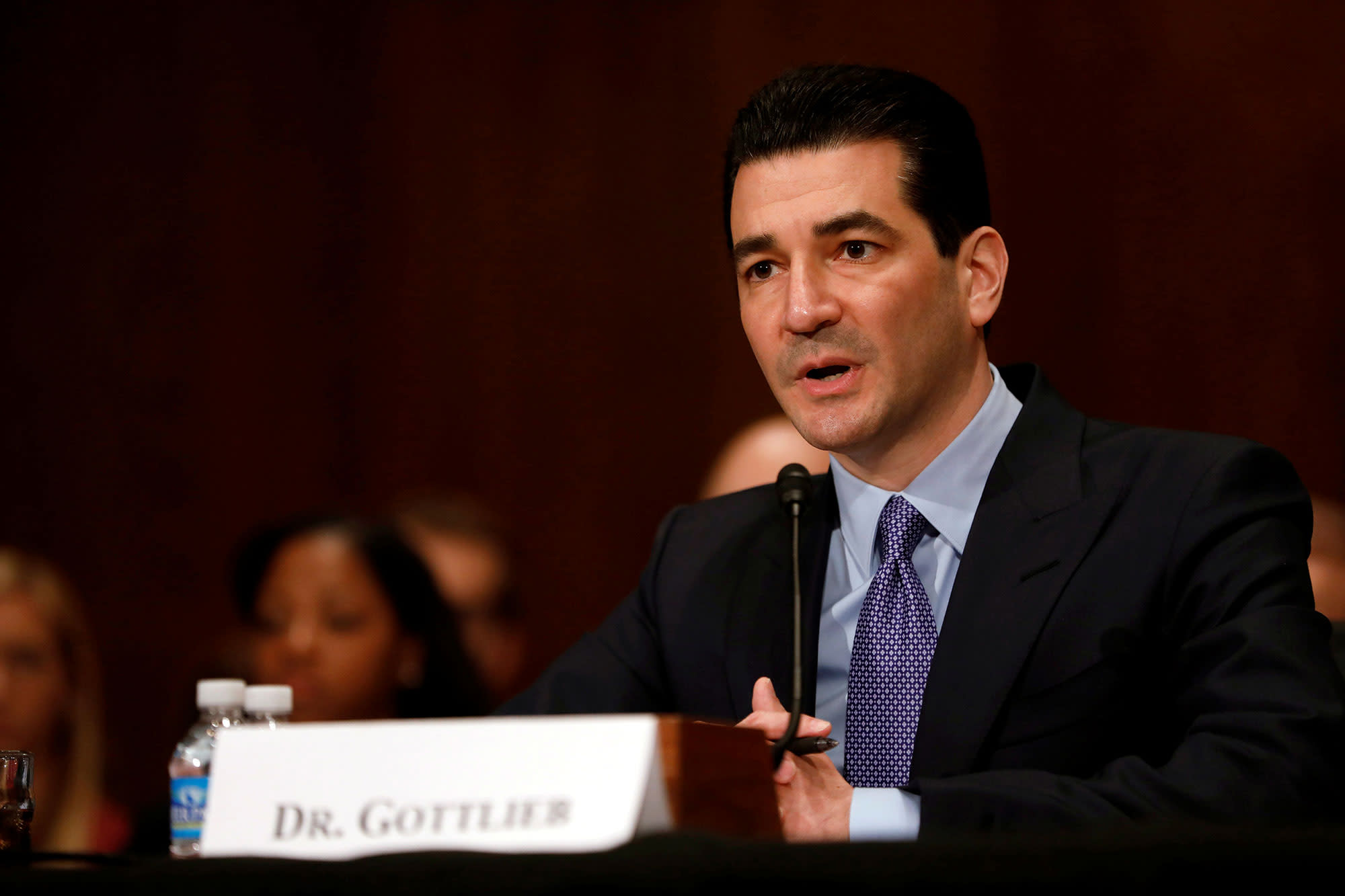
Dr. Scott Gottlieb says travel restrictions on India will have little impact on U.S. Covid cases - CNBC

The Biden administration's recently announced restrictions on travelers from India are unlikely to play a significant role in limiting new coronavirus cases in the U.S., Dr. Scott Gottlieb told CNBC on Friday.

"Will it have an impact? Perhaps a minor impact on the margins in terms of reducing introductions. It's not going to dramatically affect our trajectory at this point," the former Food and Drug Administration commissioner said on "Closing Bell."  "It's probably going to do more harm to India than any good that it attributes to us." 

Gottlieb, who sits on the board of Covid vaccine maker Pfizer, said he thinks the White House's primary rationale for restricting travel from India is concern over the coronavirus variant known as B.1.617. It was first detected in the country and is believed to be highly contagious.

"But that variant is here anyway and the best way to reduce the risk of that variant is, frankly, to get more Americans vaccinated," said Gottlieb, who led the FDA in the Trump administration from 2017 to 2019. "That's going to be the best backstop against the spread of that variant, not restricting travel at this point."

White House press secretary Jen Psaki earlier Friday announced the travel restrictions, which go into effect Tuesday. India has been experiencing a major surge of Covid cases in recent weeks, straining its health-care system as daily death counts hit new records.

The travel order is expected to apply to non-U.S. citizens or permanent residents who have recently been in India, according to a person familiar with the matter. That means the restrictions will take a similar format to those that been implemented on much travel to the U.S. from China, Brazil and the European Union, effectively barring most visitors from India to the U.S.

"There are some studies that show when you implement travel restrictions — and most of the studies that have been done have looked at this in the context of an influenza pandemic — that you can delay introduction of a virus into a new region, that you slow the introduction and maybe reduce the peak of the epidemic that another country is going to experience," Gottlieb said.

If the U.S. would have put in place travel restrictions "that weren't so leaky" earlier in the pandemic, Gottlieb said, it's possible that it would've taken longer for the coronavirus to enter into the country and limit the severity of the outbreak.

"But at this point, we have enough virus here in the United States that we're not going to prevent introduction of the virus from India," he said.

The White House did not immediately respond to CNBC's request for comment on Gottlieb's remarks.

Coronavirus cases in the U.S. have continued to decline as more Americans are vaccinated against Covid. On Friday, data from the Centers for Disease Control and Prevention showed that more than 100 million Americans have been fully vaccinated.

The pace of new vaccinations each day has been slowing down, however, and states are working to find ways to appeal to Americans who are not particularly eager to get a Covid shot.

"I think we can continue to chip away at it," Gottlieb said, suggesting that a drop off in average shots per day "doesn't mean we're doing a bad job." He added, "I think it's inevitable that it's going to start to slow as you get into softer demand."

"Things like vaccination buses where they just drive up into communities and people can show up and get vaccinated on site with no wait. That's the way we're going to get more people vaccinated," Gottlieb added. "Also delivering vaccines through worksites, that's going to help as well."

Disclosure: Scott Gottlieb is a CNBC contributor and is a member of the boards of Pfizer, genetic testing start-up Tempus, health-care tech company Aetion Inc. and biotech company Illumina. He also serves as co-chair of Norwegian Cruise Line Holdings' and Royal Caribbean's "Healthy Sail Panel."

Let's block ads! (Why?)


World - Latest - Google News
May 01, 2021 at 04:44AM
https://ift.tt/3ueL7Nq

Dr. Scott Gottlieb says travel restrictions on India will have little impact on U.S. Covid cases - CNBC
World - Latest - Google News
https://ift.tt/2SeTG7d

Featured Post

Qatar 'appalled' by reported criticism from Israel's Netanyahu - BBC.com

By David Gritten BBC News Reuters Qatar's foreign ministry said the Israeli prime minister's reported remarks were ...

Popular Posts