World - Latest - Google News
July 03, 2022 at 12:37AM
https://ift.tt/AZgXW8I
27 Feared Dead in South China Sea After Storm Snaps Ship in Half - The Daily Beast
World - Latest - Google News
https://ift.tt/mr8iVqp
Protesters stormed parliament to demonstrate over deteriorating living conditions and political deadlock.
A senior United Nations official for Libya has condemned the storming of the parliament’s headquarters by angry demonstrators as part of protests in several cities against the economic turmoil and the political deadlock in the country.
Hundreds of protesters marched in the streets of the capital, Tripoli, and other Libyan cities on Friday, with many attacking and setting fire to government buildings, including the House of Representatives in the eastern city of Tobruk.
“The people’s right to peacefully protest should be respected and protected but riots and acts of vandalism such as the storming of the House of Representatives headquarters late yesterday in Tobruk are totally unacceptable,” Stephanie Williams, the UN special adviser on Libya, posted on Twitter on Saturday.
“It is absolutely vital that calm is maintained, responsible Libyan leadership demonstrated, and restraint exercised by all.”
1/2 The people's right to peacefully protest should be respected and protected but riots and acts of vandalism such as the storming of the House of Representatives headquarters late yesterday in Tobruk are totally unacceptable.
— Stephanie Turco Williams (@SASGonLibya) July 2, 2022
Friday’s protests came a day after the leaders of the parliament and another legislative chamber based in Tripoli failed to reach an agreement on elections during UN-mediated talks in Geneva. The dispute now centres on the eligibility requirements for candidates, according to the UN.
Libya failed to hold elections in December, following challenges such as legal disputes, controversial presidential hopefuls and the presence of rogue militias and foreign fighters in the country.
The failure to hold the vote was a major blow to international efforts to bring peace to the Mediterranean nation. It has opened a new chapter in its long-running political impasse, with two rival governments now claiming power after tentative steps towards unity in the past year.
Interim Prime Minister Abdulhamid Dbeibah leads a Tripoli-based administration while former Interior Minister Fathi Bashagha draws support from the Tobruk-based House of Representatives and military renegade Khalifa Haftar.
Protesters have also rallied against dire economic conditions in the oil-rich nation, where prices have risen for fuel and bread and power outages are a regular occurrence.
Libya’s energy sector has also fallen victim to political divisions, with a wave of forced closures of oil facilities since April.
Supporters of the eastern-based administration have shut off the oil taps as leverage in their efforts to secure a transfer of power to Bashagha, whose attempt to take up office in Tripoli in May ended in a swift withdrawal.

Libya’s National Oil Corporation has announced losses of more than $3.5bn from the closures and a drop in gas output, which has a knock-on effect on the power grid.
Recent weeks have seen repeated skirmishes between armed groups in Tripoli, prompting fears of a return to full-scale conflict.
Sabadell Jose, the European Union envoy in Libya, called on protesters to “avoid any type of violence”. He said Friday’s demonstrations demonstrated that people want “change through elections and their voices should be heard”.
Libya has been racked by conflict since a NATO-backed uprising toppled and killed longtime ruler Muammar Gaddafi in 2011.
The country was then for years split between rival administrations in the east and the west, each supported by different armed groups and foreign governments.
(CNN)The Taliban's supreme leader Mawlawi Haibatullah Akhundzada has once again warned foreigners not to interfere in Afghanistan during a rare speech at a gathering of Islamic clerics in Kabul on Friday, according to state media.


As Russia relies on overwhelming destructive force to grind forward a mile or two a day in eastern Ukraine, Ukrainian soldiers fighting some 400 miles to the south have been working steadily to chip away at Russian frontline positions across an expanse of steppes and swamps.
The fighting is fierce on both fronts, and how the two campaigns unfold is critical to understanding where the war stands, as concern grows that a protracted conflict will bring Ukraine’s allies new economic costs.
President Vladimir V. Putin of Russia said this past week that he thought he would wait the West out. While the Russian leader rarely acknowledges Russian losses or defeats, military analysts said that the battering his army has taken raised questions about whether it can sustain broad offensive operations after its campaign to capture Luhansk Province is over.
Russia has committed the bulk of its combat forces to the capture of Lysychansk, the last urban center in Luhansk still controlled by the Ukrainian government, and it could fall any day.
Russia has dispatched thousands of additional soldiers to the east in recent weeks to reinforce its offensive into neighboring Donetsk Province, where it will once again likely try to overwhelm heavily fortified Ukrainian positions with its large arsenal of artillery, missiles and air power, even if its ground forces are diminished.
Just how diminished each army is after more than four months of war is an open question. Kyiv releases only broad estimates about its losses, and Moscow says virtually nothing.
The British defense chief, Ben Wallace, said this past week that 25,000 Russian soldiers had been killed since the war started. The number, which could not be independently confirmed, is the highest estimate provided by a senior Western official. The Ukrainian government has acknowledged that it has suffered staggering losses, with hundreds of casualties every day.
Even if Russia can push deeper into Donetsk, its military has struggled to sustain an advance along multiple lines of attack in different parts of a country that is roughly the size of Texas.
The defeat of the Russians on Thursday on Snake Island in the Black Sea, where its troops were forced to retreat under a sustained Ukrainian bombardment, underscored how dependent the Russians are on their superiority in heavy weapons.
The Russian withdrawal from the island was expected to undermine Moscow’s control of vital grain shipping lanes from Odesa. And when Russian missile strikes on a residential building and a recreational center near Odesa killed at least 21 people on Friday, the Ukrainians viewed it as an act of vengeance.
“This was an act of revenge for the successful liberation of Snake Island,” Yevhen Yenin, the first deputy minister of internal affairs, said in an interview. He scoffed at Russian claims that leaving the island was a gesture of “good will.”
With its forces stretched thin, Russia has for months been trying to fortify its defensive positions in the south, where Ukraine has retaken parts of the Kherson region west of the Dnieper River that Russia captured early in the war.
The Ukrainian military has said that the Russians have been driven from perimeter defensive positions in several locations and that Ukrainian soldiers are operating within 20 miles of the city of Kherson. A senior U.S. defense department official said this past week that the Ukrainians were not only taking back villages, but also showing an ability to hold the retaken ground.
But military analysts have cautioned that despite Ukrainian gains in the south, they are unlikely to be able to mount a broad offensive and move soon on the city of Kherson, the only provincial capital to fall to the Russians.
At the moment, Ukraine’s forces are counterattacking to the north and south of the city. At the same time, insurgents inside Kherson have stepped up a campaign to assassinate Russian proxy leaders and assist the Ukrainian military by engaging in sabotage operations and helping direct fire at Russian targets.
On Thursday, the Ukrainian military’s southern command said that its forces had launched missile and artillery strikes on 150 targets, killing more than 40 Russian soldiers and destroying a host of Russian artillery and armor. The claims could not be independently confirmed, but data from NASA satellites that track fires noted activity across the southern front.

DUBAI, July 2 (Reuters) - At least five people were killed and 49 injured by a magnitude 6.1 earthquake in southern Iran early on Saturday, state media reported, with the area also hit soon after by two strong quakes of up to 6.3 magnitude.
Some 24 tremors, two with a magnitude of 6.3 and 6.1, followed the 2 a.m. local time quake that flattened the village of Sayeh Khosh near Iran's Gulf coast in Hormozgan province. The most recent tremor occurred around 8 a.m., officials told state TV.
"All of the victims died in the first earthquake and no-one was harmed in the next two severe quakes as people were already outside their homes," said Foad Moradzadeh, governor of Bandar Lengeh country, quoted by the state news agency IRNA.
Emergency services spokesperson Mojtaba Khaledi told state TV that half of the 49 people injured had been discharged from hospitals.
Officials said search and rescue operations had ended.
Saeid Pourzadeh of the Kish island crisis task force said Gulf shipping and flights had not been affected by the quakes.
State TV said 150 quakes and tremors had struck western Hormozgan over the past month.
Major geological fault lines crisscross Iran, which has suffered several devastating earthquakes in recent years. In 2003, a magnitude 6.6 quake in Kerman province killed 31,000 people and flattened the ancient city of Bam.
Reporting by Dubai newsroom and Mrinmay Dey in Bengaluru; Editing by Chris Reese, Sandra Maler and Kenneth Maxwell
Our Standards: The Thomson Reuters Trust Principles.

New DelhiIndia on Friday imposed a ban on single-use plastics on items ranging from straws to cigarette packets to combat worsening pollution in a country whose streets are strewn with waste.
By Max Hunder
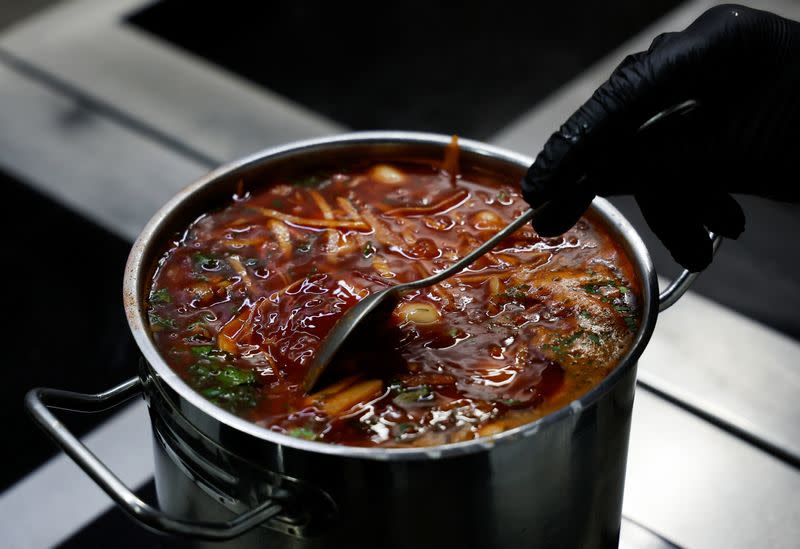
KYIV/PARIS (Reuters) - Ukraine claimed victory in an age-old culinary dispute with Russia on Friday after the United Nations' cultural agency placed a traditional beetroot soup on its list of protected Ukrainian cultural heritage.
Paris-based UNESCO announced in a statement that it had placed borshch, a rich crimson soup packed with vegetables, on a list of cultural heritage in need of "urgent safeguarding" due to the risk posed to the soup's status as an element of Ukraine's cultural heritage by Moscow's invasion.
Ukraine's culture minister Oleksandr Tkachenko wrote on Twitter: "Victory in the war for borshch is ours!"
Moscow decried the new protected Ukrainian status of the dish, which is also popular in Russia, as an example of "contemporary Kyiv nationalism".
"Our borshch does not need protection, but is subject to immediate and complete destruction in a bowl," Russia’s foreign ministry spokeswoman Maria Zakharova wrote on Telegram.
This view was met by hostility by residents of Kyiv, including 53-year old civil servant Tetiana.
"They need to develop their own culture, not just try to claim that of others, she said.
A UNESCO spokesman in Paris said the new status meant Ukraine could now apply for special funds to finance projects promoting and protecting the dish.
Diana Kharanovych-Yavorska, a 35-year old scientist enjoying a bowl of borshch on a sunny afternoon in Kyiv, said the decision represented a win over Moscow, especially significant in the fifth month of a bloody full-scale war.
"For Ukraine, this is a victory, considering that Russia always wanted to steal our history, our culture, and our national dishes," she told Reuters.
"Ukrainian borshch… can be different for every housewife, but it's ours," she said.
Yevhenii Marshal, a chef at a central Kyiv restaurant, explained that there are several main types of borshch: the traditional red beet variety, green borshch made from sorrel, and even a fish-based variety. He is adamant that all are Ukrainian.
“Of course borshch is Ukrainian heritage. To prepare tasty borshch, the main thing one needs is a real Ukrainian (to prepare it), and taste,” Marshal said while slicing his way through a stack of carrots.
(Additional reporting Tassilo Hummel in Paris and Ivan Lyubysh-Kirdey in Kyiv,; Editing by Raissa Kasolowsky)
By David Gritten BBC News Reuters Qatar's foreign ministry said the Israeli prime minister's reported remarks were ...


