Rechercher dans ce blog

Wednesday, August 3, 2022

Cold showers, no lights: Europe saves as Russian gas wanes - The Associated Press - en Español

PARIS (AP) — Fanning out like urban guerrillas through Paris’ darkened streets well after midnight, the anti-waste activists shinny up walls and drain pipes, reaching for switches to turn off the lights.

Click. Click. Click.

One by one, the outdoor lights that stores had left on are extinguished. It’s one small but symbolic step in a giant leap of energy saving that Europe is trying to make as it rushes to wean itself off natural gas and oil from Russia so factories aren’t forced to close and homes stay heated and powered.

Engineer Kevin Ha and his equally nimble friends had been acting against wasteful businesses in Paris long before Russia started cutting energy supplies to Europe in a battle of wills over Moscow’s invasion of Ukraine. As such, the campaigners were precursors of the energy economy drive becoming all the rage in France, Germany and elsewhere. Their message — that everyone can contribute — is almost word-for-word what public officials from cabinet ministers to mayors are saying now, too.

“Everyone can have a positive impact at their own level, by adopting good practices, by doing the right things to reduce their overall energy footprint,” the 30-year-old Ha said on a recent night of light-extinguishing on the Champs-Élysées boulevard.

The stakes are high. If Russia severs the supplies of gas it has already drastically reduced, authorities fear Europe risks becoming a colder, darker and less-productive place this winter. It’s imperative to economize gas now so it can be squirreled away for burning later in homes, factories and power plants, officials say.

“Europe needs to be ready,” said European Commission President Ursula von der Leyen. “To make it through the winter, assuming that there is a full disruption of Russian gas, we need to save gas to fill our gas storages faster. And to do so, we have to reduce our gas consumption. I know that this is a big ask for the whole of the European Union, but it is necessary to protect us.”

And although Europe is scrambling to get energy from elsewhere, any difficulties this winter could be a harbinger of worse to come if Russian gas supplies are completely severed and stay off through 2023, said France’s minister overseeing energy, Agnès Pannier-Runacher.

“If gas deliveries are cut by the end of the year, that will mean we’ll have a full year without Russian gas, so the following winter could be even harder,” Pannier-Runacher told French senators.

Hence the mounting appeals — already familiar to exasperated parents of wasteful teenagers everywhere — for Europeans to take shorter showers, switch off power sockets and otherwise do what they can.

Germany had been getting about a third of its gas from Russia, making the EU’s biggest economy and most populous nation conspicuously vulnerable. Energy saving is in full swing, with lights going off, public pools becoming chillier and thermostats being adjusted.

The glass dome of the Reichstag, the parliament building in Berlin, is going dark after it closes to visitors at midnight, and two facades will no longer be lit. Legislators’ office temperatures will drop by 2 degrees to 20 Celsius (68 Fahrenheit) this winter. Berlin City Hall, the Jewish Museum, two opera houses and the landmark Victory Column with panoramic views are among about 200 sites in the German capital that will no longer be lit at night.

Saunas are closing in Munich’s municipal swimming pools, which have chillier water now, too. There’ll only be cold showers at public pools in Hannover, part of a plan by the northern city to cut its energy use by 15%.

“The sum of all the contributions will help us get through this winter and be prepared for the next one,” said Robert Habeck, Germany’s vice chancellor and economy minister. He also told news weekly Der Spiegel he has slashed the time he spends showering.

“It will be a demanding, stony road, but we can manage it,” he said.

With a campaign dubbed “Flip the Switch,” the Netherlands’ government is urging showers of no more than five minutes, using sun shades and fans instead of air conditioning, and air-drying laundry.

Under a law passed Monday in often-sweltering Spain, offices, stores and hospitality venues will no longer be allowed to set their thermostats below 27 degrees Celsius (81 degrees Fahrenheit) in summer, nor raise them above 19 degrees Celsius in winter.

Prime Minister Pedro Sánchez asked office workers to ditch neckties, presumably to lessen the temptation to use air conditioning. He led by example, appearing at a news conference in an open-necked shirt.

The Italian government also is recommending limits on heating and cooling in public buildings.

In France, the government is targeting a 10% reduction in energy use by 2024, with an “energy sobriety” drive. Mayors are also waging their own war on waste, with fines introduced for air-conditioned or heated stores that leave front doors open; others are working to limit the pain of soaring energy prices.

The 8,000 residents of Aureilhan, in the foothills of the Pyrenees in southwestern France, have been adjusting to nights without street lights since July 11. Extinguishing all 1,770 of them from 11 p.m. to 6 a.m. will save money that Mayor Yannick Boubée would rather spend on roads and other maintenance. Otherwise, he said, the town’s 84,000-euro ($86,000) lighting bill in 2021 was on course to nearly triple next year.

“When it comes down to it, there’s no reason to keep the lights on at night,” he said by phone. “It is shaking up our way of thinking.”

Next will be convincing townspeople to agree to less-heated classrooms when schools reopen.

“We’re going to ask parents to put a pullover on their children, all measures that don’t cost anything,” he said. “We have no choice, unfortunately.”

—-

Associated Press writers Geir Moulson in Berlin, Mike Corder in The Hague, Colleen Barry in Milan and Frances D’Emilio in Rome contributed.

—-

Follow the AP’s coverage of the Russia-Ukraine war at https://apnews.com/hub/russia-ukraine

Adblock test (Why?)


World - Latest - Google News
August 03, 2022 at 01:22PM
https://ift.tt/jsAqltf

Cold showers, no lights: Europe saves as Russian gas wanes - The Associated Press - en Español
World - Latest - Google News
https://ift.tt/3aTwkV8

Tuesday, August 2, 2022

Stock Market Today: Dow And S&P 500 Close Lower Amid U.S.-China Tensions - The Wall Street Journal

Government bonds slumped Tuesday, unwinding much of their recent rally, after a trio of Federal Reserve officials emphasized that the central bank has more work to do to get inflation under control.

Investors sold short- and long-dated Treasurys, sparking a jump in yields, which rise as bond prices fall. The yield on the 10-year Treasury climbed to 2.74%, from 2.605% at Monday's settlement. The two-year Treasury yield rose to 3.077%, up from 2.909% Monday

The yield on a Treasury bond largely shows how investors think the Fed will tend to set target short-term interest rates over the bond's life. Yields had fallen last week after Chairman Jerome Powell said in a press conference that the Fed will respond flexibly to forthcoming economic data. Many investors read that as a sign the Fed was less locked in to an aggressive series of inflation-fighting rate increases as the economy cools, sending rate expectations lower.

Tuesday, however, brought a different sentiment from Fed governors Loretta Mester, Mary Daly and Charles Evans. Each made remarks that previewed an unrelenting anti-inflation stance from the Fed.

Ms. Daly said that a pivot to rate cuts next year "is not my modal outlook." Markets have been betting the Fed could start to cut rates in 2023.

"The outlook I think is most likely, is really that we raise interest rates and then we hold them there for a while at whatever level we think is appropriate," she said.

In separate appearances, Ms. Mester and Mr. Evans backed up that take. Mr. Evans said that that the Fed's next meeting in September could bring a 0.75-percentage-point rate increase, suggesting an opening for a more aggressive move than the 0.5-percentage-point hike that futures markets now think most probable.

"We have more work to do because we have not seen that turn in inflation," Ms. Mester told the Washington Post.

Inflation and recession concerns are jockeying for space in investors' psyches, and on Tuesday, inflation was reclaiming ground as the prime focus, said Andy Brenner of NatAlliance Securities.

Adblock test (Why?)


World - Latest - Google News
August 03, 2022 at 03:50AM
https://ift.tt/Vxm8JvY

Stock Market Today: Dow And S&P 500 Close Lower Amid U.S.-China Tensions - The Wall Street Journal
World - Latest - Google News
https://ift.tt/wZ8cepN

Russia threatens to break off diplomatic relations with US; Brittney Griner's sentencing due 'very soon': Live updates - USA TODAY

Monday, August 1, 2022

2 years later, hope for justice in Beirut explosion fades - The Associated Press - en Español

BEIRUT (AP) — It’s been two years since his 3-year-old daughter, Alexandra, was killed in a massive explosion at Beirut’s port — and Paul Naggear has lost hope that outrage over the disaster will bring justice and force change in Lebanon.

The investigation into one of the world’s biggest non-nuclear explosions has been blocked for months by Lebanon’s political powers. Many blame the Lebanese government’s longtime corruption and mismanagement for the tragedy, but the elite’s decades-old lock on power has ensured they are untouchable.

In fact, some of those charged in the probe were re-elected to parliament earlier this year.

Even as the wrecked silos at the port have been burning for weeks — a fire ignited by the fermenting grains still inside them — authorities seemed to have given up on trying to put out the blaze. A section of the silos collapsed Sunday in a huge cloud of dust.

“It has been two years and nothing’s happened,” Naggear, said of the Aug. 4, 2020 disaster, when hundreds of tons of highly explosive ammonium nitrate, a material used in fertilizers, detonated at the port. “It’s as if my daughter was just hit by a car.”

The blast caused a pressure wave that shattered everything in its path across the capital.

Naggear, his wife, Tracy Awad, and little Alexandra were in their apartment overlooking the port when the massive force sent glass, furniture and other debris flying. Naggear and his wife suffered cuts and bruises. Alexandra, or Lexou, as they called her, was severely injured and died in the hospital.

She was the second-youngest victim of the explosion, which killed more than 215 people and injured more than 6,000.

It later emerged that the ammonium nitrate had been shipped to Lebanon in 2013 and stored improperly at a port warehouse ever since. Senior political and security officials knew of its presence but did nothing.

Lebanon’s factional political leaders, who have divvied up power among themselves for decades, closed ranks to thwart any accountability.

Tarek Bitar, the judge leading the investigation, charged four former senior government officials with intentional killing and negligence that led to the deaths of dozens of people. He also charged several top security officials in the case.

ratio
Youtube video thumbnail

But his work has been blocked for eight months pending a Court of Cassation ruling after three former Cabinet ministers filed legal challenges. The court can’t rule until a number of vacancies caused by judges retiring are filled. The appointments, signed by the justice minister, are still awaiting approval from the finance minister, an ally of Parliament Speaker Nabih Berri.

Judicial officials with knowledge of Bitar’s investigation told The Associated Press it was in advanced stages of answering key questions — including who owned the nitrates, how they entered the port and how the explosion happened. They spoke on condition of anonymity because they were not authorized to speak publicly about the investigation.

Bitar is the second judge to take the case. The first judge was forced out after complaints were raised against him by two Cabinet ministers, and if the same happens to Bitar it would likely be the final blow to the investigation.

The lack of justice compounds the pain of relatives and friends of blast victims. They feel let down and abandoned, not only by the government but by public apathy as the months and years have dragged on.

Initially after the explosion, there were large protests and sit-ins demanding justice. It raised hopes that Lebanon’s politicians might be held accountable.

But public fervor waned as Lebanese became absorbed with surviving the country’s economic collapse. Also, deadly gun battles erupted last year between Hezbollah supporters protesting against Bitar and members of a Christian faction, raising fears that pressing the investigation could push Lebanon into factional conflict.

Now only a handful of people show up at protests and sit-ins organized by relatives of the victims.

Families remain wracked by grief.

For Muhieddine Ladkani, whose father, Mohammed, was killed, time has stood still.

When they first heard explosions coming from the port, his father took the family into their apartment’s entrance hall, believing it would be safe since there were no windows. But the blast tore the front door off its hinges and sent a cupboard slamming into the elder Ladkani. He was in a coma for weeks with a brain hemorrhage. He died 31 days later.

Ladkani, a 29-year-old law student, said his family still can’t talk about that day.

“We still cannot remember, and we cannot gather as a family,” he said. “My brothers and uncles have my father’s photos as their profile photo. I don’t. Whenever I remember my father, I collapse.”

“It is something that I don’t want to believe. I can’t live with it,” Ladkani said. Those who voted for the politicians charged in the disaster are also responsible for his father’s death, he added.

“The ink on the fingers of the voters who voted for them is not ink but the blood of the victims,” Ladkani said.

One of the charged and reelected politicians, former public works minister Ghazi Zeiter, told the AP he had the right to run for parliament again because there is no court verdict against him. He said Bitar has no right to charge him because legislators and ministers have a special court where they are usually tried.

Amid the deadlock, some victims’ families are turning to courts outside Lebanon.

In mid-July, families filed a $250 million lawsuit against an American-Norwegian firm, TGS, suspected of involvement in bringing the explosive material to the port. TGS has denied any wrongdoing.

Naggear said his family, two others and the Bar Association have filed a lawsuit in Britain against the London-registered chemical trading company, Savaro Ltd., which investigative journalists in Lebanon say chartered the shipment, intending to take the nitrates from Georgia to an explosives firm in Mozambique.

Naggear said he is losing hope.

He and his wife, who is a dual Lebanese-Canadian citizen, had thought about leaving Lebanon after the blast. But the large public protests in the immediate aftermath gave them hope that change was possible.

But after this year’s parliamentary election results, they are again seriously considering leaving.

Still, they vow to continue working for justice. At a recent sit-in, they showed up with their 4-month-old baby, Axel.

“They are trying to make us forget ... but we will not stop, for (Alexandra’s) sake until we reach the truth and justice,” Naggear said.

The Naggears have repaired their apartment, but they haven’t stayed there since Axel’s birth, fearing it was still not safe.

The fire burning in the ruins of the grain silos only feeds the sense of danger. A northern section of the structure collapsed on Sunday, and experts say more parts are at risk of falling. At night, orange flames can be seen licking at the base of the northern silo, glowing eerily in the darkness.

Adblock test (Why?)


World - Latest - Google News
August 01, 2022 at 01:22PM
https://ift.tt/R9WTFuj

2 years later, hope for justice in Beirut explosion fades - The Associated Press - en Español
World - Latest - Google News
https://ift.tt/J5YamH1

UN chief warns world is one step from 'nuclear annihilation' - ABC News

UNITED NATIONS -- The United Nations chief warned the world Monday that “humanity is just one misunderstanding, one miscalculation away from nuclear annihilation.”

Secretary-General Antonio Guterres gave the dire warning at the opening of the long-delayed high-level meeting to review the landmark 50-year-old treaty aimed at preventing the spread of nuclear weapons and eventually achieving a nuclear-free world. He cited especially the war in Ukraine and the threat of nuclear weapons to conflicts in the Middle East and Asia, two regions “edging towards catastrophe.”

Guterres told many ministers, officials and diplomats attending the month-long conference to review the Nuclear Nonproliferation Treaty that the meeting is taking place “at a critical juncture for our collective peace and security” and “at a time of nuclear danger not seen since the height of the Cold War.”

The conference is “an opportunity to hammer out the measures that will help avoid certain disaster, and to put humanity on a new path towards a world free of nuclear weapons,” the secretary-general said.

But Guterres warned that “geopolitical weapons are reaching new highs,” almost 13,000 nuclear weapons are in arsenals around the world, and countries seeking “false security” are spending hundreds of billions of dollars on “doomsday weapons.”

“All this at a time when the risks of proliferation are growing and guardrails to prevent escalation are weakening,” he said, “And when crises -- with nuclear undertones -- are festering from the Middle East and the Korean Peninsula to Russia’s invasion of Ukraine.”

Guterres called on conference participants to take several actions: urgently reinforce and reaffirm “the 77-year-old norm against the use of nuclear weapons,” work relentlessly toward the elimination of nuclear weapons with new commitments to reduce arsenals, address “the simmering tensions in the Middle Est and Asia” and promote the peaceful use of nuclear technology.

“Future generations are counting on your commitment to step back from the abyss,” he implored the ministers and diplomats. “This is our moment to meet this fundamental test and lift the cloud of nuclear annihilation once and for all.”

In force since 1970, the Nonproliferation Treaty known as the NPT has the widest adherence of any arms control agreement, with some 191 countries that are members.

Under its provisions, the five original nuclear powers -- the United States, China, Russia (then the Soviet Union), Britain and France -- agreed to negotiate toward eliminating their arsenals someday and nations without nuclear weapons promised not to acquire them in exchange for a guarantee to be able to develop nuclear energy for peaceful purposes.

India and Pakistan, which didn’t join the NPT, went on to get the bomb. So did North Korea, which ratified the pact but later announced it was withdrawing. Non-signatory Israel is believed to have a nuclear arsenal but neither confirms nor denies it. Nonetheless, the treaty has been credited with limiting the number of nuclear newcomers (U.S. President John F. Kennedy once foresaw as many as 20 nuclear-armed nations) as a framework for international cooperation on disarmament.

The meeting, which ends Aug. 26, aims to generate a consensus on next steps, but expectations are low for a substantial — if any — agreement.

Still, Swiss President Ignazio Cassis, prime ministers Fumio Kishida of Japan and Frank Bainimarama of Fiji, and more than a dozen nations’ foreign ministers are among attendees expected from at least 116 countries, according to a U.N. official who spoke on condition of anonymity because he wasn’t authorized to speak publicly before the conference.

Other speakers at Monday’s opening include U.N. nuclear chief Rafael Grossi, head of the International Atomic Energy Agency, U.S. Secretary of State Antony Blinken and German Foreign Minister Annalena Baerbock..

The NPT’s five-year review was supposed to take place in 2020, when the world already faced plenty of crisis, but was delayed because of the COVID-19 pandemic.

It is taking place at a time of heightened fears of a nuclear confrontation, spurred by Russia’s comments following its Feb. 24 invasion of neighboring Ukraine.

Russian President Vladimir Putin warned then that any attempt to interfere would lead to “consequences you have never seen” and emphasized that his country is “one of the most potent nuclear powers.” Days later, Putin ordered Russia’s nuclear forces to be put on higher alert.

Patricia Lewis, former director of the U.N. Institute for Disarmament Research who is now in charge of international security programs at the international affairs think tank Chatham House in London, said “President Putin’s threats to use nuclear weapons have shocked the international community.”

Russia is not only an NPT signatory but a depository for treaty ratifications and in January it joined the four other nuclear powers in reiterating the statement by former U.S. President Ronald Reagan and former Soviet leader Mikhail Gorbachev that “a nuclear war can never be won and must never be fought,” she told The Associated Press.

Lewis said countries participating in the review conference will have a difficult decision to make.

To support the treaty and what it stands for, “governments will have to address Russia’s behavior and threats,” she said. “On the other hand, to do so risks dividing the treaty members -- some of whom have been persuaded by Russia’s propaganda or at least are not as concerned, for example, as the NATO states.”

And “Russia no doubt will strenuously object to being named in statements and any outcome documents,” Lewis said.

Adblock test (Why?)


World - Latest - Google News
August 01, 2022 at 10:12PM
https://ift.tt/8d4iWC0

UN chief warns world is one step from 'nuclear annihilation' - ABC News
World - Latest - Google News
https://ift.tt/J5YamH1

Tory leadership: Penny Mordaunt backs Liz Truss to be prime minister - BBC

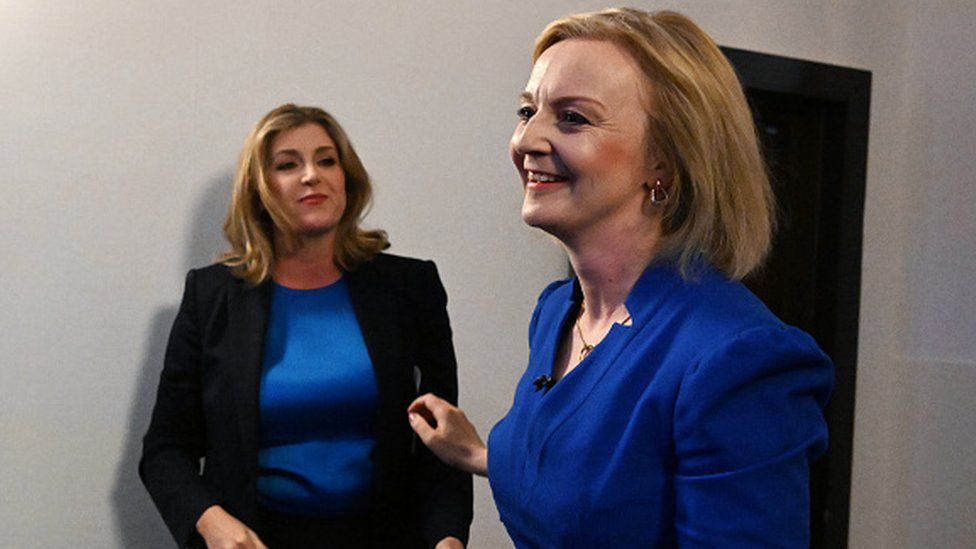
Penny Mordaunt greets Conservative leadership candidate Liz Truss during a hustings eventGetty Images

Liz Truss has received a boost in her bid to become the next prime minister after her candidacy was backed by former leadership rival Penny Mordaunt.

The trade minister was knocked out of the race after finishing third behind Ms Truss and ex-chancellor Rishi Sunak.

Ms Mordaunt gave Ms Truss her support, calling her the "hope candidate", as she appeared at a leadership hustings.

Party members will "short-change the country" and "may lose an election" if they get the decision wrong, she added.

Mr Sunak and Ms Truss are vying to win over Conservative Party members, whose votes will determine which of them will become the next Tory leader and British prime minister.

The party's roughly 160,000 members started receiving ballot papers on Monday, with the result due on 5 September, when Prime Minister Boris Johnson will leave office.

Mr Sunak and Ms Truss attended their second hustings - a live debate in front of voters - in Exeter, after several heated clashes on TV in recent weeks.

Tax policy has become the main battleground, while both have announced a string of competing policy proposals to woo Conservative members.

This video can not be played

To play this video you need to enable JavaScript in your browser.

Ms Mordaunt is the latest cabinet minister to back Ms Truss, joining Defence Secretary Ben Wallace and Chancellor Nadhim Zahawi in endorsing her candidacy.

Meanwhile Mr Sunak has received the support of senior Tory MPs, including former cabinet ministers Liam Fox and Damian Green.

Ms Mordaunt said at the event - along the south coast from her own Portsmouth North constituency - that choosing between the two candidates was hard but it was "too important" to "leave this to chance".

She said: "At the start of this final phase of this contest, I didn't know the answer to those questions, but I've seen enough to know who the person I'm going to put my faith in is - and that is Liz Truss."

Tory members cheered the announcement, before Ms Mordaunt heaped praise on Ms Truss and said: "She for me is the hope candidate."

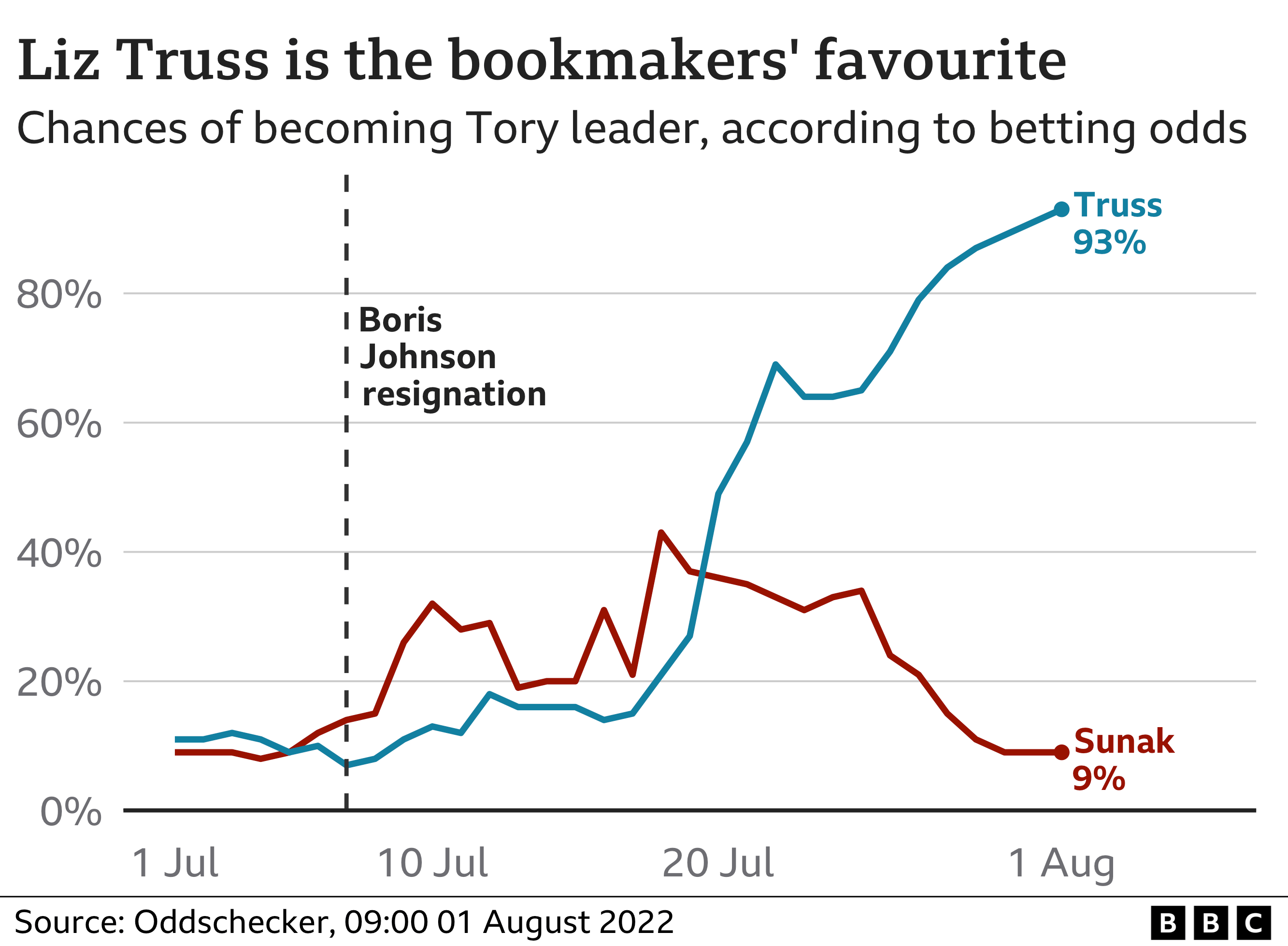
Chart showing betting odds.
1px transparent line

In her opening speech, Ms Truss said Ms Mordaunt was "a great patriot and I'm proud to call her my friend".

The warm words marked a change in tone, after allies of Ms Mordaunt accused Ms Truss's team of a dirty-tricks campaign to block her from reaching the final stage of the leadership contest.

Mr Sunak had his own Tory big hitter to introduce him on stage - in the form of Liam Fox, the former international trade secretary who has himself stood twice to be party leader.

Mr Fox said Mr Sunak had the ability to win over swing voters and stop a Labour-SNP coalition "tearing our nation apart".

"We will need a leader and a prime minister, with the right policies, yes, but with character, with courage, with experience and with intellect, and the downright decency to swing those voters behind us and get them to vote Conservative," Mr Fox said. "I believe that leader, that prime minister, will be Rishi Sunak."

He said character was shown by Mr Sunak's performance during the pandemic, making "difficult but vital decisions", including the introduction of the furlough scheme.

This video can not be played

To play this video you need to enable JavaScript in your browser.

When Mr Sunak spoke, he said he would focus on three priorities if he became PM - "restore trust", "rebuild the economy" and "reunite our country".

He once again attacked Ms Truss's plans to slash taxes and reiterated his belief that he had not taken the "easy path" in setting out his vision for the country.

He said he would "cut taxes", outlining his plan to cut the basic rate of income tax from 20% to 16% by the end of the next parliament.

But he added: "We are going to do that responsibly. We are not going to ask our kids to pay for it. We are going to do it by being tough on public spending, reforming public services, and by growing the economy."

In a hustings covering a wide range of topics, Ms Truss:

  • suggested she would not repeal the fox hunting ban in England and Wales, warning it could "make the situation worse" for country sport enthusiasts
  • said it was best to "ignore" Scottish First Minister Nicola Sturgeon, calling her an "attention seeker", when asked what she would do to avoid the break-up of the UK
  • said she would be a food critic if she wasn't a politician

And Mr Sunak:

  • was applauded by Tory members after saying Ms Truss's policies on corporate taxation were "exactly the failed Treasury orthodoxy of the last 10 years"
  • insisted he was loyal to Boris Johnson, but resigned as chancellor because the PM's government was on the "wrong side" of serious ethical questions
  • on what he would do if not a politician, said: "If I could run Southampton Football Club, I'd be a very happy man."

Following the hustings, Ms Truss announced a "war on Whitehall waste" in the latest policy announcement of her campaign.

She claimed she would save taxpayers £11bn by cutting civil service time off, ending national pay deals and scrapping jobs aimed at increasing inclusion and diversity in the public sector.

Her campaign said most of the savings would come from tailoring pay to living costs where civil servants work.

But a source close to Mr Sunak's campaign said Ms Truss "seems to have confused the wage bill of the civil service with front line public sector workers".

"This means stretching the NHS to breaking point and fewer police fighting crime as we head into a general election."

Unions and Labour have warned Mr Truss her proposals would face resistance if she implemented them as PM.

Dave Penman, general secretary of the FDA union, said Ms Truss's pledge to cut regional pay for civil servants was "astounding", calling her plans "recycled failed policies".

Deputy Labour leader Angela Rayner condemned Ms Truss's plans, saying: "This wannabe prime minister is stuck in the past, fighting old battles, and promising a race to the bottom on public sector workers' pay and rights."

Adblock test (Why?)


World - Latest - Google News
August 02, 2022 at 04:44AM
https://ift.tt/VH02rP1

Tory leadership: Penny Mordaunt backs Liz Truss to be prime minister - BBC
World - Latest - Google News
https://ift.tt/J5YamH1

Ukrainian grain tycoon killed in Mykolaiv shelling as Putin threatens 'lightning speed' response to interference - CNN

(CNN)A Ukrainian grain mogul and his wife were killed after the southern city of Mykolaiv came under intense shelling on Sunday, according to Ukrainian officials, as Russian President Vladimir Putin used his nation's Navy Day to issue more militaristic threats to anyone undermining Russia's "sovereignty and freedom."

Grain tycoon Oleksiy Vadaturskyy and his wife, Raisa, died in the attack, according to a statement from Ukrainian President Volodymyr Zelensky. Vadaturskyy was the founder of Mykolaiv-based Nibulon, one of Ukraine's largest grain producing and export companies.
The businessman's death was a "great loss for Mykolaiv ... and all of Ukraine," Zelensky said. "For more than 50 years of his career, Oleksiy Vadaturskyy made an invaluable contribution to the development of the region and the development of the agricultural and shipbuilding industries of our country."
Mykolaiv Mayor Oleksandr Senkevych said cluster munitions blew out windows and destroyed balconies. "Mykolaiv was under mass shelling today. Probably the strongest one of all time," he said in a statement.
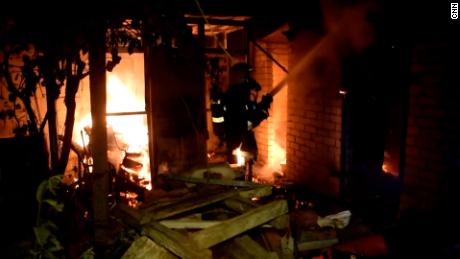
A CNN team on the ground heard the explosions caused by the strikes and saw fires that broke out in the shelling. Residents interviewed by CNN also said it was the heaviest shelling in the city since the start of the war.
In a speech commemorating Russia's Navy Day in Saint Petersburg, Putin did not make any mention of Russia's war in Ukraine, but said his country's "current situation is demanding very decisive actions."
"We will provide protection firmly and by all means. The key here is the capabilities of the Navy, which is able to respond with lightning speed to anyone who decides to encroach on our sovereignty and freedom," Putin said.
Putin said delivery of the country's Zircon hypersonic cruise missile systems would begin in the coming months. Russia said in May that it successfully tested the Zircon missile over a distance of 1,000 kilometers (621 miles).
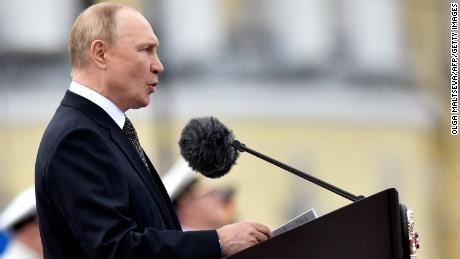
Russian President Vladimir Putin delivers a speech marking Navy Day, in St. Petersburg on July 31, 2022.

'True hero'

Vadaturskyy and his wife were sheltering in the basement at home when they were killed in a direct hit that reduced parts of their mansion to debris. It remains unclear whether he was intentionally targeted by the Russians.
A statement from Vadaturskyy's company, Nibulon, said he was a "true hero and patriot" who had stayed in Mykolaiv to help the strategically important port throughout Russia's invasion.
"He always believed in Ukraine and directed his efforts to its development and prosperity," the statement said.
Neighbors expressed their shock and anger at the attack.
"We don't know what to do. We hate Russia," said Maxim, who has lived in the area for almost 20 years. "It's unbelievable that in one moment it can destroy everything."
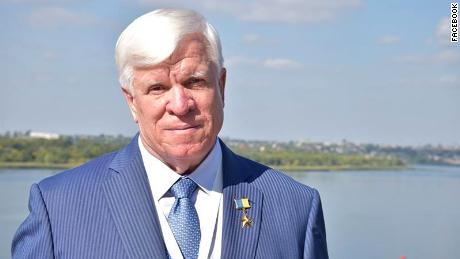
Grain mogul Oleksiy Vadaturskyy and his wife, Raisa, died in a Russian attack on the city of Mykolaiv on Sunday.

Accusations of war crimes

Separately, at least three people were killed and eight injured in fighting in eastern Ukraine, according to the Donetsk military-civilian administration, which said villages in the region were targeted by artillery, Russian Grad missiles and Uragan rockets.
"11 private residential buildings and a high-rise building, a police station, a market, a canteen were damaged, and three fields were burned," the administration said.
The Ukraine General Staff said Russian forces were attacking the front lines in the Donetsk and Luhansk regions.
A firefighter responds to shelling in Mykolaiv, Ukraine, on Sunday, July 31.
Zelensky on Saturday called on the remaining residents of the Donetsk region to urgently evacuate in what he called a "government decision."
"Everything is being organized. Full support, full assistance -- both logistical and payments," he said in his nightly address. "We only need a decision from the people themselves, who have not yet made it for themselves."
A strike on a prison in separatist-held eastern Ukraine on Friday resulted in the deaths of at least 40 prisoners. The Olenivka prison near Donetsk has been used to house many of the Ukrainian soldiers who surrendered at the Azovstal plant in Mariupol several months ago.
UK Ambassador to Ukraine Melinda Simmons said the strike was part of a pattern "the worst kind of human rights abuses" in her twitter on Saturday. "Olenivka needs investigating. It looks like part of an increasingly worrying pattern of the worst kind of human rights abuses, and possible war crimes, being committed in the occupied East of Ukraine with impunity," the ambassador tweeted.
Zelensky said the attack was "a deliberate war crime by the Russians."
Ukrainian intelligence said the strikes were carried out by the Russia mercenary group Wagner and were not coordinated with the Russian Ministry of Defense. CNN cannot independently verify the accusations made by Ukrainian military intelligence.
Russia has blamed Ukraine for the attack.

Adblock test (Why?)


World - Latest - Google News
August 01, 2022 at 04:11PM
https://ift.tt/5l3bf8p

Ukrainian grain tycoon killed in Mykolaiv shelling as Putin threatens 'lightning speed' response to interference - CNN
World - Latest - Google News
https://ift.tt/J5YamH1

Featured Post

Qatar 'appalled' by reported criticism from Israel's Netanyahu - BBC.com

By David Gritten BBC News Reuters Qatar's foreign ministry said the Israeli prime minister's reported remarks were ...

Popular Posts