Rechercher dans ce blog

Monday, June 27, 2022

NATO to boost rapid reaction force, Ukraine military support - ABC News

BRUSSELS -- NATO allies will decide at a summit this week to increase the strength of their rapid reaction force nearly eightfold to 300,000 troops as part of their response to an “era of strategic competition," the military alliance's secretary-general said Monday.

The NATO response force (NRF) currently numbers around 40,000 soldiers which can deploy quickly when needed.

Coupled with other measures including the deployment of forces to defend specific allies, NATO Secretary-General Jens Stoltenberg said the move is part of the “biggest overhaul of collective defense and deterrence since the Cold War."

“These troops will exercise together with home defense forces,” Stoltenberg said. “And they will become familiar with local terrain, facilities, and our new pre-positioned stocks. So that they can respond smoothly and swiftly to any emergency."

In response to the Kremlin’s decision to start the war, U.S. President Joe Biden and his NATO counterparts agreed in February to send thousands of troops, backed by air and naval support, to protect allies near Russia and Ukraine. The 30-nation organization decided at the time to send parts of the NRF and elements of a quickly deployable spearhead unit to the alliance’s eastern flank, marking the first time the force had been used in a defense role.

Stoltenberg made the remarks at a press conference ahead of a NATO summit this week in Madrid when the 30 allies are expected to also agree on further support to Ukraine in its war against Russia.

Stoltenberg said he expects allies to make clear they consider Russia “as the most significant and direct threat to our security." At the summit, allies will also decide to strengthen their battlegroups on NATO's eastern flanks, he said.

In NATO's new strategic concept, the alliance is also set to address for the first time the security challenges posed by China, Stoltenberg said. In Madrid, allies will discuss how to respond to the growing influence of Russia and China in their “southern neighborhood," he added.

Stoltenberg said allies will agree to deliver further military support to Ukraine when they convene in Spain, with NATO members set to adopt a “strengthened comprehensive assistance package,” including deliveries of secure communication and anti-drone systems.

Over the long term, Stoltenberg said allies aim to help Ukraine transition from Soviet-era armaments to modern NATO equipment. The world's seven leading economic powers underscored Monday their commitment to Ukraine for “as long as it takes.”

Another central theme at the NATO summit will be the possibility for Finland and Sweden to join the alliance following Russia’s invasion of Ukraine.

NATO member Turkey has so far blocked the applications, citing what it considers to be the two countries’ soft approach to organizations Turkey considers to be terrorist, such as the Kurdistan Workers’ Party, or PKK.

Stoltenberg said that Turkish president Turkish President Recep Tayyip Erdogan, Finnish President Sauli Niinisto and the Swedish prime minister Magdalena Andersson have agreed to meet Tuesday on the sidelines of the summit.

Officials from the three countries have stepped up talks ahead of the NATO gathering in a bid to break the deadlock.

“My strong hope is that this dialogue can be successful and concluded in the near future, ideally before the summit," Andersson said after talks with Stoltenberg in Brussels.

Turkey is demanding that Sweden and Finland grant extradition requests for individuals who are wanted by Turkish authorities. Ankara claims the countries are harboring PKK members as well people it says are linked to a failed 2016 coup.

Turkey also wants assurances that arms restrictions imposed by the two countries over Turkey’s 2019 military incursion into northern Syria will be removed.

“I will not make any promises, but I can assure you that we are working actively to ensure progress because the application of Finland and Sweden to join NATO, they are historic,” Stoltenberg said.

Andersson said Sweden’s stance toward the PKK is “crystal clear” and that her country considers the organization as a terror group. She added that Sweden’s anti-terror legislation is undergoing its most comprehensive overhaul in 30 years.

“Moreover, constitutional amendments are being prepared, which would help pave the way for criminalization or participation in terrorist organizations,” she said.

NATO released new defense spending figures showing that U.S. allies in Europe as well as Canada have increased defense spending for an eighth consecutive year.

“By the end of the year, they will have invested well over 350 billion US dollars extra since we agreed our defense investment pledge in 2014," Stoltenberg said.

NATO countries slashed their military budgets in the 1990s following the end of the Cold War, but upped spending when Russia annexed Ukraine’s Crimean Peninsula in 2014. In that year, NATO allies also pledged to reach a defense budget target of 2% of their gross domestic product by 2024.

“Nine allies now reach – or exceed – the 2% target. Nineteen allies have clear plans to reach it by 2024," Stoltenberg said. “Two percent is increasingly considered a floor, not a ceiling. We will also agree to invest more together in NATO."

———

Jan M. Olsen in Copenhagen contributed to this report.

———

Follow AP’s coverage of the Russia-Ukraine war at https://ift.tt/D3vdcHk

Adblock test (Why?)


World - Latest - Google News
June 27, 2022 at 11:43PM
https://ift.tt/dt3ljKI

NATO to boost rapid reaction force, Ukraine military support - ABC News
World - Latest - Google News
https://ift.tt/qAJeU9C

US to announce purchase of medium- to long-range surface-to-air missile defense system for Ukraine - CNN

(CNN)The US plans to announce as soon as this week that it has purchased an advanced, medium-to-long range surface-to-air missile defense system for Ukraine, a source familiar with the announcement tells CNN.

President Joe Biden, who is currently meeting with G7 leaders in Germany for a summit primarily focused on Ukraine, announced recently that the US would provide Ukraine with "more advanced rocket systems and munitions" as its war with Russia grinds on. Ukrainian President Volodymyr Zelensky is slated to virtually address Biden and other G7 leaders on Monday.
In response to requests by Ukrainian forces, other military assistance is also likely to be announced this week, including additional artillery ammunition and counter-battery radars. Ukrainian officials have asked for the missile defense system, known as a NASAMS system, given the weapons can hit targets more than 100 miles away, though the Ukrainian forces will likely need to be trained on the systems, a source said. The NASMAS system the same one that protects Washington, DC, and the area around the nation's capital.
The US has been steadily announcing additional security assistance for Ukraine. Last week, the Biden administration announced an additional $450 million in military assistance for Ukraine, giving it four more multiple launch rocket systems and artillery ammunition for other systems.
And earlier this month, the Biden administration said it was providing an additional $1 billion in military aid to Ukraine, a package that includes shipments of additional howitzers, ammunition and coastal defense systems.
CNN reported last week that US assessments of the war increasingly envision a long and punishing battle in the eastern part of Ukraine, with high personnel and equipment losses on both sides.
US officials believe that Russian forces plan to maintain intense attacks in the east, characterized by heavy artillery and missile strikes, with the intention of wearing down Ukrainian forces and NATO resolve over time.
For Ukraine's part, its military has been burning through Soviet-era ammunition that fits older systems, and Western governments have been facing a tough decision on whether they want to continue increasing their assistance to the country, something Biden has already pledged to do.
"We will continue to lead the world in providing historic assistance to support Ukraine's fight for freedom," the President wrote in a New York Times op-ed last month.
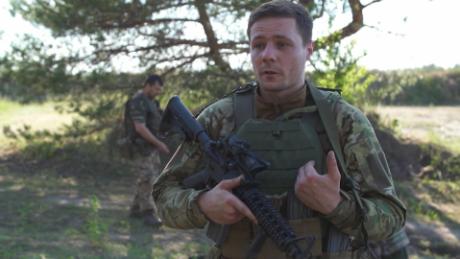
Related video: See Ukrainian troops try out US-supplied M4 rifles

    JUST WATCHED

    Related video: See Ukrainian troops try out US-supplied M4 rifles

MUST WATCH

Related video: See Ukrainian troops try out US-supplied M4 rifles 02:42

Adblock test (Why?)


World - Latest - Google News
June 27, 2022 at 05:23PM
https://ift.tt/RMIYloW

US to announce purchase of medium- to long-range surface-to-air missile defense system for Ukraine - CNN
World - Latest - Google News
https://ift.tt/qAJeU9C
Sunday, June 26, 2022

G7 aims to raise $600 billion to counter China's Belt and Road - Reuters

U.S. President Joe Biden attends a working lunch with other G7 leaders to discuss shaping the global economy at the Yoga Pavilion, Schloss Elmau in Kuren, Germany, June 26, 2022. Kenny Holston/Pool via REUTERS

SCHLOSS ELMAU, Germany, June 26 (Reuters) - Group of Seven leaders on Sunday pledged to raise $600 billion in private and public funds over five years to finance needed infrastructure in developing countries and counter China's older, multitrillion-dollar Belt and Road project.

U.S. President Joe Biden and other G7 leaders relaunched the newly renamed "Partnership for Global Infrastructure and Investment," at their annual gathering being held this year at Schloss Elmau in southern Germany.

Biden said the United States would mobilize $200 billion in grants, federal funds and private investment over five years to support projects in low- and middle-income countries that help tackle climate change as well as improve global health, gender equity and digital infrastructure.

"I want to be clear. This isn't aid or charity. It's an investment that will deliver returns for everyone," Biden said, adding that it would allow countries to "see the concrete benefits of partnering with democracies."

Biden said hundreds of billions of additional dollars could come from multilateral development banks, development finance institutions, sovereign wealth funds and others.

Europe will mobilize 300 billion euros for the initiative over the same period to build up a sustainable alternative to China's Belt and Road Initiative scheme, which Chinese President Xi Jinping launched in 2013, European Commission President Ursula von der Leyen told the gathering.

The leaders of Italy, Canada and Japan also spoke about their plans, some of which have already been announced separately. French President Emmanuel Macron and British Prime Minister Boris Johnson were not present, but their countries are also participating.

China's investment scheme involves development and programs in over 100 countries aimed at creating a modern version of the ancient Silk Road trade route from Asia to Europe.

White House officials said the plan has provided little tangible benefit for many developing countries.

Biden highlighted several flagship projects, including a $2 billion solar development project in Angola with support from the Commerce Department, the U.S. Export-Import Bank, U.S. firm AfricaGlobal Schaffer, and U.S. project developer Sun Africa.

Together with G7 members and the EU, Washington will also provide $3.3 million in technical assistance to Institut Pasteur de Dakar in Senegal as it develops an industrial-scale flexible multi-vaccine manufacturing facility in that country that can eventually produce COVID-19 and other vaccines, a project that also involves the EU.

The U.S. Agency for International Development (USAID) will also commit up to $50 million over five years to the World Bank’s global Childcare Incentive Fund.

Friederike Roder, vice president of the non-profit group Global Citizen, said the pledges of investment could be "a good start" toward greater engagement by G7 countries in developing nations and could underpin stronger global growth for all.

G7 countries on average provide only 0.32% of their gross national income, less than half of the 0.7% promised, in development assistance, she said.

"But without developing countries, there will be no sustainable recovery of the world economy," she said.

Reporting by Andrea Shalal; Editing by Mark Porter and Lisa Shumaker

Our Standards: The Thomson Reuters Trust Principles.

Adblock test (Why?)


World - Latest - Google News
June 27, 2022 at 12:54AM
https://ift.tt/RE9djAC

G7 aims to raise $600 billion to counter China's Belt and Road - Reuters
World - Latest - Google News
https://ift.tt/sr7IgVO

G7 leaders discuss price cap on Russian oil over Ukraine invasion - Al Jazeera English

G7 leaders meeting in Germany discuss plans to reduce Russian revenues from oil exports amid a surge in energy prices.

Leaders of Group of Seven (G7) nations have discussed plans to cap the price of Russian oil in order to put the squeeze on Moscow, which is benefiting from soaring energy prices, and cut off its means of financing the invasion of Ukraine.

The United States has suggested a price cap decided by consuming countries, a proposal that was discussed on Sunday by the G7 leaders at a summit in the Bavarian Alps.

Western countries rallied around Kyiv when Russia invaded Ukraine in February, but more than four months into the war, that unity is being tested as soaring inflation and energy shortages rebound on their own citizens.

Chided by Ukraine for not going far enough to punish Russia, G7 leaders were having “really constructive” talks on a possible price cap on Russian oil, a German government source was quoted as saying by the Reuters news agency.

“We are on a good path to reach an agreement,” the official said.

A French presidency official said Paris would push for a price cap on oil and gas and was open to discussing the US proposal.

However, he said the G7 needed to work towards getting a maximum oil price and this needed the buy-in of oil producers in the Organization of Petroleum Exporting Countries and its allies in a group called OPEC+, which includes Russia.

“We need to have discussions with OPEC+ and producing countries to achieve this,” the official said.

The European Union, which plans to ban imports of most Russian oil from the end of the year, has reservations about a US push for a broad oil price cap or “price exception” to restrict Moscow’s energy revenue.

A price exception could work through a mechanism to restrict or ban insurance or financing for Russian oil shipments above a certain amount.

It could prevent spillover effects to low-income countries that are struggling with high food and energy costs.

European Council President Charles Michel also said G7 leaders would discuss a technical mechanism that had the effect of an oil price cap through services related to oil and export insurance.

But Michel said the issue would need to be handled carefully or risk backfiring.

“We are ready to take a decision together with our partners, but we want to make sure that what we decide will have a negative effect [on Russia] and not a negative effect for ourselves.”

Biden hails Western unity

At the start of a bilateral meeting, US President Joe Biden thanked German Chancellor Olaf Scholz for showing leadership on Ukraine and said Russian President Vladimir Putin had failed to break their unity.

Scholz has faced criticism at home and abroad for his handling of Russia’s invasion of Ukraine.

“We can get through all of this and come out stronger,” Biden said.

“Because Putin has been counting on it from the beginning that somehow NATO and the G7 would splinter. But we haven’t and we’re not going to.”

At the start of the meeting, four members of the G7 announced plans to ban imports of Russian gold as part of efforts to tighten the sanctions squeeze on Moscow.

The US, United Kingdom, Canada and Japan will ban Russian gold imports. France also supported the move.

The UK said the ban was aimed at wealthy Russians who have been buying safe-haven bullion to reduce the financial impact of Western sanctions. Russian gold exports were worth $15.45bn last year.

“The measures we have announced today will directly hit Russian oligarchs and strike at the heart of Putin’s war machine,” UK Prime Minister Boris Johnson said in a statement.

“We need to starve the Putin regime of its funding. The UK and our allies are doing just that.”

Adblock test (Why?)


World - Latest - Google News
June 27, 2022 at 12:43AM
https://ift.tt/SA4d0FO

G7 leaders discuss price cap on Russian oil over Ukraine invasion - Al Jazeera English
World - Latest - Google News
https://ift.tt/sr7IgVO

Ukraine live updates: G-7 nations pledge support at meeting - USA TODAY

Russia fires missiles across Ukraine, cements gains in east - The Associated Press

KYIV, Ukraine (AP) — Russian forces were seeking to swallow up the last remaining Ukrainian stronghold in the eastern Luhansk region, pressing their momentum after taking full control Saturday of the charred ruins of Sievierodonetsk and the chemical plant where hundreds of Ukrainian troops and civilians had been holed up.

Russia also launched dozens of missiles on several areas across the country far from the heart of the eastern battles. Some of the missiles were fired from Russian long-range Tu-22 bombers deployed from Belarus for the first time, Ukraine’s air command said.

The bombardment preceded a meeting between Russian President Vladimir Putin and Belarusian President Alexander Lukashenko, during which Putin announced that Russia planned to supply Belarus with the Iskander-M missile system.

Russian Defense Ministry spokesman Igor Konashenkov said late Saturday that Russian and Moscow-backed separatist forces now control Sievierodonetsk and the villages surrounding it. He said the attempt by Ukrainian forces to turn the Azot plant into a “stubborn center of resistance” had been thwarted.

Serhiy Haidai, the governor of the Luhansk province, said Friday that Ukrainian troops were retreating from Sievierodonetsk after weeks of bombardment and house-to-house fighting. He confirmed Saturday that the city had fallen to Russian and separatist fighters, who he said were now trying to blockade Lysychansk from the south. The city lies across the river just to the west of Sievierodonetsk.

Capturing Lysychansk would give Russian forces control of every major settlement in the province, a significant step toward Russia’s aim of capturing the entire Donbas. The Russians and separatists control about half of Donetsk, the second province in the Donbas.

Russia’s Interfax news agency quoted a spokesman for the separatist forces, Andrei Marochko, as saying Russian troops and separatist fighters had entered Lysychansk and that fighting was taking place in the heart of the city. There was no immediate comment on the claim from the Ukrainian side.

Lysychansk and Sievierodonetsk have been the focal point of a Russian offensive aimed at capturing all of the Donbas and destroying the Ukrainian military defending it — the most capable and battle-hardened segment of the country’s armed forces.

Russian bombardment has reduced most of Sievierodonetsk to rubble and cut its population from 100,000 to 10,000. The last remaining Ukrainian troops were holed up in underground shelters in the huge Azot chemical plant, along with hundreds of civilians. A separatist representative, Ivan Filiponenko, said earlier Saturday that its forces evacuated 800 civilians from the plant during the night, Interfax reported.

Ukrainian military analyst Oleg Zhdanov said some of the troops were heading for Lysychansk. But Russian moves to cut off Lysychansk will give those retreating troops little respite.

Some 1,000 kilometers (600 miles) to the west, four Russian cruise missiles fired from the Black Sea hit a “military object” in Yaroviv, Lviv regional governor Maksym Kozytskyy said. He did not give further details of the target, but Yaroviv has a sizable military base used for training fighters, including foreigners who have volunteered to fight for Ukraine.

Russian missiles struck the Yaroviv base in March, killing 35 people. The Lviv region, although far from the front lines, has come under fire at various points in the the war as Russia’s military worked to destroy fuel storage sites.

About 30 Russian missiles were fired on the Zhytomyr region in central Ukraine on Saturday morning, killing one Ukrainian soldier, regional governor Vitaliy Buchenko said. He said all of the strikes were aimed at military targets.

In the northwest, two missiles hit a service station and auto repair center in Sarny, killing three people and wounding four, the Rivne regional governor, Vitaliy Koval, said. He posted a picture of the destruction. Sarny is located about 50 kilometers (30 miles) south of the border with Belarus.

In southern Ukraine along the Black Sea coast, nine missiles fired from Crimea hit the port city of Mykolaiv, the Ukrainian military said.

In the north, about 20 missiles were fired from Belarus into the Chernihiv region, the Ukrainian military said.

Ukraine’s military intelligence agency said the Russian bombers’ use of Belarusian airspace for the first time for Saturday’s attack was “directly connected to attempts by the Kremlin to drag Belarus into the war.”

Belarus hosts Russian military units and was used as a staging ground before Russia invaded Ukraine, but its own troops have not crossed the border.

Ukrainian President Volodymyr Zelenskyy said in his nightly video address that as a war that Moscow expected to last five days moved into its fifth month, Russia “felt compelled to stage such a missile show.”

He said the war was at a difficult stage, “when we know that the enemy will not succeed, when we understand that we can defend our country, but we don’t know how long it will take, how many more attacks, losses and efforts there will be before we can see that victory is already on our horizon.”

During his meeting in St. Petersburg with Lukashenko, Putin told him the Iskander-M missile systems would be arriving in the coming months. He noted that they can fire either ballistic or cruise missiles and carry nuclear as well as conventional warheads. Russia has launched several Iskander missiles into Ukraine during the war.

Following a botched attempt to capture Kyiv, Ukraine’s capital, in the early stage of the invasion that started Feb. 24, Russian forces have shifted their focus to the Donbas, where the Ukrainian forces have fought Moscow-backed separatists since 2014.

A senior U.S. defense official, speaking in Washington on condition of anonymity, on Friday called the Ukrainians’ withdrawal from Sievierodonetsk a “tactical retrograde” to consolidate forces into positions where they can better defend themselves. The move will reinforce Ukraine’s efforts to keep Russian forces pinned down in a small area, the official said.

After repeated Ukrainian requests to its Western allies for heavier weaponry to counter Russia’s edge in firepower, four medium-range American rocket launchers arrived this week, with four more on the way.

The Ukrainian Defense Ministry released a video Saturday showing the first use of the High Mobility Artillery Rocket Systems, or HIMARS, in Ukraine. The video gave no location or indication of the targets. The rockets can travel about 45 miles (70 kilometers).

The senior U.S. defense official said Friday that more Ukrainian forces are training outside Ukraine to use the HIMARS and are expected back in their country with the weapons by mid-July. Also to be sent are 18 U.S. coastal and river patrol boats.

The official said there is no evidence Russia has intercepted any of the steady flow of weapons into Ukraine from the U.S. and other nations. Russia has repeatedly threatened to strike, or actually claimed to have hit, such shipments.

___

Follow AP’s coverage of the Russia-Ukraine war at https://apnews.com/hub/russia-ukraine

Adblock test (Why?)


World - Latest - Google News
June 26, 2022 at 05:11AM
https://ift.tt/V9r140O

Russia fires missiles across Ukraine, cements gains in east - The Associated Press
World - Latest - Google News
https://ift.tt/sr7IgVO

Calls for a probe after 23 people die in attempt to enter Melilla - Al Jazeera English

Human rights groups in Morocco and Spain have called for an investigation into the deaths of 23 people during an attempted mass crossing into the Spanish enclave of Melilla in northern Africa.

Authorities said the individuals died on Friday as a result of a “stampede” after about 2,000 people tried to climb the iron fence that separates Morocco and Melilla, with some falling in the attempt.

The Moroccan Association for Human Rights (AMDH), in a series of tweets on Saturday, called for a “comprehensive, quick and serious” investigation into Friday’s events and published videos of the aftermath of the attempted mass crossing.

The footage showed dozens of people lying by the border fence, some bleeding and many apparently lifeless as Moroccan security forces stood over them. In one of the clips, a Moroccan security officer appeared to use a baton to strike a person lying on the ground.

The AMDH said many of those wounded “were left there without help for hours, which increased the number of deaths”.

It also gave a higher death toll than the figure provided by the Moroccan interior ministry, saying 29 people were killed, but the figure could not be immediately confirmed.

Five rights organisations in Morocco and APDHA, a human rights group based in the southern Spanish region of Andalusia, also backed the call for a probe. They urged authorities not to bury those killed until after formal investigations.

There was no immediate comment from authorities in Morocco on AMDH’s allegations, but an unnamed Moroccan official told the Reuters news agency that security personnel had not used undue force during Friday’s events.

Spanish Prime Minister Pedro Sanchez meanwhile condemned the attempted mass crossing as a “violent assault” and an “attack on the territorial integrity” of Spain.

“If there is anyone responsible for everything that appears to have taken place at that border, it is the mafias that traffic in human beings,” he said.

A Spanish police source told Reuters the people who tried to cross the fence had used sticks, knives and acid against security forces and had changed tactics to try crossing at one perceived weak spot en masse, rather than in separate attempts along the fence.

Some 133 people made it across the border, while 176 Moroccan security officers and 49 Spanish border guards sustained injuries, authorities say.

‘Profound sadness’

Ousmane Ba, a Senegalese asylum seeker on the Moroccan side who runs a community group to help others like him, said the violence followed days of rising tension in the area.

Ba, who neither took part in Friday’s incident nor witnessed it, said asylum seekers living nearby had clashed several times with Moroccan security forces while trying to cross the fence earlier this week.

Many of them are living rough in the countryside nearby and were desperate, he said. “I have never seen migrants attacking this violently. We deplore the deaths near the fence,” he said.

A border fence in Melilla, Spain
The fence separating Morocco and the Spanish enclave of Melilla [Jose Colon/AP Photo]

Amnesty International issued a statement saying it was deeply concerned by the events at the border.

“Although the migrants may have acted violently in their attempt to enter Melilla, when it comes to border control, not everything goes,” said Esteban Beltran, the director of Amnesty International Spain. “The human rights of migrants and refugees must be respected and situations like that seen cannot happen again.”

The International Organization for Migration (IOM) and United Nations refugee agency (UNHCR) also weighed in with a statement that expressed “profound sadness and concern” over what happened at the Morocco-Melilla border.

“IOM and UNHCR urge all authorities to prioritize the safety of migrants and refugees, refrain from the excessive use of force and uphold their human rights,” the organisations said.

The Spanish Commission for Refugees, CEAR, also decried what it described as “the indiscriminate use of violence to manage migration and control borders” and expressed concerns that the violence had prevented people who were eligible for international protection from reaching Spanish soil.

The Catholic Church in the southern Spanish city of Malaga meanwhile said “both Morocco and Spain have chosen to eliminate human dignity on our borders, maintaining that the arrival of migrants must be avoided at all costs and forgetting the lives that are torn apart along the way”.

Melilla and Ceuta, Spain’s other North African enclave, have the European Union’s only land borders on the African continent.

The mass crossing attempt on Friday was the first since Spain and Morocco mended relations after a year-long dispute related to Western Sahara, a former Spanish colony annexed by Morocco in 1976. The dispute had begun when Madrid allowed Brahim Ghali, leader of Western Sahara’s pro-independence Polisario Front, to be treated for COVID-19 in a Spanish hospital in April 2021.

Rabat wants Western Sahara to have autonomous status under Moroccan sovereignty, but the Polisario Front insists on a UN-supervised referendum on self-determination as agreed in a 1991 ceasefire deal.

A month after Spain allowed Ghali to be treated in a Spanish hospital, some 10,000 refugees and migrants surged across the Moroccan border into Spain’s Ceuta enclave as border guards purportedly looked the other way, in what was widely seen as a punitive gesture by Rabat.

Adblock test (Why?)


World - Latest - Google News
June 26, 2022 at 01:00PM
https://ift.tt/gtpdXrB

Calls for a probe after 23 people die in attempt to enter Melilla - Al Jazeera English
World - Latest - Google News
https://ift.tt/sr7IgVO

Featured Post

Qatar 'appalled' by reported criticism from Israel's Netanyahu - BBC.com

By David Gritten BBC News Reuters Qatar's foreign ministry said the Israeli prime minister's reported remarks were ...

Popular Posts