Zelenskyy recounted waking up at home with his family on the day of the invasion and how he came to his office, where he has since spent most of his time as a wartime president.
"I love my family, but for me, as president, being here was a priority," he said.
In April of last year, two months into the war, Ukraine's First Lady Olena Zelenska said that she had not seen her husband in person since the war began.
In the documentary, Zelenskyy also showed off his closet, filled with his now signature casual and mostly khaki-colored clothing, as well as some suits that he said he is looking forward to wearing after the war.
He also showed the journalist the back room from which he made international phone calls and spoke to dozens of world leaders on the morning of the invasion.
One leader he said he did not speak to was his Russian counterpart, Vladimir Putin. Zelenskyy said that while he had made efforts to speak to Putin directly before the invasion, he had been repeatedly rebuffed.
When asked if he would now speak to Putin, Zelenskyy said: "No. Now I am not ready to talk to him."
The Ukrainian president also explained why he chose to stay in the country despite being warned that he was a target and that he should pack up and leave.
"I didn't think about what would happen, about myself," Zelenskyy said. "Again, this isn't about bravery. I thought about the consequences of my leaving and what would happen."
BRUSSELS, Feb 24 (Reuters) - The European Union, after hectic last-minute haggling, has approved a tenth package of Russia sanctions on the anniversary of Moscow's invasion of Ukraine, the Swedish EU presidency said late on Friday.
"Together, the EU member states have imposed the most forceful and far-reaching sanctions ever to help Ukraine win the war," the presidency announced on Twitter.
"The EU stands united with Ukraine and the Ukrainian people. We will keep supporting Ukraine, for as long as it takes."
The package includes tighter export restrictions regarding dual-use goods as well as measures against entities supporting the war, spreading propaganda or delivering drones used by Russia.
With two hours to go until midnight, EU member states made it across the finish line with little time to spare after Poland earlier threw a spanner into the works.
Warsaw said the proposed restrictions on EU imports of Russian rubber included such a big quota of imports exempted and such long transition periods that they would have no effect in practice.
Other EU countries were baffled that Warsaw - a leading Russia hawk in the bloc - was risking having no new sanctions announced on the one-year anniversary of Russia's attack against Ukraine over just one element of a broader package.
"This is very bad optics. What was supposed to be key here is a message of solidarity with Ukraine on this special day," said one diplomat involved in the confidential negotiations between the 27 EU countries in the bloc's hub Brussels.
All member states need to approve sanctions for them to be enacted, making negotiations among the 27 often tedious and lengthy.
The EU has said the 10th round of sanctions against Russia since the war started was designed to make financing the war more difficult and starve Russia of tech equipment and spare parts for arms used against Ukraine.
Measures were also meant to blacklist more individuals including what the West says are Russian propagandists, those Kyiv holds responsible for deporting Ukrainian children to Russia and those involved in the production of Iranian drones deployed on the frontline.
The package was also designed to cut off more banks including the private Alfa-Bank and the online bank Tinkoff from the global system SWIFT and cut trade between the EU and Russia by more than 10 billion euros, according to the bloc's executive.
Reporting by Gabriela Baczynska and Sabine Siebold Editing by Philippa Fletcher and Matthew Lewis
The US has launched a fresh bid to win over abstaining and neutral states by urging them not to be fooled by Russian calls for a temporary or unconditional ceasefire in Ukraine, warning that a peace plan proposed by China drew “false equivalence” by calling on both sides to stop fighting.
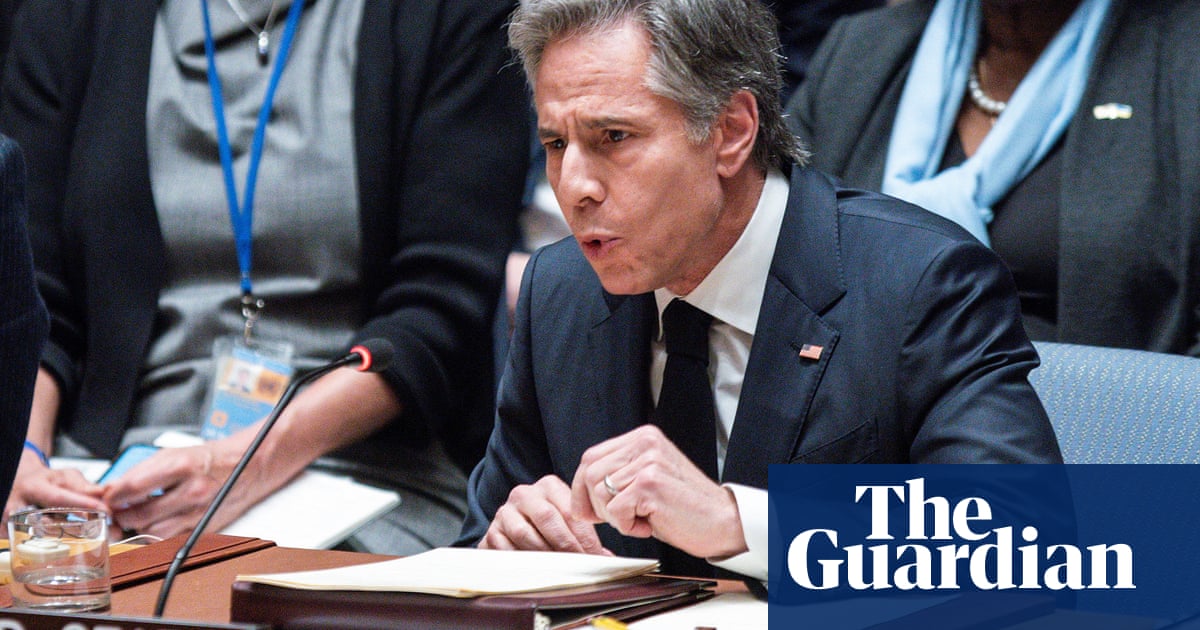
US secretary of state Antony Blinken was speaking at a highly charged meeting of the UN security council where he reminded his fellow diplomats that the Russian envoy only a year ago had dismissed his warnings that Moscow was about to launch an invasion of Ukraine.
Blinken was speaking the day after more than 40 countries at the General Assembly refused to join 141 other nations in backing a motion calling on Russia to withdraw from Ukraine unconditionally. A fierce diplomatic battle is under way to persuade many of these neutral states that abstaining or calling for peace at any price amounts to an endorsement of Russia’s invasion.
Faced by the new Chinese call for a ceasefire, Blinken warned that Russia will use any pause in fighting to consolidate control of territory and replenish its forces.
He urged: “Don’t fall for the false equivalency of calling both sides to stop fighting. No member of this council should call for peace while supporting Russia’s war on Ukraine and on the UN Charter. In this war there is an aggressor and there is a victim”. Blinken added: “This war is one for conquest. The fact remains one man started this war, Vladimir Putin, and one man can end it.”
The secretary of state said he heard “the concerns of countries that worry that standing with Ukraine diverts focus and resources for those in need in other countries”. But he said “look at our actions” pointing out “in addition to the $13.5bn in food aid the US had provided to fight food hunger, we also fund 40% of the UN world food programme budget, Russia contributes less than 1 % of that budget. That is not an outlier. The US donates nine times as much as Russia to UN peacekeeping, 390 times as much to Unicef and 1,000 times as much to the UN refugee agency.”
The Ukrainian foreign minister, Dmytro Kuleba, given permission to speak early in the debate despite the objections of Russia, accused Putin of using Russia’s permanent seat on the security council as “a throne of impunity”.
He attacked China’s claim that the west was throwing fuel on the fire by giving arms to Ukraine. He said: “Ukraine needs weapons, just as a firefighter needs water to extinguish a fire that is destroying your home, killing innocent people. The sooner and the more we get, the sooner the fire will be extinguished. Arming a country that defends itself from aggression is absolutely legitimate and is an act of defending the UN Charter”.
Kuleba also portrayed Russia as a disruptive force not just in Europe but globally. “The geography of Russian crimes against international peace and security goes far beyond the borders of Ukraine and reaches Africa, Asia and the Middle East. Russia not only incites conflicts, but also systematically obstructs UN security council decisions needed to resolve them.”
He argued: “Yesterday Russia argued that this council is overly focused on Ukraine and ignores problems of the rest of the world. Let us all remember the truth. Russia is the problem of the world.”
Such is the tension between Russia and Ukraine that when Kuleba called for a minute’s silence to remember the victims of aggression, Vasily Nebenzya, the Russian envoy, refused saying instead he would stand for all those killed since the conflict started in 2014.
António Guterres, the UN secretary general, also urged doubters to accept that the war was about universal principles. He said: “The purposes and principles embedded in the United Nations Charter are not a matter of convenience. There are many words on paper, they are at the core of who we are. And they reflect the driving mission of our United Nations. And they exist precisely to address any grievance, whatever it may be.”
Nebenzya denied any goal to destroy Ukraine, saying: “Russia just wants to restore a friendly neighbour that does not want to resurrect nazism or behave like a Russophobic wasp’s nest.”
Friday marks the one-year anniversary since Russia invaded Ukraine and half of American voters say the U.S. should back the embattled nation for as long as it takes, according to a new Fox News survey.
The survey, released Thursday, asks what the timeframe should be for U.S. support in Ukraine: 50% think it should continue until Ukraine wins, while 46% think it should be time limited.
Fox News Poll on whether support for Ukraine should be indefinite or on a deadline.(Fox News Poll)
Democrats (66%) favor sticking with Ukraine until it’s victorious, while Republicans (61%) opt for a time limit on U.S. support. Independents split: 49% set limit vs. 45% as long as it takes.
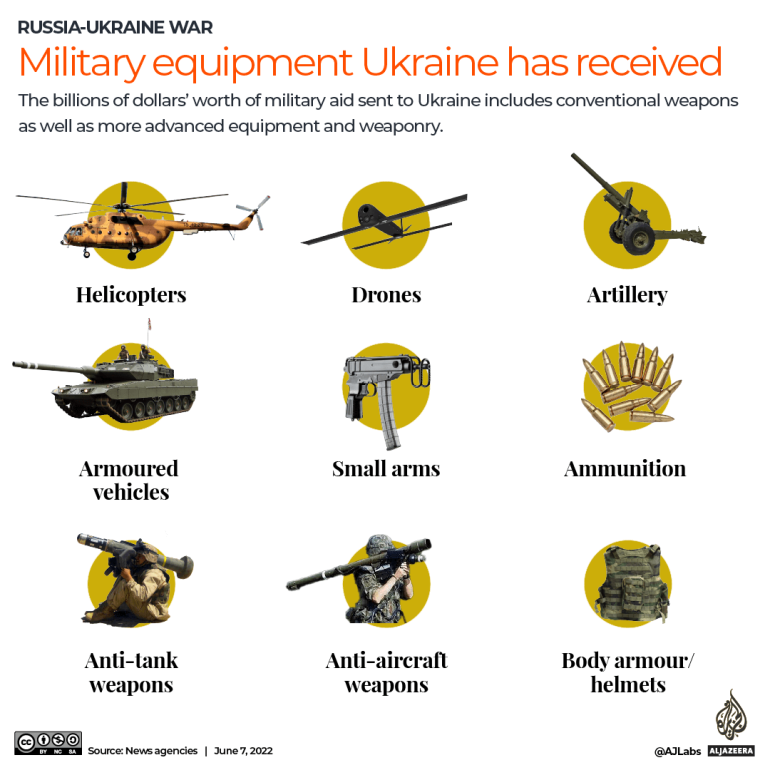
On Monday, in the middle of the survey’s interviewing period, President Biden made a surprise visit to Kyiv stating the U.S. would support Ukraine for "as long as it takes." Biden also announced an additional half-billion dollars in assistance which will include artillery ammunition, anti-armor systems, and air surveillance radars.
A January Fox News survey found that two-thirds favored the U.S. continuing to support Ukraine both by sending weapons supplies and providing funding. Majorities of Democrats, Republicans, and independents agreed on lending help in both ways.
Voters sharply divide over Biden’s response to Russia’s invasion: 48% approve vs. 49% disapprove. That’s the highest his approval has been since the war started, the previous high was 45% in January and the lowest was 40% in August.
Fox News Poll on Americans' opinions on President Biden's response to Russia's invasion of Ukraine.(Fox News Poll)
Since last August, Democrats (74% today vs. 68% in August), Republicans (24% vs. 19%), and independents (41% vs. 31%) have all increased their approval of Biden on Ukraine.
"Biden is approaching majority approval for his handling of the Ukraine situation," says Democratic pollster Chris Anderson, who conducts the Fox News survey with Republican Daron Shaw. "He may not get there, but even getting close to majority approval for anything in our current environment is noteworthy."
Voters view Ukrainian President Volodymyr Zelenskyy’s handling of the Russia situation much more positively than they do Biden’s, with 74% approving of the job he’s doing (21% disapprove). That’s held relatively steady since last year, when 76% approved shortly after the war started (March 2022).
Fox News Poll on American's opinion of Ukrainian President Volodymyr Zelenskyy's handling of the war.(Fox News Poll)
Majorities of Democrats (85%), Republicans (66%), and independents (64%) approve of Zelenskyy.
Conducted Feb. 19-22, 2023 under the joint direction of Beacon Research (D) and Shaw & Company Research (R), this Fox News Poll included interviews with 1,006 registered voters nationwide who were randomly selected from a voter file and spoke with live interviewers on both landlines and cellphones. The total sample has a margin of sampling error of plus or minus three percentage points.
Ukrainian officials say there have been further explosions in the Russian-occupied city of Mariupol, a supply hub and rear base for Moscow's forces.
Petro Andriushchenko, an adviser to the mayor of Mariupol, said there had been three explosions Thursday.
The official, who is not in Mariupol himself but maintains contacts there, said two strikes had hit the area of the Ilyich Iron and Steel Works. "The Armed Forces of Ukraine are surgically precisely hitting the bases of the occupiers," he said on Telegram.
"There is a third explosion, it was a hit near the airport. Again. We are finishing the job," he added.
The adviser also said Russian aircraft had been flying over the city at several points on Thursday. According to social media video and unofficial accounts, there have been several explosions around the city over the past two nights.
It's unclear what has caused the explosions and how many may be air defenses operating. Mariupol is beyond the range of Western-provided rockets systems and howitzers operated by the Ukrainian armed forces.
The city is about 80 kilometers (50 miles) from the nearest Ukrainian front line positions, which would be just beyond the range of M142 High Mobility Artillery Rocket Systems (HIMARS) and M270 Multiple Launch Rocket Systems (MLRS) provided to Ukraine.
Natalia Humeniuk, spokesperson for the Ukrainian military in the south, said only that "at this stage, we can only state that remoteness is a very relative concept. What is considered so remote that it is unreachable is not always so. The direction of Mariupol is no longer absolutely unreachable for us."
Ukrainian media have suggested that the military may have deployed a new locally-produced rocket system with greater range.
More on Russia's presence in Mariupol: There has been an extensive build up of Russian forces in and around Mariupol since November, according to Ukrainian officials and geolocated social media video.
In November, Andriushchenko posted a video and comment saying that "Russia continues to build up military personnel in Mariupol area. At least 30 trucks with manpower are moving through Mariupol daily." CNN cannot verify that number.
This week, Andriushchenko reported that the "movement of military equipment towards Manhush/Berdiansk has resumed. A column of at least 7 trucks with ammo was recorded moving through Mariupol towards Manhush."
Why Mariupol is important to Moscow: Analysts say the supply routes from Mariupol to the west and north are essential to the Russians to hold defensive lines in neighboring Zaporizhzhia region against any Ukrainian counteroffensive.
China has told the United Nations that one year into the Ukraine war, “brutal facts offer an ample proof that sending weapons will not bring peace” – a statement that comes just days after the United States and NATO warned Beijing against giving Russia military support.
“Adding fuel to the fire will only exacerbate tensions. Prolonging and expanding the conflict will only make ordinary people pay an even heftier price,” China’s UN Deputy Ambassador Dai Bing told the UN General Assembly on Thursday.
The comments came hours before the General Assembly adoped a resolution calling for a “comprehensive, just and lasting peace” and demanding Russia withdraw its troops and stop fighting.
The resolution was adopted with 141 votes in favour and 32 abstentions. Six countries joined Russia to vote no.
Western powers have provided Ukraine with billions of dollars in weapons since Russia launched its full-scale invasion on February 24, 2022. The United States and NATO have in the past week accused China of considering supplying arms to Russia and warned Beijing against such a move. China has dismissed the accusations.
Dai was speaking at the UN a day after China’s top diplomat Wang Yi visited Moscow and pledged a deeper partnership with Russia. China and Russia announced a “no limits” partnership shortly before Russia invaded Ukraine.
The European Union’s top foreign affairs official Josep Borrell met with Wang in Munich last week. He said he asked Wang about the possibility of Chinese military support for Russia.
“He was very clear and assertive,” Borrell told reporters at the UN on Thursday, noting that the pair have had a good personal relationship for many years.
“I can only repeat what he told me: China is not providing arms for Russia and it will not provide arms to Russia because it’s part of their foreign policy not to arm parties in a conflict,” he said. “We have to remain vigilant.”
China’s Ambassador Dai said, “We stand ready to continue playing a constructive role in resolving the Ukraine crisis, and bring about peace at an early date.”
Since Moscow invaded its neighbour, Russian President Vladimir Putin has repeatedly hinted that Russia could use a nuclear weapon if threatened.
“Nuclear weapons cannot be used, nuclear war cannot be fought,” Dai said. “All parties should join together against the use or threat of use of nuclear weapons, prevent nuclear proliferation and avoid a nuclear crisis.”
(Al Jazeera)
‘Not broken’
Meanwhile, Group of Seven ministers discussed new sanctions on Russia and the White House said it will announce “sweeping” new sanctions.
As Western leaders promised to step up their support for Kyiv on the eve of the one-year anniversary of the invasion, Ukrainian President Volodymyr Zelenskyy vowed to keep up the fight.
“We have not broken down, we have overcome many ordeals and we will prevail,” Zelenskyy said on social media. “We will hold to account all those who brought this evil, this war to our land.”
‘More weapons and quicker’
The prime ministers of Poland and Denmark said after meeting in Copenhagen that Western European countries should be faster and more generous in supplying Ukraine with weapons.
“I would like them to be exactly like Denmark and Poland. A longer version is to be more generous in terms of weapon delivery and more quick,” Polish Prime Minister Mateusz Morawiecki told reporters.
Poland, a key ally of Ukraine, has been instrumental in convincing European allies to donate heavy gear to Ukraine, including tanks, a move opposed by several countries until recently.
“Let’s be frank. If not for the United States, Poland and the United Kingdom, probably Ukraine would not have survived the first couple of weeks or the first couple of months,” Morawiecki said. “It’s just strengthening the NATO alliance. Some sceptical countries should no longer be sceptical.”
Speaking on the eve of the anniversary of the start of the war, Morawiecki and his Danish counterpart Mette Frederiksen stressed the urgency of delivering support to Kyiv as Europe could not allow Ukraine to be defeated.
“We need to be aware that we don’t have a lot of time. So we need to speed up our financial support, our military help, we need more donations and we need to work very closely together to make sure they have the capacities they need,” Frederiksen said.
Sweden is preparing to send Ukraine the advanced Archer artillery system, but support in the Swedish parliament has been growing to additionally contribute some of the country’s around 120 Leopard tanks.
“We are open to that and we are in close dialogue with above all Germany about it,” Swedish Minister of Defence Pal Jonson was quoted by TT as saying.
Spain to send tanks
Elsewhere in Europe, Spanish Prime Minister Pedro Sanchez said the government will consider supplying Ukraine with four more Leopard 2 A4 tanks in addition to the six ones already promised. The decision will be made “in the coming weeks,” he added.
The first group of Ukrainian troops is already being trained on the use of Leopard 2 tanks in Spain, Sanchez said during a joint press conference with Zelenskyy in Kyiv.
According to Sanchez, Spain aims to “synchronise the delivery of the Leopards with the finalisation of the training”.
“Ukraine has never posed any threat to Russia; we are helping a country that is defending its people that were attacked,” emphasised the prime minister. “We must understand that Putin violates all fundamental laws, violates the territorial integrity of Ukraine. Therefore, this struggle is absolutely legal, it must receive our joint assistance.”
It was Sanchez’s second visit to Ukraine since Moscow started its all-out war against the country.
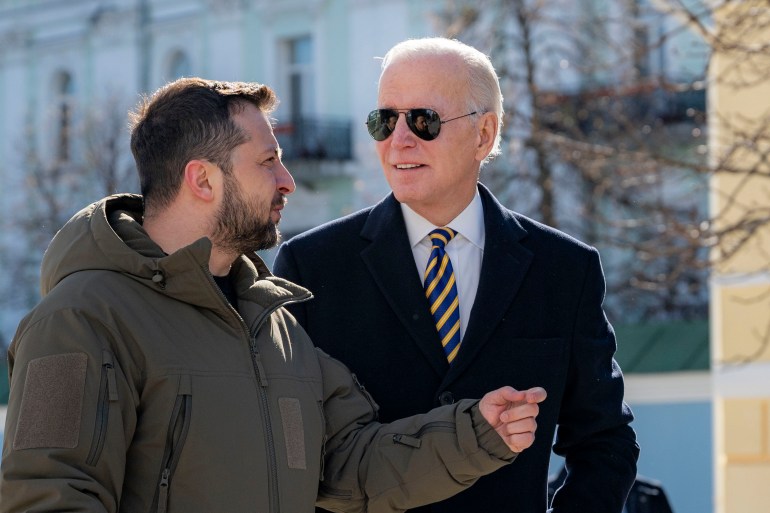
United States President Joe Biden, right, and Ukrainian President Volodymyr Zelenskyy talk during Biden’s recent unannounced visit in Kyiv, Ukraine [File: Ukrainian Presidential Press Office/AP]
Germany calls for coordination
Regarding the question of whether to arm Ukraine with warplanes, German Chancellor Olaf Scholz said this “currently makes no sense”.
His comments came in an interview with ZDF public television, in which he was asked to address growing calls for Western powers to supply arms.
Scholz, who earlier faced criticism for perceived foot-dragging over sending Ukraine tanks, said other countries’ difficulties in meeting Ukraine’s demands vindicated his decision to move in lockstep with them.
In January, Germany agreed to send, and allow other countries to send, heavy battle tanks to help Ukraine in a potential offensive against Russian troops in its east. Despite this, deliveries have been slow because of donors’ limited supplies.
“Maybe this is an indication of why it’s so important to coordinate with each other, with the US, for example, and to prepare these decisions carefully so they work,” Scholz said.
Ukraine is now asking for warplanes, though Germany does not have any of the F-16 fighters that have been mentioned in this context.
Speaking on the eve of the first anniversary of Russia’s invasion, Scholz said he feared that the conflict could become “a very long-lasting war”, but added that Germany and the west would support Ukraine for as long as needed.
Russian President Vladimir Putin would eventually have to understand that his war aims – which Scholz noted had several times been revised down since the start of the conflict – were unachievable.
Scholz, who will head to India on Saturday in a bid to rally support for Ukraine against Russia, said he was not deterred by signs that many large, emerging countries were reluctant to condemn Russia.
“There are only a few countries on Russia’s side,” he said.
The UN General Assembly has approved a non-binding resolution that calls for Russia to end hostilities in Ukraine and demands the withdrawal of its forces.
The move sends a strong message on the eve of the first anniversary of the invasion that Moscow's aggression must end.
The 141-7 vote with 32 abstentions was slightly below the highest vote for the five previous resolutions approved by the 193-member world body since Russia sent troops and tanks across the border into its smaller neighbour on February 24, 2022.
The General Assembly's resolutions may be non-binding but are a powerful barometer of international opinion.
The UN Security Council is the world body responsible for maintaining peace and security but is paralysed by Russia's veto because the country is a permanent member.
Foreign ministers and diplomats from more than 75 countries addressed the assembly during two days of debate, with many urging support for the resolution that upholds Ukraine’s territorial integrity.
That is a basic principle of the UN Charter that all countries must subscribe to when they join the world organisation.
In his appeal to the assembly, Polish Foreign Minister Zbigniew Rau said Ukrainians deserve “not only our compassion but also our support and solidarity.”
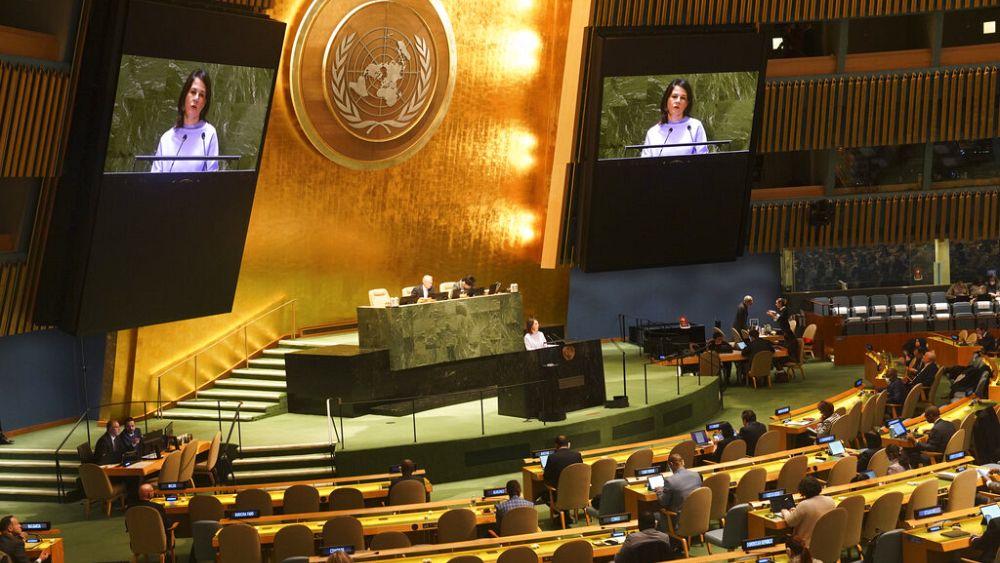
Germany’s Foreign Minister, Annalena Baerbock, asked countries that claim “that by arming Ukraine, we are pouring oil into the fire” why Western nations would do that.
"The West didn’t want or choose the war and would rather focus all its energy and money on fixing schools, fighting the climate crisis or strengthening social justice," she told the assembly. “But the truth is: If Russia stops fighting, this war ends. If Ukraine stops fighting, Ukraine ends.”
Opposition and abstention
Venezuela’s deputy ambassador addressed the council on behalf of 16 countries that either voted against or abstained on almost all five previous resolutions on Ukraine: Belarus, Bolivia, Cambodia, China, Cuba, Eritrea, Equatorial Guinea, Iran, Laos, Mali, Nicaragua, North Korea, St. Vincent, Syria, Venezuela and Zimbabwe.
While other countries focused on Russia’s actions, Deputy Ambassador Joaquín Pérez Ayestarán said Wednesday that all countries without exception "must stringently comply with the United Nations Charter."
He said the countries in his group were against what he called divisive action in the General Assembly, and for "a spirit of compromise."
China’s deputy UN ambassador Dai Bing told the assembly Thursday: “We support Russia and Ukraine in moving towards each other, resuming direct dialogue as soon as possible, bringing their legitimate concerns into the negotiation, setting out feasible options, and giving a chance to an early end of the crisis and the rebuilding of peace.”
“The international community should make joint efforts to facilitate peace talks.”
But European Union foreign policy chief Josep Borrell told reporters the aggressor and the victim can’t be put on equal terms, and Ukraine cannot be asked not to defend itself.


/cloudfront-us-east-2.images.arcpublishing.com/reuters/GDXT43MQZBN5JHQ2KPKXH4FMPY.jpg)