Rechercher dans ce blog

Saturday, April 29, 2023

Reported Ukraine drone strike ignites major fuel blaze on Crimea - Al Jazeera English

A drone strike caused a fire at a fuel storage facility in the Crimean port of Sevastopol, sending a vast column of black smoke into the sky before it was extinguished, the city’s Moscow-installed governor has said.

Experts examined the site and “it became clear that only one drone was able to reach the oil reservoir”, Mikhail Razvozhaev said on the Telegram messaging app on Saturday.

He said no one had been injured in the fire and another drone was downed, its wreckage found on the shore near the terminal.

A Ukrainian military intelligence official said more than 10 tanks of oil products with a capacity of about 40,000 tonnes intended for use by Russia’s Black Sea Fleet were destroyed, RBC Ukraine reported.

Andriy Yusov did not claim that Ukraine was responsible for the explosion in comments reported by RBC, instead describing the blast as “God’s punishment” for a Russian strike on a Ukrainian city on Friday.

“This punishment will be long-lasting. In the near future, it is better for all residents of temporarily occupied Crimea not to be near military facilities and facilities that provide for the aggressor’s army,” RBC quoted Yusov as saying.

Earlier a spokesperson for Ukraine’s armed forces said he did not have any information to suggest Ukraine was responsible for the fire.

Sevastopol has come under repeated air attacks since Russia launched its full-scale invasion of Ukraine in February 2022. Kyiv has repeatedly declared its intention to retake the Crimean Peninsula, which Russia illegally annexed in 2014 to an international outcry.

After previous attacks on Crimea, Ukraine has stopped short of openly claiming responsibility but emphasised it has the right to strike any target in response to Russian aggression.

Razvozhayev reported on Monday the Russian military destroyed a Ukrainian surface sea drone that attempted to attack the harbour and a second drone had exploded. The blasts shattered windows in several apartment buildings but did not inflict any other damage, he said.

The fire in Sevastopol comes a day after a barrage of Russian missiles hit residential areas in Ukraine killing 25 people and Ukrainian President Volodymyr Zelenskyy urged allies to provide his troops with better air defences, including fighter jets.

“Air defence, a modern air force – without which effective air defence is impossible – artillery, armoured vehicles. Everything that is necessary to provide security to our cities, to our villages, both in the hinterland and on the front lines,” Zelenskyy listed in a video message on Friday night.

He condemned the attack in the city of Uman in the early hours of Friday that he said killed at least 23 people, including four children.

Ten residential buildings were hit by missiles in Uman, in the Cherkasy region, officials said. One block of flats was destroyed. Eighteen people were injured in the attack, nine of whom were being treated in hospital.

In the Dnipropetrovsk region, a woman and her two-year-old daughter were also killed by night-time Russian shelling.

“Russian evil can be stopped by weapons – our defenders are doing it. And it can be stopped by sanctions – global sanctions must be enhanced,” Zelenskyy wrote on Twitter earlier in the day.

The commander-in-chief of the Ukrainian army, Valerii Zaluzhnyi, on Friday gave the total number of missiles fired at Ukraine during the night as 23. Of these, 21 were shot down, along with two drones. The Ukrainian military said cruise missiles were also fired near the capital, Kyiv, with air defences downing 11 of them.

Shelling in the Russian-controlled eastern Ukrainian city of Donetsk killed seven people and injured 19, local authorities reported on Friday.

Adblock test (Why?)


World - Latest - Google News
April 29, 2023 at 11:07PM
https://ift.tt/9kqZi1w

Reported Ukraine drone strike ignites major fuel blaze on Crimea - Al Jazeera English
World - Latest - Google News
https://ift.tt/lM14sGi

Why did Iran seize a US-bound oil tanker in the Gulf of Oman? - Al Jazeera English

Neither side has acknowledged whether Iran’s capture of the Turkish-operated fuel tanker was a tit-for-tat move.

Tehran, Iran – Iran and the United States have again found themselves on opposite sides as they provided contradictory accounts of events that led to Tehran’s seizure of an oil tanker in the Gulf of Oman.

Iran’s state television on Friday showed footage of the country’s navy commandos boarding the Marshall Islands-flagged tanker Advantage Sweet in a helicopter operation a day earlier.

The Turkish-operated, Chinese-owned tanker entered the Gulf of Oman after moving through the Strait of Hormuz and was reportedly bound for Houston, Texas carrying Kuwaiti crude oil for US energy firm Chevron Corp.

Iran said the tanker collided with an unidentified Iranian vessel hours before its seizure, leading to several crew members falling overboard and going missing and others getting injured. The tanker then fled the scene and ignored radio calls for eight hours before its seizure based on a court order, the Iranian army said.

“We repeatedly called on the vessel to stop so we can conduct a more comprehensive investigation, but there was no cooperation,” Mostafa Tajodini, deputy for operations at the Iranian navy, told state media.

The vessel’s manager, a Turkish firm called Advantage Tankers, said similar experiences have shown that crew members – all 24 of whom are Indian – are in no danger.

The Middle East-based US Navy 5th Fleet had said Iran’s actions constituted a violation of international law and called on Tehran to immediately release the tanker.

“Iran’s continued harassment of vessels and interference with navigational rights in regional waters are a threat to maritime security and the global economy,” it said, adding this was at least the fifth commercial vessel taken by Iran in the past two years.

Tit-for-tat move

On Friday, the Reuters news agency reported the seizure of the vessel came as a response to the confiscation of an oil tanker by the US in an effort to enforce its unilateral sanctions on Tehran.

The report said the Iran-linked tanker was the Marshall Islands-flagged Suez Rajan that had a Greece-based manager and was last reported to be positioned near Southern Africa before being seized several days prior to the taking of the Advantage Sweet vessel by Iran.

There are precedents for such tit-for-tat moves, with the US trying to confiscate a cargo of Iranian oil near Greece last year, prompting Tehran to seize two Greek tankers and hold them for months. The supreme court in Greece ultimately ordered the cargo returned to Iran, and the Greek vessels were also released.

Washington imposed its harshest-ever sanctions on Iran, which include a major focus on impeding Tehran’s oil sales, after former President Donald Trump unilaterally withdrew from a 2015 nuclear deal with world powers in 2018.

Amid deadlocked efforts to restore the nuclear accord, which put curbs on Iran’s nuclear programme in exchange for the lifting of sanctions, Iran has been circumventing the embargoes and steadily boosting its oil sales.

Twelve US senators on Thursday urged President Joe Biden to remove Treasury Department policy hurdles that have impeded the seizure of more Iranian oil shipments in a call that is likely to increase tensions.

Adblock test (Why?)


World - Latest - Google News
April 29, 2023 at 04:27PM
https://ift.tt/Ozni7AH

Why did Iran seize a US-bound oil tanker in the Gulf of Oman? - Al Jazeera English
World - Latest - Google News
https://ift.tt/lM14sGi
Sudan fighting: No talks until bombing stops, Hemedti tells BBC - BBC

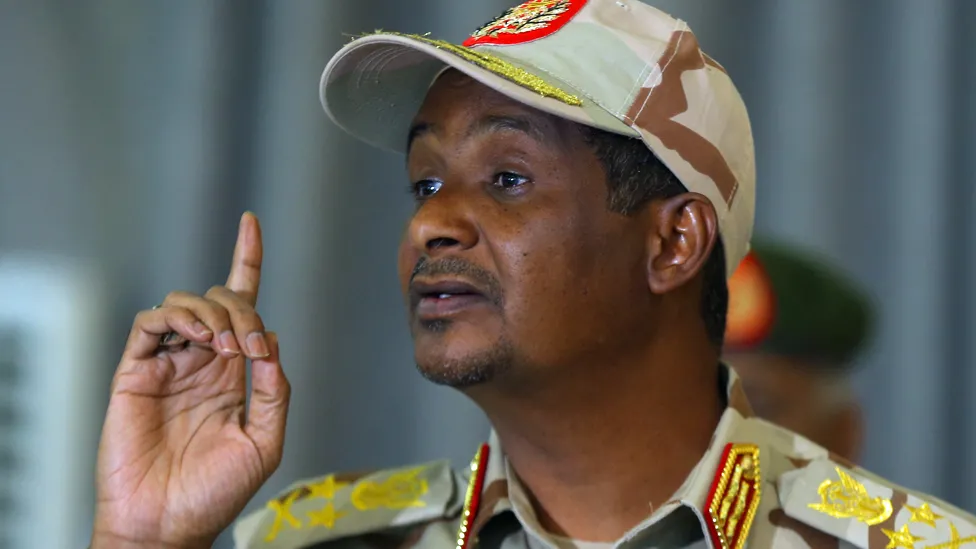
Mohamed Hamdan Dagalo pictured in August 2022Getty Images

One of Sudan's duelling generals, who leads the paramilitary force fighting the country's army, has told the BBC he will not negotiate until fighting ends.

But Gen Mohamed Hamdan Dagalo, better known as Hemedti, said his fighters were being "relentlessly" bombed since a three-day truce had been extended.

"We don't want to destroy Sudan," he said, blaming army chief Gen Abdel Fattah al-Burhan for the violence.

Gen Burhan has tentatively agreed to face-to-face talks in South Sudan.

Thursday night's extension of an uneasy ceasefire followed intensive diplomatic efforts by neighbouring countries, as well as the US, UK and UN.

As of Saturday air, tank and artillery strikes are continuing in parts of Khartoum, making the prospect of any wider dialogue between the two rival military factions seem remote.

Speaking to the BBC by phone, Hemedti said he was open to talks but the condition was that the ceasefire should hold: "Cease hostilities. After that we can have negotiations."

He said he had no personal problem with Gen Burhan, but regarded him as a traitor for bringing into government those loyal to former President Omar al-Bashir, who was ousted by the army and RSF together in 2019 after mass street protests.

Bashir's regime - in power for three decades - was known for its Islamist ideology and imposition of a strict version of Sharia (Islamic law).

"Unfortunately Burhan is being led by the radical Islamic front leaders," Hemedti said.

In 2021, he and Gen Burhan overturned an agreement to share power with civilians, taking full control in a coup.

They fell out this year over the proposed return to civilian rule, in particular about the timeframe of incorporating Hemedti's 100,000-strong Rapid Support Force's (RSF) into the army.

"I am looking forward to having the civilian government today - before tomorrow, a fully civilian government. This is my principle," Hemedti told the BBC.

This is not the first time the RSF leader has spoken of his commitment to democracy, although analysts point out that his forces have brutally put down civilian protests in the past.

Hemedti told the BBC that his RSF fighters were not the enemies of the military soldiers, explaining they were battling to protect the country from "the relics of the government of the past 30 years".

"We won't fight you. Please go back to your army divisions and we won't fight you."

Fears grow as violence spreads

Hemedti's comments to the BBC come as millions remain trapped in the capital Khartoum, where there are shortages of food, water and fuel.

In some parts of the city, trenches have been dug as rival troops battle each other street by street, AFP reports.

people gather to leave khartoum, 28/04
Reuters

The UN says RSF troops are forcing people from their homes and looting and extortion is taking place.

However, Hemedti told the BBC his rivals were dressing up in RSF uniforms in order to discredit his fighters.

He categorically denied involvement in looting and taking over hospitals, saying his troops were trying to help residents of a city reeling from fierce clashes that began 14 days ago.

"My team is working on the water and electricity supplies for the areas we control. Unfortunately all the technicians and engineers have disappeared. And this is our main problem," he said.

At least 512 people have been killed and 4,193 wounded in the fighting, according to health ministry figures, although the real death toll is likely much higher.

The UN says hundreds of thousands of Sudanese have now fled their homes, often paying huge sums to leave and facing abuses en route.

As well as the thousands of foreigners who have been evacuated, tens of thousands of Sudanese have crossed into neighbouring countries, including Chad, Egypt and South Sudan.

Reuters reports a UN official as saying some have walked from Khartoum to South Sudan's border, a distance of more than 400km (250 miles).

Earlier a Turkish evacuation plane was shot at as it was landing at an airport outside Khartoum. No-one was injured and the RSF denied accusations by the army that it was involved.

Those remaining in Khartoum describe living in a "constant state of fear".

"We hear the sounds of planes and explosions. We don't know when this hell will end," 65-year-old Mahasin al-Awad, a resident of Bahri, a northern area of Khartoum, told Reuters.

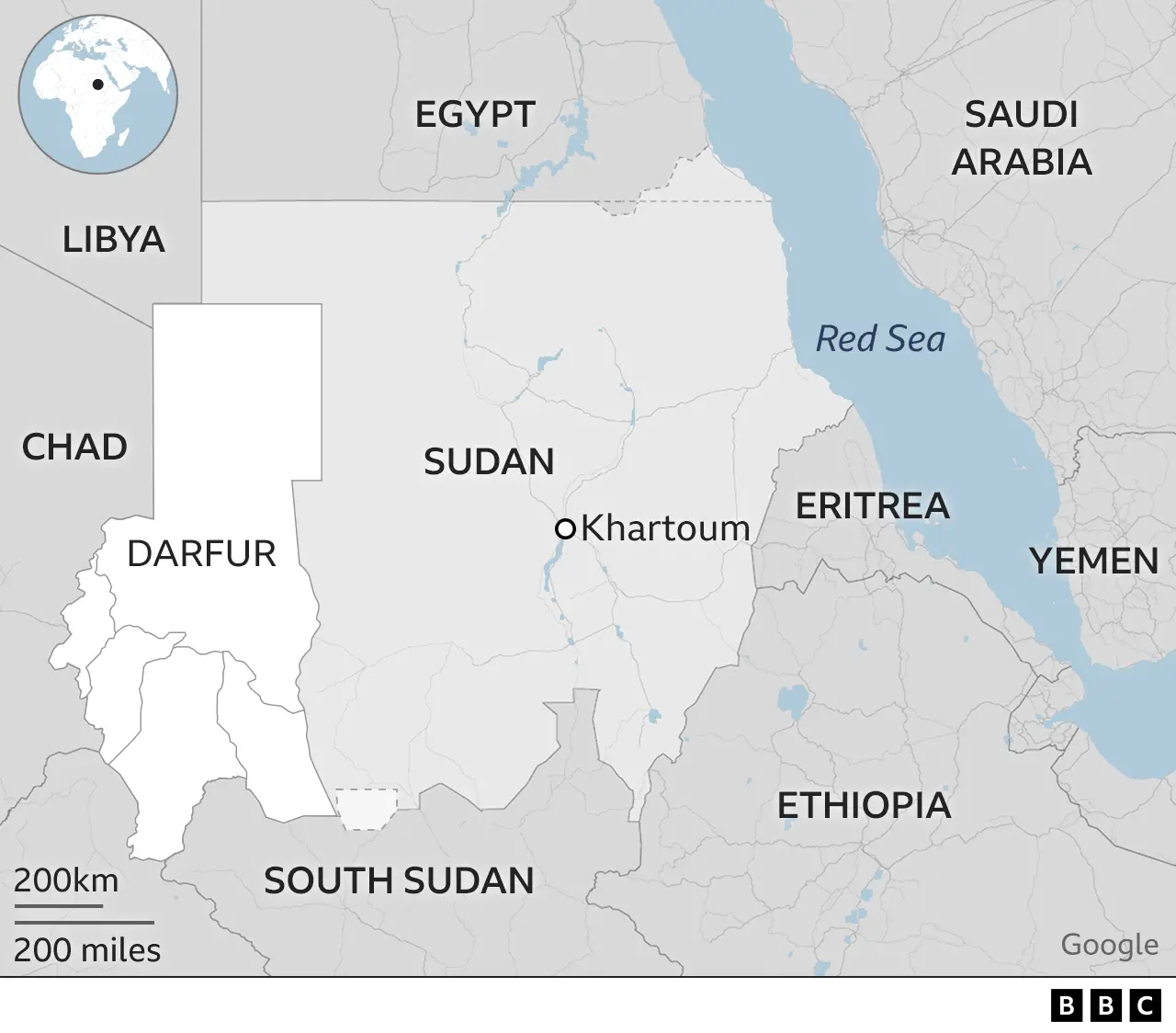
Violence is reported to have been particularly bad in El Geneina, a city in Darfur in western Sudan, where the RSF and militias linked to the group are reported to have looted and torched markets, aid warehouses and banks.

Map showing Darfur in Sudan and the surrounding countries

Related Topics

Around the BBC

Adblock test (Why?)


World - Latest - Google News
April 29, 2023 at 03:00PM
https://ift.tt/2jDtUIy

Sudan fighting: No talks until bombing stops, Hemedti tells BBC - BBC
World - Latest - Google News
https://ift.tt/lM14sGi

Friday, April 28, 2023

Russian cruise missile strikes kill at least 25 civilians in Ukraine - Euronews

Russian cruise missiles killed 25 civilians including four children in Ukraine. Twenty-three of the victims lived in a tower block in Uman, which was hit by two missiles.

 Russia fired more than 20 cruise missiles and two drones at Ukraine early Friday, killing at least 25 people, almost all of them when two missiles slammed into an apartment building in a terrifying night time attack, officials said. Three children were among the dead.

The missile attacks included the first one against Kyiv, Ukraine's capital, in nearly two months, although there were no reports of any targets hit. The city government said Ukraine's air force intercepted 11 cruise missiles and two unmanned aerial vehicles over Kyiv.

The strikes on the nine-story residential building in central Ukraine occurred in Uman, a city located around 215 kilometres (134 miles) south of Kyiv. Twenty-three people died in that attack, according to Ukraine's National Police. They included two 10-year-old children and a toddler.

Another of the victims was a 75-year-old woman who lived in a neighbouring building and suffered internal bleeding from the huge blast's shock wave, according to emergency personnel at the scene.

The Ukrainian national police said 17 people were wounded and three children were rescued from the rubble. Nine were hospitalised.

The bombardment was nowhere near the war's sprawling front lines or active combat zones in eastern Ukraine, where a grinding war of attrition has taken hold. Moscow has frequently launched long-range missile attacks during the 14-month war, often indiscriminately hitting civilian areas.

Ukrainian officials and analysts have alleged such strikes are part of a deliberate intimidation strategy by the Kremlin.

The Russian Defence Ministry said the long-range cruise missiles launched overnight were aimed at places where Ukrainian military reserve units were staying before their deployment to the battlefield.

"The strike has achieved its goal. All the designated facilities have been hit," Lt. Gen. Igor Konashenkov, the Defence Ministry's spokesperson, said. He didn't mention any specific areas or residential buildings getting hit.

Survivors of the Uman strikes recounted terrifying moments as the missiles hit when it still was dark outside.

Halyna, a building resident, said she and her husband were covered in glass by the blast. They saw flames outside their window and scrambled out, but first Halyna checked whether her friend in a neighbouring apartment was OK.

"I was calling, calling her (on the phone), but she didn't pick up. I even rang the doorbell, but still no answer," she told The Associated Press. She used the spare keys from her friend's apartment and went inside to check on her. She found her lying dead on her apartment floor.

Halyna refused to provide her last name out of security concerns.

Another building resident, Olha Turina, told the AP that glass from the explosion flew everywhere.

Turina, whose husband is fighting on the front lines, said one of her child's classmates was missing.

"I don't know where they are, I don't know if they are alive," she said. "I don't know why we have to go through all this. We never bothered anyone."

Three body bags lay next to the building as smoke continued to billow hours after the attack. Soldiers, civilians and emergency crews searched through the rubble outside for more victims, while residents dragged belongings out of the damaged building.

One woman, crying in shock, was taken away by rescue crews for help.

Yulia Norovkova, spokeswoman for emergency rescue crews on the scene, said local volunteers were helping nearly 150 emergency personnel. Two aid stations, including psychologists, were operating, she said.

Mother and daughter killed in Dnipro

A 31-year-old woman and her two-year-old daughter were also killed in the eastern city of Dnipro in another attack, regional Governor Serhii Lysak said. Four people were wounded, and a private home and business were damaged.

The attacks came days after President Volodymyr Zelenskyy said that he and Chinese leader Xi Jinping held a "long and meaningful" phone call where Xi said his government will send a peace envoy to Ukraine and other nations.

Ukrainian Foreign Minister Dmytro Kuleba said Friday's bombardment showed the Kremlin isn't interested in a peace deal.

Adblock test (Why?)


World - Latest - Google News
April 29, 2023 at 02:35AM
https://ift.tt/ijs5CGk

Russian cruise missile strikes kill at least 25 civilians in Ukraine - Euronews
World - Latest - Google News
https://ift.tt/lM14sGi
Thursday, April 27, 2023

Iran's Navy seizes Marshall Islands-flagged ship - CNN

CNN  — 

Iran’s Navy has seized an “offending Marshall Islands-flagged” ship in the Gulf of Oman, after it allegedly collided with an Iranian boat and attempted to flee the scene, according to Iranian state news agency IRNA.

“The seizure came after an unknown ship collided with an Iranian vessel last night on Wednesday in the Persian Gulf, causing several Iranian crew members to go missing and get injured,” Iran’s military said on Thursday.

It added that “the Iranian naval forces later intercepted the fleeing ship in the Gulf of Oman and directed it toward Iran’s coastal waters.”

The United States Navy confirmed in a statement earlier Thursday that Iran’s Navy had seized Marshall Islands-flagged oil tanker Advantage Sweet in international waters in the Gulf of Oman.

“US 5th Fleet is monitoring the situation,” it said.

Adblock test (Why?)


World - Latest - Google News
April 28, 2023 at 01:27AM
https://ift.tt/FfRmCbW

Iran's Navy seizes Marshall Islands-flagged ship - CNN
World - Latest - Google News
https://ift.tt/Y6Sh5qu

Russia-Ukraine War News: Pope Francis Discusses Peace Efforts - The New York Times

Evidence is piling up about the steady disintegration of Russia’s vital natural gas export industry since the country’s invasion of Ukraine.

Russian news reports estimate that Russia’s gas exports by pipeline could fall as much as 50 percent in volume this year from last year. And last year was an especially bad year.

The problems are not limited to gas delivered by pipeline. The European Union is threatening to curtail imports of liquefied natural gas from Russia, which were the solitary bright spot for the Russian industry last year.

Russia has to a great extent cut itself off from Europe — its most important customer for natural gas, one that paid on time and full prices. By launching hostilities and then slashing and manipulating supplies, Russia threw away decades of work establishing itself as the largest gas supplier to energy-hungry Europe, ceding that position to Norway.

On Thursday, Izvestia, a Kremlin-linked publication, reported that pipeline exports might fall 50 percent in 2023, citing a government forecast. That figure roughly correlates with some Western estimates.

Russia has fared surprisingly well at holding onto its share in the oil markets despite Western embargoes, although the need to sell at a discount has cut deeply into revenue.

But finding new customers for gas is much more difficult because most of the fuel is still transported through fixed pipelines. Russia has less capacity to export liquefied natural gas, a fuel that can be transported on ships like oil, than the United States, Qatar and Australia.

Russia’s losses have provided an easy victory for the petroleum industry in the United States, which has greatly increased shipments of liquefied natural gas to terminals across Europe.

Russian gas exports to the European Union by pipeline are likely to fall around two-thirds this year over 2022, according to estimates from Viktor Katona, an analyst at Kpler, a research firm. And exports in 2022, the first year of the invasion, fell more than 50 percent over the previous year.

Russia is likely to see some gain in gas sales to China and, potentially, to Turkey — now Moscow’s largest customers for gas. Russia exports gas to China using a pipeline called Power of Siberia, and it is angling to build another link. But at this point, China is just a fraction of the market that Europe used to be for Russian gas.

Europe’s strategy for reducing dependence on Russian gas and other energy sources has worked surprisingly well. Europe made up the losses largely through increases in imports of liquefied natural gas, largely from the United States, and by slashing demand. The European Union recently reported that gas consumption fell nearly 18 percent from August 2022 through March, compared with the average over those months from 2017 to 2022.

Europe has now survived what once threatened to be a difficult winter with little disruption, and that has soothed markets. European gas prices, which spiked in the early months of the war, have now fallen almost 90 percent from their peak last August. Those price declines will translate into lower revenue on the gas Moscow does manage to sell.

Russian oil revenue is also under pressure, dropping 29 percent in the first quarter of 2023 compared to the last three months of 2022, to about $39 billion, as sanctions and price caps began to bite, according to a study published Wednesday by the Kyiv School of Economics.

With this success behind them, European leaders are now contemplating widening their attack to include imports of liquefied natural gas from Russia.

Moscow last year substantially increased liquefied natural gas shipments to Europe, largely from an Arctic facility, while it slashed pipeline exports. Russian L.N.G. shipments to Europe reached record levels in February, according to Rystad Energy, a consulting firm.

But Kadri Simson, the E.U. energy commissioner, has urged members of the bloc and European energy companies to stop buying Russian L.N.G. and “not to sign any new contracts with Russia,” she told lawmakers last month.

Some analysts are skeptical that the European Union would prohibit Russian L.N.G. purchases, not least because big buyers of gas from the facility called Yamal LNG are TotalEnergies, one of France’s most important companies, and Naturgy, a major Spanish energy company,

“We think it would become a real headache for the E.U. to do that,” said James Waddell, head of European gas and global L.N.G. at Energy Aspects, a research firm.

On the other hand, having largely gone cold turkey on Russian pipeline gas, European leaders may calculate that “going without Russian L.N.G. would be less damaging,” figures Massimo Di Odoardo, vice president for gas at Wood Mackenzie, a consulting firm.

Adblock test (Why?)


World - Latest - Google News
April 28, 2023 at 01:17AM
https://ift.tt/ZCq3rN6

Russia-Ukraine War News: Pope Francis Discusses Peace Efforts - The New York Times
World - Latest - Google News
https://ift.tt/Y6Sh5qu

Wednesday, April 26, 2023

Pope Gives Women a Vote in Influential Meeting of Bishops - The New York Times

The move is an important step by Francis as he strives for greater inclusiveness.

ROME — When Francis became pope a decade ago, his inclusive tone and openness to change fueled expectations among many Catholic women about a greater role for them in the Roman Catholic Church.

The contribution of women should not be limited “to altar girls or the president of a charity,” he said in a 2013 news conference aboard the papal plane. “There must be more.”

Francis remains adamant in his opposition to ordaining women as priests and cautious about making women deacons. But on Wednesday he took what may be his most important step to give women a greater voice in the church. He approved changes that will for the first time allow women and lay people to vote at a major meeting of bishops that the pope has repeatedly made clear will be a central deliberative body to help him determine the future of the church.

That meeting, set to begin next October, will focus on better engaging the faithful as the church moves forward and is expected to take on major issues such as the role of women in the church and L.G.B.T.Q. relationships. It will now include an additional 70 non-bishop voting members, half of whom the pope wants to be women.

“It’s an important change,” said Cardinal Jean-Claude Hollerich, a top organizer of the meeting of bishops, called a synod. “It’s not a revolution.”

The rules change, while seemingly procedural, amounts to a concrete shift toward the democratization of the church, a central tenet of the Francis papacy that views the abuse of power in an aloof hierarchy as the cause of many of the church’s problems. Conservatives have for a decade now warned that Francis’ efforts to open up the church would dilute its traditions and expose it to secular ideology.

Pope Francis being greeted on Wednesday during the general audience in Saint Peter’s Square in Rome.Riccardo Antimiani/EPA, via Shutterstock

Conservatives saw the rules presented Wednesday as further evidence of that erosion. But those who support expanded roles for women said Francis had finally delivered real change after years of being urged.

“It’s an incredible development in the church’s history and something that we’re celebrating as a significant crack in the stained-glass ceiling,” said Kate McElwee, executive director of the Women’s Ordination Conference, who said it was very encouraging to see a “growing trend toward gender parity in the synod hall.”

The change, however, does not mean that Francis himself has had a conversion on the more fundamental issues that remain important to women’s advocates in the church.

He has spoken in sometimes folksy terms about women’s contributions — once calling a group of female theologians the “strawberry on the cake” — in ways that some have found diminishing or demeaning.

But he has also evolved, steadily giving women more of a voice inside both local parishes and the Vatican bureaucracy that governs the church.

In 2022, he added women to the committee that advises him on picking the world’s bishops. In 2021, Francis amended the church’s laws so that women could be Bible readers at Mass, serve at the altar and distribute communion — practices already common in many countries.

But for years, some lay Catholics have wanted more — especially for more women to be included in its synodal meetings, which are vital under Francis, who believes in a collegial process before making big changes.

Some church analysts see the upcoming bishops’ meeting from Oct. 4 to 29, known as the “Synod on Synodality,” as a major event, comparable to a mini version of the Second Vatican Council, dear to Francis, that modernized the church in the 1960s.

For two years the church has surveyed lay members around the globe about changes they would like to see in the church to better fit their needs. The pope’s liberal supporters are hoping that he will use the meetings and the votes of all participants on major issues to inform decisions to bring about real change on issues ranging from allowing some married men in remote areas to become priests, to permitting divorced and remarried Catholics to receive communion.

But the composition of the voting body has long been a source of conflict.

In 2018, a petition that called for the inclusion of nuns as voting members in a synod on youth in the church gained nearly 10,000 signatures. Some liberal Catholic activists staged protests at the Vatican demanding that the female participants at that meeting be given the right to vote “as equals alongside their brothers in Christ.”

In the 2019 special synod for countries in the Amazon region, which broached the issue of allowing married men to become priests, women took part as observers, but could not vote.

The new norms presented by the Vatican Wednesday also stipulated that 10 male representatives of various Catholic religious orders voting in the synod would be replaced by five male clerics and five nuns with voting rights. One of the synod’s two undersecretaries, Nathalie Becquart, a nun, can now also vote.

One of the synod’s two undersecretaries, Nathalie Becquart, a nun, can now also vote.Alberto Pizzoli/Agence France-Presse — Getty Images

“All those who participate in the synod will vote,” Francis told the Argentine newspaper La Nacion in an interview last month. “Whether male or female. Everyone, everyone. That word everyone for me is key.”

The pope can also add other participants, according to the new rules.

Key to the changes approved by Francis is an expansion of the participants to include lay people as voting members, reflecting Francis’ vision for a greater role for the rank-and-file faithful in their churches, rather than leaving all decision-making in the hands of the hierarchy of priests, bishops and cardinals.

“In the synod, lay men and women will also have the right to vote” read a headline on Vatican News, the church’s official outlet.

“It’s church changing. It is paradigm changing, it is literally restructuring one of the most important ways that the church makes decisions and looks at pastoral issues within the church,” said Deborah Rose, co-director of Future Church, an organization seeking greater involvement of laypeople.

“There will be times we are disappointed because he won’t follow through as he has decreed,” she added. “Nonetheless, what he has done is open a dam and opened a door, and I think there’s no going back.”

Conservative critics of Francis, some of whom disdain the synod on synodality as a bureaucratic circus that undercuts the majesty of the church, excoriated the new rules as a Trojan Horse for a liberal ideological invasion of the church.

“It is clear that Pope Francis” and the cardinals leading the synod “are trying, in every way, to bring into this institution all those people who have an interest in disrupting the church for their own personal ambitions,” read a post on the conservative Catholic site Silere non possum. “No longer finding many bishops willing to trample on Christ’s teaching, they are now turning to ambitious lay people.”

But even the generally liberal Cardinals who spoke about the new rules on Wednesday insisted that the overwhelming influence of the synod remained in the hands of the bishops known as “synodal fathers.”

“The 70 new members are 21 percent of the assembly, which remains an assembly of bishops,” Cardinal Hollerich, archbishop of Luxembourg, told reporters, declining to speak for the women when asked how they would refer to themselves.

Cardinal Mario Grech, another top synod official, doubled down.

“The Synod will remain a Synod of Bishops,” he said, though one enriched by the participation of lay members.

But Ms. McElwee, who still hopes women will one day be ordained as priests, believed the “inclusion of women in this sort of significant way will change the church, will create new conversations and new ways of making decisions within the church.”

Adblock test (Why?)


World - Latest - Google News
April 27, 2023 at 02:02AM
https://ift.tt/ApK0dSk

Pope Gives Women a Vote in Influential Meeting of Bishops - The New York Times
World - Latest - Google News
https://ift.tt/nCp3ute

Featured Post

Qatar 'appalled' by reported criticism from Israel's Netanyahu - BBC.com

By David Gritten BBC News Reuters Qatar's foreign ministry said the Israeli prime minister's reported remarks were ...

Popular Posts