LONDON, Sept 15 (Reuters) - British Prime Minister Rishi Sunak said on Friday American XL bully dogs would be banned by the end of the year after a man was killed in another suspected attack on Thursday.
The announcement came less than a week after one of the stocky, muscular dogs was involved in an attack on an 11-year-old girl who was walking to the shops with her sister in the English city of Birmingham.
Announcing the plan, Sunak said he "shares the nation's horror" regarding a series of serious dog attacks.
"It's clear this is not about a handful of badly trained dogs, it's a pattern of behaviour and it cannot go on," Sunak said in a video message.
He said a man was killed on Thursday in central England in an attack involving a suspected XL bully dog. Police said a man had been arrested on suspicion of manslaughter.
According to campaign group Bully Watch, which advocates for a ban on selling and breeding large XL bully dogs, the breed was responsible for more than half of all fatal dog attacks in Britain last year.
XL bully dogs were originally bred from American pit bull terriers and American Staffordshire terriers and first appeared in the UK "around 2014 or 2015", with the numbers growing rapidly in recent years, the campaign group said.
Sunak has asked the police and experts to define XL bully dogs, a first step he said before he hopes they can be banned by the end of the year.
A number of British animal welfare charities, including the RSPCA, said this week that banning specific dog breeds is not the solution.
In a joint statement, they instead blamed "irresponsible breeding, rearing and ownership" and said the government should instead focus on "dog control regulations, and on promoting responsible dog ownership and training".
Reporting by Andrew MacAskill; editing by Michael Holden and Andrew Heavens
Track outages and protect against spam, fraud, and abuse
Measure audience engagement and site statistics to understand how our services are used and enhance the quality of those services
If you choose to “Accept all,” we will also use cookies and data to
Develop and improve new services
Deliver and measure the effectiveness of ads
Show personalized content, depending on your settings
Show personalized ads, depending on your settings
If you choose to “Reject all,” we will not use cookies for these additional purposes.
Non-personalized content is influenced by things like the content you’re currently viewing, activity in your active Search session, and your location. Non-personalized ads are influenced by the content you’re currently viewing and your general location. Personalized content and ads can also include more relevant results, recommendations, and tailored ads based on past activity from this browser, like previous Google searches. We also use cookies and data to tailor the experience to be age-appropriate, if relevant.
Select “More options” to see additional information, including details about managing your privacy settings. You can also visit g.co/privacytools at any time.
Track outages and protect against spam, fraud, and abuse
Measure audience engagement and site statistics to understand how our services are used and enhance the quality of those services
If you choose to “Accept all,” we will also use cookies and data to
Develop and improve new services
Deliver and measure the effectiveness of ads
Show personalized content, depending on your settings
Show personalized ads, depending on your settings
If you choose to “Reject all,” we will not use cookies for these additional purposes.
Non-personalized content is influenced by things like the content you’re currently viewing, activity in your active Search session, and your location. Non-personalized ads are influenced by the content you’re currently viewing and your general location. Personalized content and ads can also include more relevant results, recommendations, and tailored ads based on past activity from this browser, like previous Google searches. We also use cookies and data to tailor the experience to be age-appropriate, if relevant.
Select “More options” to see additional information, including details about managing your privacy settings. You can also visit g.co/privacytools at any time.
Visitors have poured back into Venice, with outsiders often vastly outnumbering the 50,000 residents of the city center, overwhelming the narrow alleys and putting the daily charge back on the mayor's agenda. (Reuters)
The tourist hotspot of Venice risks joining UNESCO’s "endangered" list as mass tourism continues to overwhelm the ancient Italian city.
"We are trying to avoid this,’’ Michele Zuin, Venice’s top budget official, told The Associated Press. "But it is not as if we are slaves of UNESCO."
UNESCO issued a warning over the summer that Venice has not done enough to protect the cultural sites as post-lockdown tourism soars across Europe. Social media termed the phenomenon "revenge travel," i.e., people making up for the lack of freedom they endured during both local and national restrictions during the height of the pandemic.
Tourism has therefore soared, reaching, or even at times exceeding, pre-pandemic levels. The first half of 2022 saw an almost 250% increase in passenger volumes from 2021 when travel restrictions first eased, and 2023 has shown no slowdown, Euronews reported.
Tourists crowd the area near the Rialto Bridge in Venice on Aug. 2, 2023. UNESCO officials have deemed Italy not effective in protecting Venice from mass tourism and extreme weather conditions.(Stefano Mazzola/Getty Images)
Venice had already struggled with its significant tourism before the post-lockdown surge: Around 50,000 people live in the historic city center, with the city receiving millions of tourists every year, especially during the Carnival in February.
Visitors and tourists walk by shopping stalls selling carnival masks during the Venice carnival on Feb. 11, 2023.(Miguel Medina/AFP via Getty Images)
The city joined the World Heritage list in 1987, but failure to maintain the quality of the historical sites could see it moved to the "endangered" list and eventually lose its World Heritage status. UNESCO previously threatened to downgrade Venice in 2021, but the city banned cruise ships from traveling through it, which appeared to appease the World Heritage Committee, AFAR reported.
Tourists enjoy a gondola ride in Venice on June 12, 2021. International tourists started to travel again after the COVID-19 pandemic, as more people are now inoculated against the virus.(Luca Zanon/Awakening/Getty Images)
UNESCO officials have emphasized that a downgrade is not meant to be punitive but to alert the world community that more needs to be done to address issues plaguing a World Heritage site.
A group of visitors waits for the arrival of a gondola in Venice, one of the most famous tourist destinations in the world.(Christoph Sator/picture alliance via Getty Images)
Official city data now indicates that the number of tourist beds in the city outnumbers the number of residents.
Visitors crowd the "Calle de la Madoneta," one of the narrow streets in Venice. (Christoph Sator/picture alliance via Getty Images)
The city will try to battle the surge by enforcing a 5 euro ($5.40) entrance fee for all "day-trippers" on 30 high-traffic days yet to be determined, and it will go into effect in spring 2024, The Telegraph reported.
Some critics worry the move will lead to a "Disneyfication" of the city, creating the sense of a "cultural theme park," as the fee is not enough to deter most people, but failure to present proof of entry when questioned could result in heavy fees.
The recommendation to downgrade Venice cites not only management of mass tourism but also the impact of climate change. It notes, for example, that the underwater barriers to protect Venice are not yet fully operational.
UNESCO will also consider listing five other sites as "endangered," including the Saint Sophia Cathedral in Ukraine’s capital, Kyiv; the historic center of Lviv, in western Ukraine; the ancient city of Nessebar in Bulgaria; the Diyarbakir Fortress in Turkey; and the Kamchatka Volcanoes in Russia’s Far East.
The Associated Press contributed to this report.
Peter Aitken is a Fox News Digital reporter with a focus on national and global news.
MANAGUA, Nicaragua — From the Honduras side of the border, I can see a small brick building. It's down a hill, nestled in between the mountains, and that's where Nicaragua begins.
And as soon as I walk down that hill, it feels like I've stepped back in time. A big billboard that once beckoned tourists — "Nicaragua, unique, original!" — has lost its colors to the sun. Inside, instead of blue-and-white Nicaraguan flags, there are dozens of little red-and-black flags, the colors of the Sandinista party, which has dominated this country under President Daniel Ortega on and off for nearly three decades.
The border agents are all huddled behind a glass. They look like impatient bank tellers. I look at the Nicaraguan passport in my hand and know there is no turning back.
I was born in Nicaragua, but I'm a U.S. citizen. I'm also a journalist, and for the past few years, the Nicaraguan government has made it nearly impossible for foreign journalists to enter the country. I was hoping with a Nicaraguan passport, the authorities wouldn't pay me much mind. This particular border post isn't very trafficked — just a few big trucks ferrying bread from Honduras, and families who move back and forth often.
But I have to admit that at that moment, I was nervous. It's not that I've never been in this position before. In authoritarian countries, a border post is a government's first opportunity to scare you. In the past, I've had armed military men surround me in Uganda. In Ethiopia, the airport authorities once confiscated every bit of my recording gear, everything that I would have needed to make a radio story come to life.
This was different. In other countries, I knew my U.S. passport gave me a measure of protection. At worst, I would be sent back from where I came. But this was my motherland — and instead of feeling protected by my Nicaraguan passport, I felt vulnerable.
I moved up to the counter and handed my passport to a border agent.
I had run through all the scenarios I could think of. I thought about the questions the agents would ask. I imagined them getting mad at me, taking my passport — hopefully, I thought, deporting me back to Honduras.
I never imagined what actually happened. In five minutes, the border agent handed me my passport with an entry slip sticking out from the top.
Nicaragua has become one of the world's most dangerous places for journalists
Reporters Without Borders considers Nicaragua one of the most hostile countries in the world for journalists.
"It is not safe to practice journalism in Nicaragua," its blunt assessment reads. "Journalists who remain in the country work with utmost discretion and do not sign their articles for fear of reprisals."
I've worked in all the other countries Reporters Without Borders considers repressive in the Americas. I was in Venezuela four years ago, just as the country shut down to foreign journalists, and I've reported from Cuba and Honduras.
But Nicaragua was the first country where I couldn't show up to a public space with a microphone. Even in Cuba, which Reporters Without Borders considers the most repressive country for journalists in Latin America, I was able to talk with people in plazas. It wasn't easy and Cubans were careful with their words. But I always walked away feeling like people had found a way to express what they believed — from open criticism of the Cuban government to sincere opposition to U.S. intervention.
In Nicaragua, the government doesn't overtly prohibit journalism. Indeed, newsgathering is expressly protected by the constitution. But slowly, the Nicaraguan government has moved to close the journalistic space. Over the course of a decade, the Ortega family bought many of the country's TV stations, and then, after it violently quashed a popular rebellion in 2018, the government accelerated attacks on the press.
But the government didn't stop there: It imprisoned the editor, charging him with money laundering, and last year, after La Prensa covered the expulsion of a group of nuns, part of the order founded by Mother Teresa, the government arrested the journalists covering the story and their drivers and confiscated all of the paper's equipment and its headquarters.
/ Eyder Peralta/NPR
/
Eyder Peralta/NPR
As the country celebrated the 44th anniversary of the Sandinista revolution, almost everyone who went to public events flew the Sandinista flag. In order not to raise suspicions, I did the same.
In the last century, La Prensa had survived decades of brutal dictatorship under the Somoza dynasty. It survived civil war and political strife. Now, the whole newsroom is in exile in Costa Rica.
On its website, the paper keeps a running count of how long it's been since its banishment. "Despite the attacks and aggressions from the dictatorship," the masthead reads, "we are still here, keeping you informed."
Running toward it
I was born in the Nicaraguan town of Matagalpa. It's coffee country, so the terrain is unforgiving. The mountains touch the sky and then plunge into fast-moving rivers. It's also where the civil war was the bloodiest. I wasn't born yet, but in the 1970s, during the Sandinista war against the Somoza dictatorship, my parents' house was bombed.
Like a lot of Nicaraguans, my family believed in the revolution. They were idealists. My dad worked on agrarian reform for the Sandinistas. My uncle was a militant. My aunt went off into the rural areas to teach people how to read.
But when one civil war turned into another, they tired of the fighting. So, my parents started helping young men sneak out of the country, to avoid the Sandinista draft. One of their friends was tortured and killed for helping these young men. My dad received a death threat, and the Sandinistas also accused him of selling gold, which was illegal. So in the mid-'80s, they fled the country.
The same thing happened with my paternal grandma. She told me that one day, the Sandinistas came to take my youngest uncle to the war. And she stopped them at the door. She told the soldiers, "God gave me my son. Not Daniel Ortega."
And that was it. She became an enemy of the revolution. They had to leave the country.
When NPR named me East Africa correspondent in 2016, I called my mom, excited. She was silent for a bit and then, with a tinge of disappointment, she said, "We ran from war, and now here you are running toward it."
Growing up, I heard my parents say over and over, "War is hell." Over and over, they told me the story about how at the peak of the war, they had to flee into the mountains. How they made a white flag out of rags and how they held my older sister in their arms, begging the soldiers to stop shooting.
The thing is, I grew up in the suburbs of Miami, so I always felt removed from their experience.
But in my six years covering the African continent, I kept seeing my parents and my grandparents. I saw them in the highlands of Ethiopia, a people torn apart by fighting but yearning to come home. I understood their hope as young Sudanese toppled a four-decade-long dictatorship. I suddenly understood their vulnerability, when I was thrown in a jail in South Sudan.
When I learned last year that NPR was posting me to Mexico, one of the first things I wondered was, could I possibly cover Nicaragua? In conversations with other journalists, with human rights activists, with regular Nicaraguans, I kept hearing, "Going to Nicaragua is a stupid idea. You're going to end up in jail."
But when I spoke to my mom, she helped me plan.
"If you're deliberate, if you move with care," she said, "this is doable."
I felt it was the first time that she not only truly understood my job, but encouraged it. It was the first time I've heard my mother say, unequivocally, "Run toward it."
Moving around one's own country like a bandit
The last time I was in Nicaragua was almost a decade ago. I visited family and I was also there reporting. I would arrive in neighborhoods where no one knew me and Nicaraguans told me off-color jokes about the president and the first lady. The newspapers printed pointed criticism of the government, and I talked with poets about politics at cafes. There were rumblings that Ortega was building an authoritarian state. He had slowly politicized the police and he and his children had already bought many TV stations.
/ Eyder Peralta/NPR
/
Eyder Peralta/NPR
A museum to the Nicaraguan revolution condemns the abuses of the Somoza dictatorship. This is an issue of the old Sandinista newspaper displaying the "victims of tyranny."
At that time, I was mostly covering national news in the United States. I hadn't yet experienced how quickly a government can turn on its people. I hadn't yet witnessed the Zimbabwean military opening fire on protesters, or how popular uprisings in Ethiopia and Sudan would devolve into civil wars.
Maybe I was naive, but at the time, I felt free in Nicaragua.
This time, I still marveled at the mountains, at the coffee plantations, and how the waxy leaves of the coffee trees look like emeralds. But all of the poets I'd talked to had left and gone into exile.
And I had to move around the country of my birth like a bandit.
Just in case I was being followed, I changed cars and hotels. I carried only my phone and a tiny recorder. I did manage to speak with workers and merchants, but everyone was nervous and they said the same thing: To survive here, the only thing you can do is remain silent and pretend life is normal.
But normalcy is only skin-deep. I went to a comedy club, where even the comedians watched their words. I went to Mass, where the priest talked about the importance of finding truth in parables, in a place where people have "covered their eyes and closed their ears."
At a church where an unknown assailant threw a Molotov cocktail in 2020, I tried to talk to a woman crying in front of the still-charred altar. I told her I wanted to know what she was feeling. She just gave me a gentle smile. "I'm sorry, my son," she said. "We don't talk about those things to journalists here."
/ Eyder Peralta/NPR
/
Eyder Peralta/NPR
In Nicaragua, the Catholic Church has been under attack. In 2020, a man threw a bomb at a chapel inside the Metropolitan Cathedral. The church has left the charred remains untouched.
In the town of Masaya, I met someone who was willing to speak more openly. Graciela asked that I not use her full name because she fears retribution.
In 2018, she joined the massive demonstrations against Ortega that paralyzed the country. She told me that she volunteered at a makeshift clinic treating wounded protesters and her whole family was helping the rebellion. They thought President Ortega was stealing elections and laying the groundwork to rule forever, and they wanted to stop him.
But the government put that rebellion down with overwhelming force. By some estimates, as many as 300 protesters were killed during that spring.
Graciela remembers police going house to house, looking for organizers. She ended up in hiding for months and when she emerged, she heard the message loud and clear: Keep your dissent to yourself, or face the consequences.
She got a job. She kept quiet. But even so, at one point, police raided her home; they took her things and accused her of helping to organize a rebellion.
At around the same time, her dad got sick. She took him to a public hospital, and there he got even sicker.
"I ran across the hospital," she said. "I cried, I shouted for a doctor, asking for help. And no one helped. The people who were supposed to help him closed the area and said, 'Everyone is out to lunch.'"
Her dad died. And hanging over Graciela was the idea that he was allowed to die because of his politics.
"And what could we do?" she said. "We can't do anything. We live with this fear that we can't speak, that we can't complain."
As she told me this, a neighbor turned on a faucet. Graciela grew nervous. "You think they're listening?" she whispered. Our conversation ended.
Oswaldo Rivas / AFP via Getty Images
/
AFP via Getty Images
Supporters hold pictures of Nicaraguan President Daniel Ortega while taking part in an event at the Juan Pablo II square on the eve of the 44th anniversary of the Nicaraguan Revolution in Managua on July 18, 2023.
The Ortega family holds a rally — but few are invited
I spent part of my time in Nicaragua trying to get a view of the country's dynasty. I went during a period when Nicaragua was celebrating the anniversary of the triumph of the Sandinista revolution in 1979.
I learned President Ortega and Vice President Murillo would be speaking outside a stadium near their home. Before the 2018 rebellion, Ortega would speak to crowds of cheering thousands at a huge plaza in front of Lake Managua. But over the last few years, the events have gotten smaller and tailored to his core supporters.
This time, on the day they were set to speak, Managua turned into a police state. On nearly every corner of the capital city, police set up checkpoints. It became clear that only a select group of people were invited to hear the president's speech in person. The rest, including me, would have to watch it on the big screens set up across the country.
I ended up at a park where the municipality had set up tents and chairs. It felt like a party. People drank and chatted, and on the big screen, the country's dynasty was on display.
President Ortega wore a red Members Only jacket and a baseball cap. Rosario Murillo, his wife and vice president, wore a flowing pink dress and matching visor. When Nicaragua had a free press, the first couple's attire was often ridiculed in political cartoons. These days, their aesthetic rules the country. Murillo erected dozens of colorful trees made out of metal across the capital city and the government offices are painted her favorite color — fuchsia.
Ortega gave a typical speech. He decried American imperialism and rehashed the history of Nicaragua's civil war.
But Murillo was different. A younger daughter stood behind her, making sure the pages of her speech didn't fly away. And Murillo delivered her speech in verse.
"How is it possible to understand that absurd chorus of snakes, of treacherous vipers, of fabricators of lies, of denigrators for hire," she said, raising her hands, like a conductor, to help set the pace.
Of course, I thought, she's talking about journalists.
"How to understand those who, in shameless and diabolical pestilences, close themselves to the cosmos, to the coexistence of all vibrations," she said.
It seemed I was the only one paying attention, because people in the crowd just continued drinking and chatting it up.
But I looked around and almost everyone was wearing red and black. In the latest polls, just 13% of Nicaraguans identified as Sandinistas, but when you're in Nicaragua, the presence of the party hangs over the country like a heavy smog. It's suffocating. A health ministry employee told me public employees are forced to attend these types of rallies or face dismissal. I spoke to a young man who told me some jobs require an official recommendation from the party representative.
I wondered what would happen if the crowd knew I was a journalist. For a moment, I let paranoia seep into my thoughts. For a moment, I felt the weight of living here.
I thought about what this trip might cost me. For most of their lives, my parents have lived in exile. They rebuilt in the United States, but have always dreamed of coming home. My dad even bought a little coffee farm right across the border in Honduras, where he plans to retire. And he always tells me that if you head up the mountain, there's a place where you can listen to Nicaraguan radio. He always points and says: You see the mountains across the valley, that's Nicaragua.
I had rarely felt that same pang. Maybe because I never felt that I was forced out of my country of birth. Maybe because I had never felt that I couldn't go back.
But in that moment, standing amid that crowd, I knew being here, as a journalist, could very well mean I might not be allowed back. In that moment, I saw myself like my parents — on some mountain, across the border, yearning for my country.
Copyright 2023 NPR. To see more, visit https://www.npr.org.
The fossilised bodies presented in glass cases by journalist and UFO scientist Jaime Maussan at Mexico's parliament are said to be 1,000 years old.
The bodies of two alleged "alien" beings were exhibited before politicians in a special session of the Mexican Congress.
The fossilised bodies, presented by journalist and UFO scientist Jaime Maussan and displayed in glass cases, were retrieved from Cusco in Peru and are said to be 1,000 years old.
"These specimens are not part of the evolution of our world. They were not recovered from a UFO scrap. They were found fossilised in a diatom moss mine," Maussan said, testifying under oath.
The session in the Mexican Congress comes weeks after another in front of the US Congress, but this appearance was much more sensational in its content.
Maussen said the samples were analysed by the National Autonomous University of Mexico (UNAM) and the scientists who managed to get DNA samples applied radiocarbon testing to determine their age.
However, despite the intensive examination, the fossils were found to be covered with a layer of sand.
"We are not alone in the vast universe, we need to accept this reality," said Maussan, who argued that the public has the right to learn about non-human beings and technologies.
Maussen was accompanied at the session by former US pilot Ryan Graves and Avi Loeb, professor of astrophysics at Harvard University. Graves also presented evidence at a hearing in the US Congress in July.
It is now generally accepted in scientific and political circles that there are unusual phenomena that cannot be identified, but there are still deep disagreements about their origin.
Maussen gave testimony under oath but his claims have not been proven and has been associated with claimed discoveries that have since been debunked.
World - Latest - Google News
September 13, 2023 at 10:05PM
https://ift.tt/LmYr5zW
1,000-year-old fossils of 'alien' corpses displayed in Mexico's Congress as UFO expert testifies - Euronews
World - Latest - Google News
https://ift.tt/YWV32uc
Russian naval targets and port infrastructure have been hit in an attack on its Black Sea fleet in Crimea, Ukraine has said.
Russia earlier claimed Ukraine had launched 10 missiles and three unmanned boats in the attack.
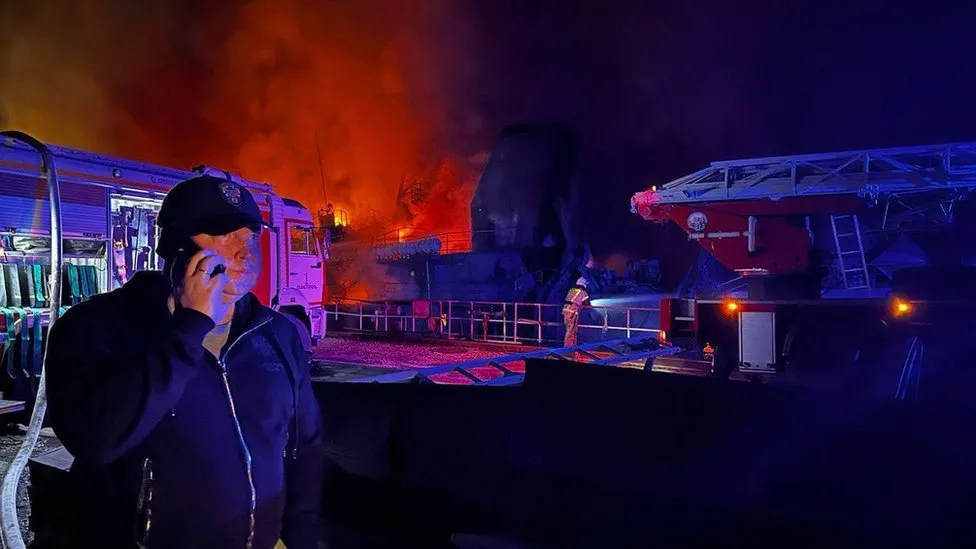
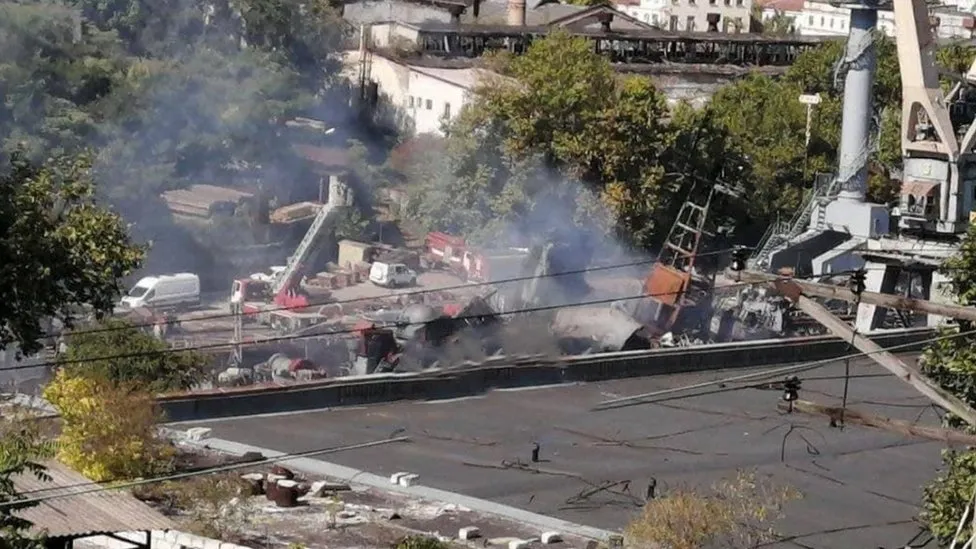
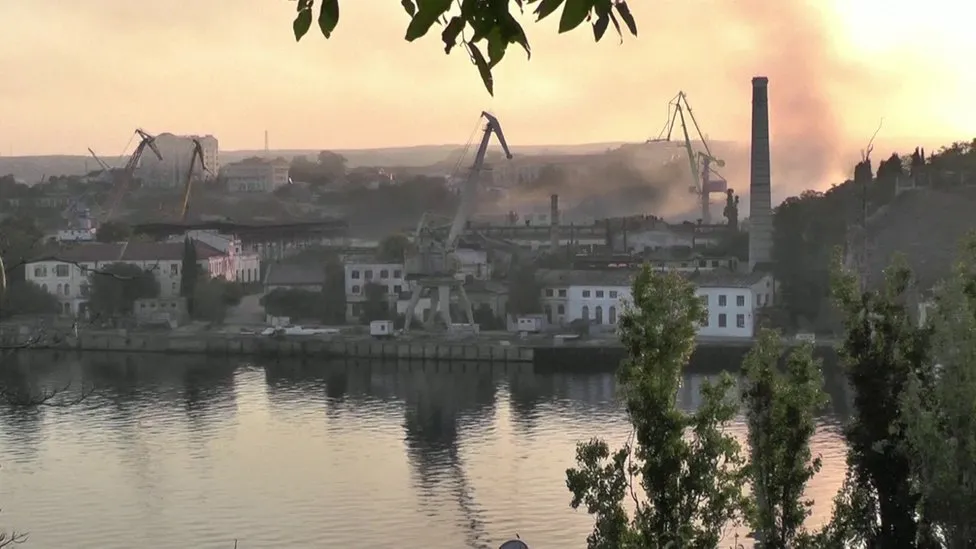
It caused a large fire at a Sevastopol shipyard which left 24 people injured, Russia said.
The Moscow-installed governor claimed most of the weapons were intercepted but that two ships had been damaged.
Ukraine has strongly implied western-supplied cruise missiles were used in the attack, one of the biggest on the Black Sea fleet since the war started.
Unmanned vessels, known by many different names including sea drones and drone boats, operate on or below the water. They usually have built-in explosives and cameras that feed directly back to the person controlling them.
A photo shared by Sevastopol Governor Mikhail Razvozhayev on Telegram shows flames engulfing what appears to be a ship at a port as he stands speaking into his phone.
It is thought to be in an area where ships were undergoing repairs.
A large landing ship, named the Minsk, and a submarine, called the Rostov-on-Don - both thought to be in dry dock - are said to have been damaged. This makes it one of Ukraine's most significant attacks so far on the Black Sea fleet.
According to state-run Ria Novosti news agency, the Russian defence ministry said both vessels will be fully repaired and continue in normal service.
Reuters
Ukrainian military intelligence official Andriy Yusov told Reuters: "We confirm a large landing vessel and submarine were hit. We do not comment on the means (used) for the strike."
In a post on Telegram, the head of Ukraine's air force Mykola Oleshchuk thanked his pilots for their "excellent combat work" - strongly suggesting weaponry had been launched by Ukrainian aircraft. He also warned there was more to come.
Posted in Ukrainian, Mr Oleshchuk used language which strongly implied the use of either UK Storm Shadow or French SCALP cruise missiles. These missiles have a range of over 150 miles (240km) - triple the range of missiles Ukraine used previously.
When contacted, the air force said Storm Shadow and SCALP cruise missiles are the only such weapons currently in Ukrainian use.
This appears to be the first time such weapons have been used on targets inside Crimea.
Reuters
Images circulating on social media, which the BBC has yet to verify, show several large explosions in the area.
The fact that some missiles got through Russia's air defences and appear to have done substantial damage will be of real concern in Moscow.
Seven of the missiles were downed and all three unmanned boats were destroyed, the country's defence ministry claimed.
Russia illegally annexed Crimea from Ukraine in 2014 and this attack shows the tussle for control of the waters.
Ukraine has consistently maintained that its ultimate goal is to retake the peninsula and it is not the first time it has targeted Sevastopol and the Black Sea fleet.
Meanwhile, Russian drones reportedly damaged the Ukrainian grain port of Izmail, on the Danube river.
The governor of the Odesa region, Oleh Kiper, said six people had been injured in the attack, which caused a fire and damaged infrastructure.
"Several groups of drones were launched at the Izmail district," Mr Kiper said on Telegram.
"Unfortunately, there were hits: damage to port and other civil infrastructure was recorded."
In recent days, Ukraine claimed it seized back control of four gas drilling platforms in the northern Black Sea, close to the Crimean peninsula. The so-called Boyko Towers were captured by Russia in 2015, shortly after its annexation of Crimea.
/cloudfront-us-east-2.images.arcpublishing.com/reuters/R3WTY7VRO5FLNEMNSMRUYYLXNM.JPG)