Rechercher dans ce blog

Monday, October 30, 2023

German-Israeli woman taken hostage by Hamas at music festival is dead, Israel says - Reuters

Oct 30 (Reuters) - A German-Israeli woman who was seized by Hamas from a music festival on Oct. 7 and paraded around Gaza by the Palestinian militant group is dead, the Israeli government said on Monday.

"I am really sorry to report that we have now received news that Shani Nicole Louk has been confirmed murdered and dead," Israeli President Isaac Herzog told Germany's Bild newspaper.

"What we saw on the Gaza-Israel border goes far beyond a pogrom. We saw a slaughterhouse."

Louk, 23, was one of scores of people taken by Hamas during a deadly assault on the Israeli military and civilian communities that killed 1,400 people, mostly civilians.

German Chancellor Olaf Scholz, whose government has staunchly supported Israel as it mounted an offensive against Gaza in retaliation, said Hamas had to be held accountable.

"For me, this news is terrible," Scholz said during an official visit to Nigeria. "This shows all the barbarism that lies behind Hamas."

Hamas has not commented on Louk's fate.

The circumstances of her death were not immediately clear.

The German government confirmed on Monday that a German national had died but did not offer specifics.

A family source told Reuters that a part of a body had been found which was matched to Louk's DNA.

Her family initially thought she was alive but injured when she was snatched from the music festival but now believe she was killed on the same day, possibly shot in the head, German broadcaster RTL/ntv said.

"At least she didn't suffer," her mother Ricarda Louk told RTL/ntv.

Writing by Matthias Williams; additional reporting by Andreas Rinke; Editing by Rachel More and Emelia Sithole-Matarise

Our Standards: The Thomson Reuters Trust Principles.

Acquire Licensing Rights, opens new tab

Adblock test (Why?)


World - Latest - Google News
October 30, 2023 at 10:55PM
https://ift.tt/pZ0islx

German-Israeli woman taken hostage by Hamas at music festival is dead, Israel says - Reuters
World - Latest - Google News
https://ift.tt/WMpUTsr

A passenger train slams into another in southern India, killing 13 people - NPR

Rescuers and others stand after two passenger trains collided in Vizianagaram district, Andhra Pradesh state, India, Sunday, Oct.29, 2023. AP

AP

HYDERABAD, India — A passenger train crashed into another in southern India on Sunday, killing 13 people and inuring 25, officials said.

The incoming train slammed into a stationary train in Andhra Pradesh state's Vizianagaram district, causing a derailment of at least three rail cars, senior railway officer Saurab Prasad said.

Prasad said a preliminary investigation found human error was the cause.

Train crashes are common in India and are often blamed on human error or outdated signaling equipment.

In June, more than 280 people were killed in one of the country's deadliest rail crashes in decades when two passenger trains rammed into each other in eastern India.

More than 12 million people ride 14,000 trains across India every day, traveling on 64,000 kilometers (40,000 miles) of track.

Adblock test (Why?)


World - Latest - Google News
October 30, 2023 at 02:18PM
https://ift.tt/ef2xbkV

A passenger train slams into another in southern India, killing 13 people - NPR
World - Latest - Google News
https://ift.tt/1jI0bCp

Sunday, October 29, 2023

India police probe bomb that killed two in Kerala, injured dozens - Reuters India

KOCHI, India, Oct 29 (Reuters) - A former member of the Jehovah's Witnesses group was detained for questioning about his alleged involvement in setting off homemade bombs at a meeting of the group in the southern Indian state of Kerala on Sunday, killing two women and injuring dozens of other people, police said.

A 53-year-old woman succumbed to burn injuries, the health minister Veena George said, bringing fatalities to two. A 12-year old girl with 95% burns remained in critical condition, George said.

Dominic Martin posted a video on Facebook claiming responsibility for the attacks, before surrendering shortly after noon at a police station in Thrissur district, about 40 kilometers away from site of the explosions.

"Dominic is still being questioned in Kochi. He is in our custody but we have not recorded his arrest so far," police public relations officer Pramod Kumar told Reuters.

"We are still trying to ascertain the veracity of his statement, it will take some time. We are not in a position to confirm his involvement in the case right now, investigation is ongoing," he added.

The incident took place during a Jehovah's Witnesses convention in Kalamassery, about 10 kilometres (6.21 miles) northeast of Kochi city.

TA Sreekumar, regional spokesperson for the Jehovah's Witnesses, told Reuters that Martin was not a registered member of the group. He said about 2,300 people attended the three-day event but he was unaware if Martin was present.

Sreekumar confirmed to Reuters that there were at least two explosions at the centre.

"I am taking full responsibility for this. I carried out the bomb explosion. I am making this video to make it clear why I did this," Martin said in a near-six-minute Facebook video which was online for about 4 hours before it disappeared.

Martin said about he believed the Jehovah's Witnesses' teachings were "antinational" about six years ago and that he had tried to talk to the group about changing their views.

Preliminary investigation showed that an improvised explosive device was used, Kerala Director General of Police Shaik Darvesh Saheb told reporters earlier.

Local newspaper Mathrubhumi, citing witnesses, said at least three explosions occurred inside the convention hall.

Kerala Chief Minister Pinarayi Vijayan said police were taking the incident seriously.

"The explosions occurred seconds after the end of a prayer as part of the day's event. The first blast took place in the middle of the hall. Seconds later, two more explosions rocked simultaneously on either sides of the hall," Sreekumar had earlier told mathrubhumi.com.

Jehovah's Witnesses are an international Christian denomination founded in the United States around 1870. They are best known in many countries for door-to-door evangelism.

The group said it has about 60,000 followers in India.

Writing by Swati Bhat; Editing by Gerry Doyle and Bernadette Baum

Our Standards: The Thomson Reuters Trust Principles.

Acquire Licensing Rights, opens new tab

Adblock test (Why?)


World - Latest - Google News
October 29, 2023 at 09:34PM
https://ift.tt/oFsVdqw

India police probe bomb that killed two in Kerala, injured dozens - Reuters India
World - Latest - Google News
https://ift.tt/1jI0bCp

Saturday, October 28, 2023

Pope's major Vatican summit ends without action on women deacons, mention of LGBTQ Catholics - National Catholic Reporter

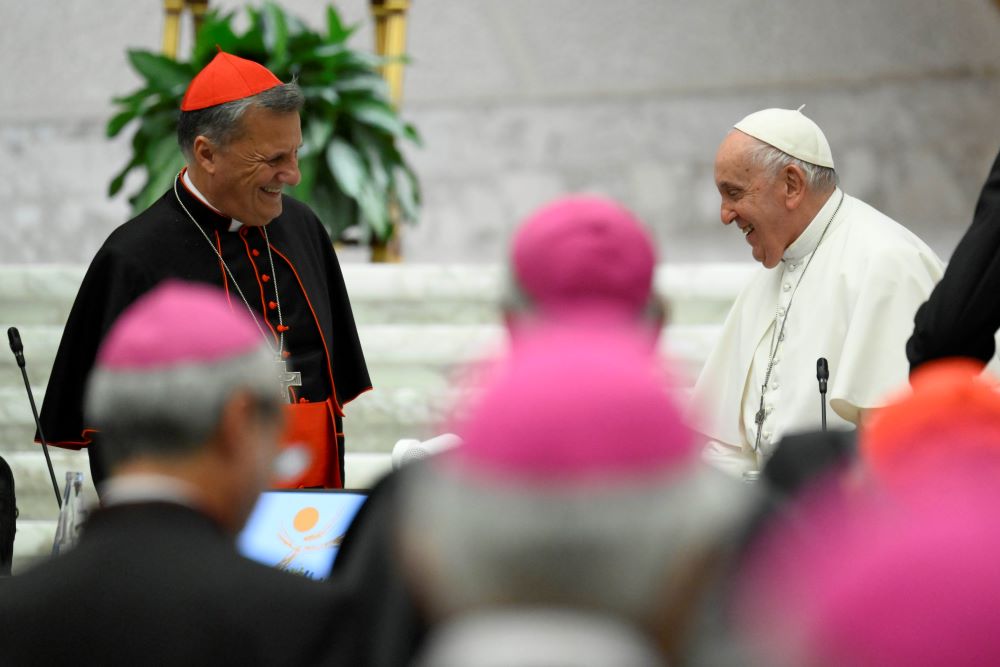
Pope Francis' high-stakes summit on the future of the Catholic Church concluded on Oct. 28 by postponing action on the possibility of ordaining women as deacons and failing to acknowledge deep tensions that surfaced in a month of debates over how the global institution should care for its LGBTQ members. 

A 41-page report, approved and published that evening, called for the results of earlier papal and theological commissions on women deacons to be presented for further consideration at the next assembly of the Synod of Bishops, to be held in October 2024. 

The report, titled "A synodal church in mission," follows an intense month of debates at the Vatican among some 450 participants over a range of big issues, including the role of women in church ministries, clergy sexual abuse and better inclusion of LGBTQ Catholics.

While previous documents leading up to the closely watched meeting were marked by candor and openness, the synthesis report for the Oct. 4-29 assembly takes a much more cautious tone. Although it makes 81 proposals, they are often quite open-ended or general, and the text calls for further theological or canonical study, evaluation or consideration at least 20 times.

Francis officially launched his "synod on synodality," a multiyear, multi-phase process meant to examine how the church's ministries and structures might become more inclusive, in 2021. The newly released report outlines areas of convergence, matters for consideration and proposals discussed during this month's assembly that are expected to set the stage for further debate throughout the year ahead of next year's assembly. 

Participants voted on the final text paragraph by paragraph through the early evening of Oct. 28. The threshold for passage for each paragraph was a two-thirds majority of the voting members.

The paragraphs that received the most no votes were two of the primary paragraphs addressing the possibility of women deacons. One passed by a vote of 277-69; the other by a vote of 279-67. A paragraph addressing the question of clerical celibacy also received substantial no votes, but passed 291-55.

At a press briefing shortly after the text was published, Cardinal Jean-Claude Hollerich, one of the synod's lead organizers, said he was "full of wonder that so many people have voted in favor" of the paragraphs about women's leadership in the church. "That means that the resistance is not so great as people have thought," he said.

On the question of LGBTQ Catholics, Cardinal Mario Grech, who heads the Vatican's synod office, told the briefing that the assembly felt a need to "respect everyone's pace." He added: "It doesn't mean if your voice is stronger it will prevail."

Jesuit Fr. James Martin, a popular spiritual author and 

editor of the LGBTQ Catholic publication Outreach who took part in the synod as a voting member, told NCR he was "disappointed but not surprised" by the result for LGBTQ Catholics.

"There were widely diverging views on the topic," said Martin. "I wish, however, that some of those discussions, which were frank and open, had been captured in the final synthesis."

For the first time since the establishment of the church's Synod of Bishops in 1965, about 50 women were granted voting rights by Francis at this assembly. While the final report they helped approve did not call immediately for the ordination of women as deacons, and did not even mention calls for priestly ordination for women, it did offer some pointed language about the role of women in church leadership.

In one example, the text says women in the assembly "spoke of a Church that wounds" through "clericalism, a chauvinist mentality and inappropriate expressions of authority continue to scar the face of the Church and damage its communion."

The text also states that there was a "clear request" from the assembly that women's contributions "would be recognized and valued, and that their pastoral leadership increase in all areas." It also asks how the church can include more women in existing ministries, and poses an open-ended question: "If new ministries are required, who should discern these, at what levels and in what ways?" 

On the possibility of ordaining women to the diaconate — an issue discussed at the 2019 synod on the nine-nation Amazon region, which, in its final text, proposed moving the idea forward — the new report takes a stark tone.

The possibility of ordaining women, it says, was considered "unacceptable" by some assembly members "because they consider it a discontinuity with Tradition."

"For others, however, opening access for women to the diaconate would restore the practice of the Early Church," it states. "Others still, discern it as an appropriate and necessary response to the signs of the times, faithful to the Tradition, and one that would find an echo in the hearts of many who seek new energy and vitality in the Church."

Francis has previously established two special commissions to examine the historical questions surrounding the ordination of women to the diaconate, though neither commissions' work has been made public. In 2002, the International Theological Commission also concluded a study of the diaconate that considered the question women deacons

"Theological and pastoral research on the access of women to the diaconate should be continued, benefiting from consideration of the results of the commissions specially established by the Holy Father, and from the theological, historical and exegetical research already undertaken," the report states. "If possible, the results of this research should be presented to the next session of the assembly."

The report goes on to state the need for the church to address employment injustices and unfair remuneration for women in the church, "especially for women in consecrated life, who are too often treated as cheap labor." 

Proposals also include a review of liturgical texts and church documents so that language will be considerate to both men and women and to also include "a range of words, images and narratives that draw more widely on women's experience."

LGBTQ Catholics, clergy sexual abuse

While emotional debate took place during the synod over the church's response to LGBTQ Catholics — including the testimonial of a bisexual women who died by suicide after feeling rejected by the church — the report largely glosses over the tensions that emerged over how the church should respond to such persons. 

Issues involving sexuality and identity, the report notes, raise "new questions." The report says that such individuals or couples must be "heard and accompanied" and that language or "simplistic judgements" that "hurt individuals and the Body of the Church" should be avoided.

"There was a deep sense of love, mercy and compassion felt in the assembly for those who are or feel hurt or neglected by the church, who want a place to call 'home' where they can feel safe, be heard and respected, without fear of feeling judged," it states.  

The final report, however, did not use the acronym "LGBT" or the word "gay," despite the fact that Vatican documents have regularly used "LGBT" as a common acronym to refer to the gay community for at least five years, and the pope himself has regularly used the term "gay." 

As NCR reported on Oct. 13, there was active debate during the synod discussions over whether the use of such language was appropriate. 

In confronting the ongoing crisis of clergy sexual abuse, the report proposes the creation of further structures to prevent abuse, including the possibility of establishing a new body to review abuse cases that does not rely on bishops.

"The sensitive issue of handling abuse places many bishops in the difficult situation of having to reconcile the role of father with that of judge," it states. "The appropriateness of assigning the judicial task to another body, to be specified canonically, should be explored."

In addition, the report recommends that women receive the necessary formation "to enable them to be judges in all canonical processes."

"Cases of abuse of various kinds experienced by those in religious life and members of lay associations, especially of women, signal a problem in the exercise of authority and demand decisive and appropriate interventions," the report states, adding that the "concrete gestures of penitence" are required to adequately respond the decades-long crisis.

Role of lay people, clerical celibacy

On other issues, the report stresses the role of lay people in advising church leaders, makes some pointed recommendations for Vatican officials and briefly discusses the issue of clerical celibacy.

The section on the role of bishops says a bishop's ministry is synodal only "when governance is accompanied by co-responsibility, preaching by listening to the faithful People of God, and sanctification and celebration of the liturgy by humility and conversion."

One proposal in that section calls for episcopal councils, lay-led groups that advise bishops in the leadership of their dioceses, to be made mandatory. Bishops currently have the option of creating such groups, but are not required to do so.

That section also calls "for a review of the criteria" for how priests are selected to become bishops, and notes "requests to expand consultation with the faithful People of God, and to involve a greater number of lay people and consecrated persons in the consultation process."

The document also reflects specifically on the role of the pope and Vatican in governing the global church. It suggests that Vatican offices should "enhance" their consultation with local bishops. It also says the church needs to "carefully evaluate" whether curial officials, who typically are appointed by the pope as cardinals, need even to be bishops.

On social issues, the text mentions the ongoing impacts of climate change and praises Laudate Deum, Francis' recent apostolic exhortation on environmental issues. The text also highlights the church's relationships with Indigenous peoples, migrants and refugees, and those who are economically impoverished.

The text also addresses the issue of persistent racism and calls for "continued engagement in dialogue and discernment regarding racial justice."

"Systems within the Church that create or maintain racial injustice need to be identified and addressed," it says. "Processes for healing and reconciliation should be created, with the help of those harmed, to eradicate the sin of racism."

Among other proposals in the synod's final text:

  • Creation of "new paradigms" in terms of pastoral engagement with Indigenous peoples, "along the lines of a journey together and not an action done to them or for them;"
  • Establishment of a "permanent council" of the leaders of Eastern RIte Catholic Churches to advise the pope on issues facing their communities;
  • Invitation of more delegates from other Christian denominations to the October 2024 assembly;
  • Expression of "a keen desire" by the assembly for the Catholic and other Christian churches to set a common date to celebrate Easter.

On clerical celibacy, the text says that "different opinions" were expressed about the topic.

"Its value is appreciated by all as richly prophetic and a profound witness to Christ; some ask, however, whether its appropriateness, theologically, for priestly ministry should necessarily translate into a disciplinary obligation in the Latin Church," the text states. "This discussion is not new but requires further consideration."

Adblock test (Why?)


World - Latest - Google News
October 29, 2023 at 03:15AM
https://ift.tt/16xlNaZ

Pope's major Vatican summit ends without action on women deacons, mention of LGBTQ Catholics - National Catholic Reporter
World - Latest - Google News
https://ift.tt/RBJQ5yk

Friday, October 27, 2023

Drone blasts hit two Egyptian Red Sea towns, Israel points to Houthi - Reuters

  • Explosions hit Taba and Nuweiba near Israeli border
  • Israel says drones launched by Yemen's Houthi movement
  • No claim of responsibility, Egypt blames drones
  • Incidents show risk of spillover from Israel-Gaza war

CAIRO/JERUSALEM, Oct 27 (Reuters) - Drones caused explosions that rocked two Egyptian towns on the Red Sea on Friday, the Egyptian army said, while Israel said Yemen's Iran-backed Houthi movement sent them to strike Israel.

The explosions injured six people and illustrated the risk of regional spillover from the Israel-Gaza conflict. There was no claim of responsibility.

Israel's foreign ministry said the Iran-backed Houthi launched drones and missiles "with the intention of harming Israel."

Egypt's military spokesman Colonel Gharib Abdel-Hafez said two drones were fired from the southern Red Sea aiming north. Yemen is at the south end of the sea and Israel at the north.

One drone crashed into a building adjacent to a hospital in the Egyptian town of Taba on the border with Israel, injuring six, in the early hours of Friday, Egypt's military said.

The second drone was downed outside Egyptian airspace on Friday morning, and the debris fell in a desert area of Nuweiba town, about 70 km (43 miles) from the Israeli border, Egypt said.

Israeli military spokesperson Daniel Hagari said that combat helicopters had been scrambled when "an aerial threat was spotted in the Red Sea region".

"To our understanding, the strike that took place in Egypt originated in this threat," he added in a televised briefing before Israel's foreign ministry attributed the drones to the Houthi.

Witnesses in Taba and Nuweiba, popular tourist destinations on Egypt's Sinai Peninsula, said they heard explosions and saw smoke as well as Egyptian warplanes flying overhead.

EGYPT EXPOSED

"The air force and air defence force are intensifying efforts to secure Egyptian airspace on all strategic directions," the Egyptian military said.

The Israeli spokesman said, "Israel will work with Egypt, and the United States, and bolster regional defences against threats from the Red Sea region."

The U.S. said last week a Navy warship in the Red Sea intercepted projectiles launched by the Houthi, potentially toward Israel.

Bordering both Gaza and Israel, Egypt is exposed to the conflict that blew up after Hamas' Oct. 7 assault on Israel and the subsequent bombardment of the Gaza Strip.

Cairo has been prominently advocating for aid flows into Gaza, the release of Hamas' hostages and a ceasefire.

On Wednesday, Hamas said it had targeted the Israeli town of Eilat, across the border from Taba, with a missile in what appeared to be the Islamist group's longest-range Palestinian attack since Oct. 7.

Reporting by Emily Rose and Dan Williams in Jerusalem, Ahmed Mohamed Hassan, Nafisa Eltahir, Ahmed Tolba, Hatem Maher, and Mai Shams El-Din in Cairo, Yusri Mohamed in Ismailia, Nayera Abdallah, Nadine Awadalla and Ahmed Elimam in Dubai; writing by Rami Ayyub and Nafisa Eltahir; Editing by Michael Perry, Andrew Cawthorne, Jonathan Oatis and Cynthia Osterman

Our Standards: The Thomson Reuters Trust Principles.

Acquire Licensing Rights, opens new tab

Adblock test (Why?)


World - Latest - Google News
October 28, 2023 at 04:19AM
https://ift.tt/S0QVwtg

Drone blasts hit two Egyptian Red Sea towns, Israel points to Houthi - Reuters
World - Latest - Google News
https://ift.tt/gv8Myfk

How Hamas broke through Israel's border defenses during Oct. 7 attack - The Washington Post

KISSUFIM, Israel — When Hamas militants arrived in the tiny kibbutz of Kissufim, less than a mile from the border with the Gaza Strip, they attacked a carefully picked first target: the white and red metal communication towers on its outskirts.

They made a beeline for the small fenced compound that housed the critical equipment, shooting at it and using a ladder to scale a barbed wire fence to get inside, videos obtained by The Washington Post show.

“They knew exactly what they were doing,” said Shai Asher, 50, a member of the armed kibbutz security squad that battled Hamas gunmen that day, struggling to communicate with each other and unable to call for backup.

“The phone network doesn’t work, WhatsApp doesn’t work, everything is broken down, our radio doesn’t work, all the channels of command are missing,” he recalled. “They had a flawless battle plan that they executed flawlessly.”

For hours, volunteers such as Asher were left to fend for themselves, outnumbered and outgunned. The soldiers that were supposed to protect them were blind to the unfolding disaster, or had been killed or kidnapped.

In a simultaneous wave of attacks on at least seven military posts across the border, Hamas sought to systematically disable key detection, communications and warning systems, using snipers and commercial drones armed with explosives. The strategy allowed its gunmen to advance deep into Israeli territory with little resistance and scrambled the subsequent military response.

The Washington Post spoke to more than a dozen current and former Israeli intelligence and security officials and studied footage from Hamas body cameras to build a picture of how militants were able to overwhelm Israeli military installations and rampage through more than 20 residential communities.

“There weren’t enough soldiers; there weren’t enough capabilities,” said Eyal Hulata, the head of the country’s National Security Council from 2021 to 2023. “The first line of defense became the last line of defense, and this should never happen. Israel knows that.”

The attack, in which more than 1,400 people were killed and 229 others taken hostage, exposed the vulnerabilities of Israel’s border security system, long believed to be one of the most advanced and indomitable in the world. At least 309 Israeli soldiers are among the dead.

End of carousel

Israeli Prime Minister Benjamin Netanyahu had boasted for years of multimillion-dollar investments in an expansive “smart wall,” running the length of the enclave above ground and extending deep into the ground.

Claiming in recent years that Hamas had been successfully contained in Gaza, Netanyahu oversaw the gradual withdrawal of troops from the south. Forces left behind at the military and intelligence bases were trained to rely on sophisticated cameras and sensors to monitor for border infiltrations, and to alert forces on the ground in case of unusual events.

But in the early hours of Oct. 7, at least 1,500 Hamas and Islamic Jihad militants broke through some 30 points along the border barrier. They overran some bases so rapidly that soldiers were killed in their bunks, and the militants took out communication networks so efficiently that the area became a blind spot for the military.

“They coordinated it, in sync, to get the maximum impact,” Hulata said. “The fact we failed doesn’t mean the IDF isn’t prepared to respond,” he added.

The assault came on a Saturday morning, on the Jewish holiday of Simchat Torah — the end of a two-week string of holidays — ravaging a sleeping nation that had been assured repeatedly by its top security officials that Hamas posed no immediate threat.

“Despite a series of actions that we carried out, unfortunately on Saturday we were unable to generate a sufficient warning that would have thwarted the attack,” said Ronen Bar, the head of the Shin Bet internal security service, in a letter to his employees and their families.

Asked for comment by The Post, the Israeli military replied: “Currently the IDF is focused on the ongoing war, we will get to questions of your kind later on.” The prime minister’s office did not respond to a request for comment.

The coordinated attack began with rocket fire from Gaza — a regular occurrence that caused no particular alarm among soldiers and civilians. As the air raid sirens sounded just before 6:30 a.m., Israeli officers stayed below their lookouts.

Then came the familiar booms from the Iron Dome antimissile defense system, drowning out the gunfire from snipers, who shot at a string of cameras dotting the border, and the explosions from more than 100 remotely operated drones that took out watchtowers, according to security experts who analyzed the footage — most of it posted in real time by the militants.

The towers were outfitted with machine guns and cameras, both connected to the border’s thermal imaging sensors and to optical and radar detection systems. They relied partly on automation, partly on remote control.

Once the systems were disabled, fighters from the Nukhba, Hamas’s special operations unit, were able to breach the border with relative ease, videos show, using bulldozers, trucks and motorcycles. From there, it was less than a mile’s drive to the first military installations, which were mostly unguarded outside.

Front-line observation troops were caught off guard when the militants stormed their bases, navigating confidently through facilities and barracks, security officials familiar with the situation told The Post.

Soldiers managed to kill some Hamas gunmen with remotely controlled guns but, within minutes, hundreds more had taken their place. They killed soldiers in their safe rooms and took others hostage while ransacking weapons caches, loading up trucks and motorbikes already laden with AK-47s, grenades and other weaponry.

Only at 8:06 a.m. — an hour and a half after the start of the assault — did the Israel Defense Forces report a “combined attack.” At 8:25, with a large number of Israelis already dead, it declared “a state of alert for war.”

Placing key command centers so close to the border was a key mistake, said a former senior Israeli intelligence officer, who spoke to The Post on the condition of anonymity because of the sensitivity of the subject.

“That’s what happens when you suffer a catastrophic systemic failure,” he said, “and military headquarters and other installations are so close to the border. That’s what happens when you forget that all defense lines can eventually be breached and have been historically. That’s what happens when you underestimate your enemy.”

The Israeli military’s regional command-and-control center, near Kibbutz Re’im, suffered a “complete destruction” of “communications systems, their antennas, even the systems that activated the sensors on the fence itself,” said Lt. Col. Alon Eviatar, a member of the reserves and an expert in Palestinian militancy as well as being a former officer in 8200, Israel’s elite intelligence unit.

In parallel, according to footage reviewed by security analysts, a separate Hamas unit stormed an 8200 installation near Urim, about 10 miles inside Israeli territory, detonating an explosive at the entrance to an underground bunker that housed an expansive intelligence apparatus — synthesizing data from Israel, the Palestinian territories and around the world.

“It is the largest and most significant intelligence base in Israel, one of the country’s greatest assets,” said Eviatar. “It was a top priority for them.”

Hamas fighters battled with Israeli forces outside the bunker, Eviatar said. It is still unclear whether any of the militants survived the battle or managed to take espionage documents or equipment back to Gaza, which he said could be “extremely valuable to Hamas leadership and to Iran.”

Forty-five miles to the north, in Zikim, troops at a training base for the Israeli military’s search-and-rescue brigade were among the few units not affected by the disabling of communication systems. They belonged to a separate command center that was spared the blackout that affected most of the other installations.

When a rocket struck the base, the duty officer was able to report the attack to Col. Elad Edri, the brigade’s commander, who sped to the scene.

“We managed to speak to each other by radio, by phone. It was clear, it was okay,” he told The Post. “The bombs didn’t influence my unit. They obviously influenced the units that were there to defend the fence.”

Edri lost seven soldiers but managed to repel the attack and maintain control of the base.

The breadth and speed of the assault points to deep planning by Hamas. Asher, the security guard in Kissufim, estimates that the militants were at his kibbutz just a few minutes after 6:30 a.m., shortly after the first rocket barrage.

At 6:45 a.m., he got a voice note in the kibbutz’s security group on WhatsApp. “This is real action, real action, a real situation,” a member of the team said, as gunfire sounded and sirens wailed in the background.

“Do you have any connection with the IDF?” Asher asked, as squad members tried in vain to call in military reinforcements. The internet would cut out soon after. Asher didn’t know until 10 p.m. that his wife and two children, barricaded in their safe room at home, had survived.

“It was a nightmare,” he said.

After entering the kibbutz, the militants went straight to the house of the community’s head of security, who was forced to retreat to a safe room with his family. He could not join the fight, but he survived.

It was a pattern repeated in other communities, Asher said, citing conversations with residents.

“Their success wasn’t tech; it was preparation,” said Miri Eisin, a former senior intelligence officer in the IDF. They “used military tactics to carry out a terror attack.”

As the hours wore on and the death toll climbed, the rare messages that did make it back to Israel’s main military headquarters in Tel Aviv were interpreted with “a lot of question marks,” said Michael Milshtein, a former senior adviser to COGAT, the Israeli military agency in charge of the Palestinian territories. “After so many years of discounting Hamas,” he said, military leaders struggled to grapple with the scale of the unfolding calamity.

Initially, the IDF sent in special operations units, trained to respond to infiltrations from Gaza. But none of their war games resembled what confronted them on Oct. 7.

“[Hamas] knew exactly where they were going, what they were doing, even though it was their first time there,” said Milshtein, who said that Shin Bet has been trying to crack down on espionage networks from Gaza over the past two years.

Israeli forces that were able to fight their way into communities under attack struggled to manage the situation, lacking higher-altitude assessments of a vast and chaotic battlefield.

“Without an overall picture, we had to make a lot of quick decisions,” said Maj. Palmach, one of the Israeli reservists who, without waiting to be called up, put on their uniforms and jumped in their cars that Saturday, speeding south to fight alongside the special operations forces. He shared his story on the condition that he be identified only by his last name because of IDF ground rules.

Palmach battled Hamas gunmen at the entrance to Alumim, preventing them from entering. He then joined an improvised convoy to Be’eri, one of the hardest-hit kibbutzim. Guided by word of mouth and frantic WhatsApp messages, Palmach rescued people from their safe rooms, many as their houses were burning. Militants lit tires on fire and wheeled them into homes to smoke out families that were in hiding, according to other officers who arrived at the scene that day.

Israel’s southern border region is a military zone now. Its tightknit towns are charred and abandoned. Bodies are still being found. Many survivors feel betrayed by a government that promised them safety even as it withdrew protection.

In December 2021, Netanyahu tweeted that the installation of an “underground barrier that stops Hamas’s tunnel weapons” amounted to a “historic” day. He had completed the project, he said, despite “great opposition” from other politicians and the defense establishment.

Amir Tibon, a journalist from the Israeli newspaper Haaretz, moved to Nahal Oz in 2014. At least 14 of his neighbors were killed there Oct 7.

When he began living there, combat units were stationed in every community. In recent years, they were redeployed to the West Bank to protect Jewish settlements and to counter new Palestinian militant groups.

“After that fancy underground obstacle that Netanyahu was so proud of, it was decided that the forces weren’t needed anymore,” Tibon said in a recent Haaretz podcast. “If in every community on that dark Saturday there were forces of 20 people, everything would have looked differently.”

Some Israeli soldiers stationed along the border now say they feared a Hamas incursion was imminent and tried to sound the alarm.

“It was clear that something would happen. It was only a matter of time,” Maya Dasiatnik, an observation officer in the Nahal Oz base, said an interview with the Kan public broadcaster on Wednesday.

She said that she and dozens of fellow soldiers had repeatedly reported suspicious activity: people approaching the fence with maps, appearing to study it for its weak spots, getting closer every week. There also were tractors and large groups of armed men, carrying out exercises that looked like military drills.

Roni Eshel, who served alongside Dasiatnik, is believed to be among the hostages held in Gaza.

“She reported all kinds of breakdowns along the border,” Eyal, her father, told The Post. His last contact with Roni was a text message at 9:27 a.m., three hours after her base was raided. The beds, the safe rooms and the central war room were torched.

“It could have been prevented,” he said, “if someone in the army had opened their eyes and ears.”

Adblock test (Why?)


World - Latest - Google News
October 28, 2023 at 12:59AM
https://ift.tt/KM4Hpbr

How Hamas broke through Israel's border defenses during Oct. 7 attack - The Washington Post
World - Latest - Google News
https://ift.tt/gv8Myfk

Thursday, October 26, 2023

The Biden coalition risks a damaging break over the US role in Israel’s response in Gaza - CNN

CNN  — 

The liberal coalition that drove Joe Biden’s victory over Donald Trump in 2020 is fraying under the weight of the escalating Israeli military strikes aimed at Hamas inside the Gaza Strip, where the humanitarian situation is rapidly deteriorating.

Though Democrats are largely united in their support for abortion and voting rights, the promise of “Bidenomics” and growing organized labor power, the president’s unswerving public support for the Israeli government’s retaliatory attacks, which have killed thousands of Palestinian civilians, could deepen the frustration felt by the young, progressives voters who broke heavily for him three years ago.

In backing Israel’s increasingly bloody response to Hamas’ brutal terror attacks on October 7, Biden risks further unwinding a meticulously woven confederacy of supporters crucial to his reelection hopes in 2024. Though the vast majority of elected Democrats, and even leading progressives, generally agree that Israel is within its rights to carry out retaliatory strikes inside Gaza, the rising death toll has touched off a passionate push, particularly among the under-30 crowd, for an immediate ceasefire.

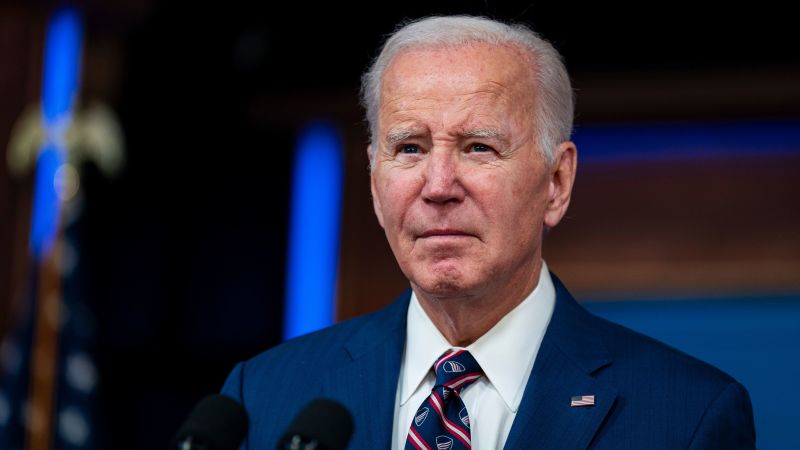
Biden on Monday dismissed that talk, saying he would not consider supporting one until all of the hostages taken by Hamas were returned home. That remark irked many on the left. But even within the camps most critical of the president’s position, the path forward seems murky – and the search for powerful political allies has yielded little.

More than 250 former staffers from Bernie Sanders’ 2016 and 2020 presidential campaigns sent a letter on Tuesday that called on the Vermont progressive to introduce a “Ceasefire Now” resolution in the Senate.

“It is largely because of your advocacy that Democratic voter sympathies made a major historical shift this past year toward Palestinian rights,” the group wrote. “Today, we’re asking you to use your power, the respect you have across the United States and globe, to clearly and boldly stand up against war, against occupation and for the dignity of human life.”

Sanders has not gone as far as his former staffers asked, but in remarks Wednesday on the Senate floor called for a humanitarian “pause,” arguing it was “essential for the protection of civilians as required by the laws of war, as well as for the provision of robust supplies of food, water, and medical aid to address the growing humanitarian catastrophe.” He also set out his many concerns over a potential ground invasion and re-occupation of Gaza by Israel.

He did not, however, endorse more formal demands, like those in Missouri Rep. Cori Bush’s House resolution, calling for “an immediate de-escalation and cease-fire in Israel and occupied Palestine.”

Still, tactical differences among progressives represent a relatively minor obstacle for Democrats in 2024. The more immediately consequential divisions – the kind that could be exploited by Republicans – exist between the Democratic Party establishment, led by Biden, and young liberal voters.

“Age is the biggest factor into where folks are on this issue,” one Democratic strategist said. “Engaged voters under 30 are very much in the ceasefire camp. Over-40 folks are standing with Israel. And then you have the mucky middle of a lot of engaged Democrats in their 30s.”

Any decrease in support for Biden among the youngest voting bloc – which had shown significant signs of dissatisfaction with him before this month – could be troubling to his reelection prospects.

Nearly 60% of 18- to 29-year-old voters backed Biden in 2020, giving him a 24-point advantage against Trump with the age group, according to the Pew Research Center. No other demographic group broke even half as strongly for the Democrat.

“The president and the White House are underestimating how much of a threat it would be for them to be seen as behind an Israeli ground invasion and how direct of a threat that could pose to his reelection prospects,” Max Berger, a progressive organizer and co-founder of IfNotNow, a left-wing American Jewish group. “The possibility that an Israeli ground invasion and a regional war becomes Biden’s Vietnam is something that (the administration) needs to do everything in their power to prevent.”

The Biden administration has pressed Israeli leaders to delay their expected invasion of Gaza to allow for the release of more hostages held by Hamas and for additional aid to reach Gaza, according to two sources briefed on the discussions, CNN reported earlier this week.

“The [administration] pressed Israeli leadership to delay because of progress on the hostage front,” and the need to get trucks of aid into Gaza, one person familiar with the discussions said.

Asked about those discussions on Wednesday, Biden denied any suggestion that he was guiding or pressuring Israeli Prime Minister Benjamin Netanyahu’s response.

“What I have indicated to him is that if that’s possible, to get these folks out safely, that’s what he should do,” Biden said of the hostages held by Hamas in Gaza. “It is their decision, but I did not demand it.” (A senior Israeli official told CNN the US “is not pressing Israel in regards to the ground operation.”)

Though he insisted Israel’s focus should be on “going after the folks that are propagating this war against Israel” and not civilians, and condemned “extremist settlers” from Israel attacking Palestinians in the West Bank, Biden expressed skepticism over the death figures provided by the Hamas-controlled Gaza Health Ministry.

“I have no notion that the Palestinians are telling the truth about how many people are killed,” Biden said during a Rose Garden news conference. “I’m sure innocents have been killed, and it’s a price of waging war.”

A CNN poll conducted in the days after Hamas’ attack included a raft of sobering data for the White House to consider.

Asked if they “trust President Joe Biden to make the right decisions about the situation in Israel,” only 7% of 18- to 34-year-olds said they had a “great deal” of confidence in the president. That figure jumped to 43% in the same demographic when including those with “moderate” belief in his decision-making on the issue. But that still fell short of the combined 57% who said they had “not much” trust in him or “none at all.”

The potential political troubles created by young voters’ lack of faith in Biden’s handling of the conflict could be compounded by the fact that they were the only group polled in which a majority (54%) of respondents said they had “a lot” of sympathy “for the Palestinian people.”

Only 27% of that same cohort said Israel’s military response to the Hamas attacks was “fully justified” – an opinion that predated nearly two additional weeks of attacks inside Gaza and any future ground invasion.

Last week, more than 400 congressional staffers, a traditionally young crowd, signed onto a letter imploring their bosses to back a ceasefire. They did not, however, put their names on the document, citing “concern for our personal safety, risk of violence, and the impact on our professional credibility on Capitol Hill.”

Concerns among young voters with mixed or conflicting views about Israel’s onslaught in Gaza have come under fierce scrutiny from Democratic elected officials and corporate titans.

Some of the most intense backlash has been directed at mostly younger students at preeminent institutions, like Harvard University, where a coalition of groups issued a joint statement following Hamas’ attacks that claimed “the Israeli regime (is) entirely responsible for all unfolding violence.”

The backlash was immediate and harsh. Billionaire hedge fund CEO Bill Ackman and other corporate leaders demanded Harvard release the names of students whose organizations signed on to the letter – with a promise to blacklist them.

A handful of the groups and individuals who signed the document withdrew their endorsements in the days that followed and prominent progressive groups mostly ignored or dismissed the sentiments expressed in the Harvard letter and other, similar documents, as fringe views.

But the chilling effect was clear – and deeply disturbing to young activist leaders.

“I’m too young to know what the world felt like in the aftermath of 9/11,” IfNotNow political director Eva Borgwardt told CNN, “but I’ve heard the stories and I’ve heard the way in which similar repression of dissent was part of what created a path toward the Iraq war and deaths of hundreds of thousands of people.”

Adblock test (Why?)


World - Latest - Google News
October 26, 2023 at 06:00PM
https://ift.tt/ptY1UjB

The Biden coalition risks a damaging break over the US role in Israel’s response in Gaza - CNN
World - Latest - Google News
https://ift.tt/7vJ1Son

Featured Post

Qatar 'appalled' by reported criticism from Israel's Netanyahu - BBC.com

By David Gritten BBC News Reuters Qatar's foreign ministry said the Israeli prime minister's reported remarks were ...

Popular Posts